


Telehealth Market Size
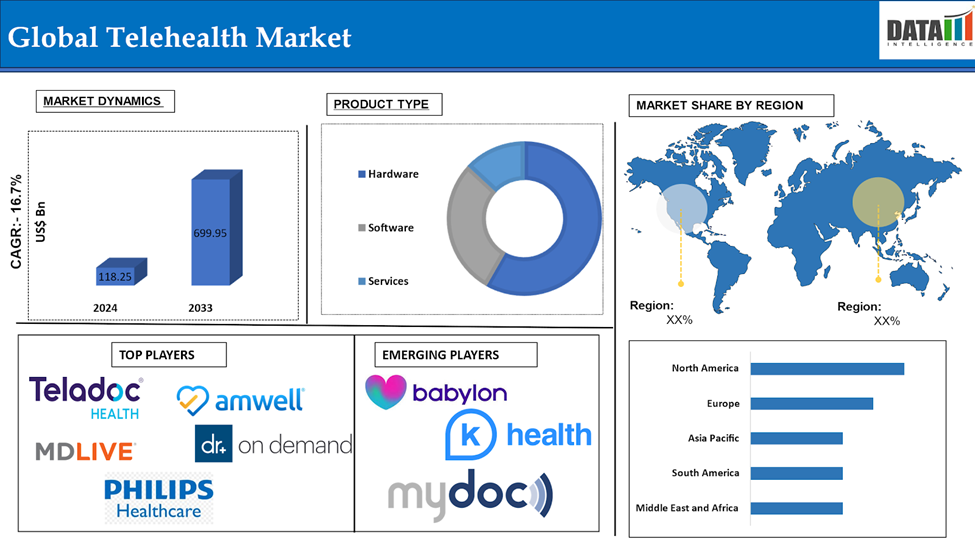
The Global Telehealth Market reached US$ 138.59 billion in 2025 and is expected to reach US$ 478.18 billion in 2033, growing at a CAGR of 17.2% during the forecast period (2026 –2033).
Telehealth is the use of digital technologies to access and manage healthcare services remotely. It can be used by individuals from home or by healthcare professionals in rural areas. Telehealth can also be used by healthcare providers to enhance or support healthcare services, such as using computers and mobile devices for remote access or remote care.
Executive Summary
Explore the Future of the Telehealth Market
Get a comprehensive sample report covering Telehealth Market trends, technology advancements, competitive landscape, application insights, and growth opportunities. Request your sample today to understand the factors shaping the next generation of digital healthcare and remote care delivery.Request Sample Report Today!
Telehealth Market Drivers & Restraints
Rising Need for Remote Patient Monitoring
The global telehealth market is growing due to the increasing demand for remote patient monitoring. As chronic diseases like diabetes, cardiovascular conditions, and respiratory disorders become more prevalent, healthcare systems are seeking efficient ways to provide continuous care. Remote patient monitoring allows healthcare providers to track patients' vital signs and health data in real-time, reducing healthcare costs and improving patient outcomes. The growing aging population and advancements in wearable devices, mobile health applications, and IoT technologies further increase the demand for remote monitoring solutions.
Lack of Robust Infrastructure and Limited Digital Literacy in Developing Regions
The global telehealth market faces challenges due to inadequate infrastructure and limited digital literacy in developing regions. Poor internet connections, advanced telecommunications systems, and smart device access hinder telehealth effectiveness. Limited digital literacy also hinders adoption. High costs and government support further hinder market growth. Investments in infrastructure, technology, and education are needed.
Telehealth Market Scope
| Metrics | Details | |
| CAGR | 16.7% | |
| Market Size Available for Years | 2025-2033 | |
| Estimation Forecast Period | 2026-2033 | |
| Revenue Units | Value (US$ Bn) | |
| Volume (Units) | ||
| Segments Covered | Component | Hardware, Software, Services |
| Delivery Mode | Software, Hardware, Services | |
| Application | Chronic Disease Management, Mental Health & Behavioral Disorders, Radiology, Cardiology, Neurology, Dermatology, Others | |
| End User | Healthcare Providers, Patients, Payers, Others | |
| Regions Covered | North America, Europe, Asia-Pacific, South America, and Middle East & Africa | |
Telehealth Market Segment Analysis
The global telehealth market is segmented based on, Component, Delivery Mode, Application, End User and Region.
Product Type:
The hardware segment is expected to dominate the Telehealth market share
The hardware segment holds a major portion of the telehealth market share and is expected to continue to hold a significant portion of the telehealth market share during the forecast period.
Hardware is crucial in the global telehealth market, providing essential tools and devices for real-time data collection, analysis, and transmission between patients and healthcare providers. Advancements in hardware technology, such as portable diagnostic devices and IoT-enabled health monitoring gadgets, have improved the accuracy and accessibility of telehealth services. The integration of these devices with cloud platforms and mobile applications enhances the scalability of telehealth solutions, making them more efficient for patients and providers.
End User:-
Healthcare providers segment is the fastest-growing segment in Telehealth market share
The healthcare providers segment is the fastest-growing segment in the telehealth market share and is expected to hold the market share over the forecast period.
Healthcare providers are driving the global telehealth market by promoting virtual consultations, remote patient monitoring, and follow-up care. They build trust, educate patients about telehealth, and address privacy and usability concerns. Integrating telehealth into routine care reduces the burden on traditional facilities, especially in managing chronic diseases and emergency consultations. Active participation, supported by training programs and government incentives, is crucial in scaling telehealth adoption across different regions and demographics.
Telehealth Market Geographical Analysis
North America is expected to hold a significant position in the Telehealth market share
North America holds a substantial position in the telehealth market and is expected to hold most of the market share due to its high adoption of digital health technologies, and focus on cost reduction. The region's high prevalence of chronic diseases like diabetes and cardiovascular disorders makes telehealth an ideal solution. Government policies, such as reimbursement for services and funding programs, encourage adoption. The widespread use of smartphones, high-speed internet, AI, and IoT also accelerates market growth.
Europe is growing at the fastest pace in the Telehealth market
Europe holds the fastest pace in the telehealth market and is expected to hold most of the market share fueled by the need to improve healthcare access in rural areas and reduce the burden on overstretched systems. The aging population in countries like Germany, Italy, and the UK has increased the demand for remote patient monitoring and virtual consultations. The integration of digital technologies, government initiatives, and EHR adoption, along with advancements in telecommunication infrastructure, enhances the efficiency and accessibility of telehealth services.
For instance, Doctorsa, a global telehealth platform, has launched in the UK, connecting travellers with local doctors within five minutes. The platform, founded in Italy, has expanded internationally to 33 countries and has served over 100,000 users. Doctorsa connects tourists and UK residents seeking urgent care, especially those facing long waits for GP appointments or needing support outside surgery hours. The platform aims to meet the growing demand for accessible healthcare in the UK.
Telehealth Market Major Global Players
The major global players in the telehealth market include Epic Systems Corporation, Oracle Corporation, Veradigm LLC, MEDITECH, McKesson Corporation, GE Healthcare, NXGN Management, LLC, Athenahealth, eClinicalWorks, Greenway Health and among others.
Telehealth Market Recent Developments
August 2026 – Telehealth platforms expand AI-enabled virtual care
Leading telehealth providers are increasingly integrating generative AI, clinical decision-support tools, and intelligent virtual assistants into digital care platforms. These capabilities are improving patient triage, virtual consultations, clinical documentation, and personalized care delivery.
July 2026 – Telehealth companies strengthen virtual specialty care
Telehealth providers continued expanding access to specialty consultations, including behavioral health, chronic disease management, dermatology, and primary care. The expansion is supporting broader virtual-care adoption and improving access for patients in underserved and remote locations.
June 2026 – Teladoc Health advances AI-powered virtual care
Teladoc Health continued enhancing its virtual-care ecosystem with AI-enabled tools designed to support clinicians, improve patient engagement, and streamline care delivery. The company is increasingly integrating digital health technologies across chronic condition management and virtual primary care.
June 2026 – Amwell expands AI and digital care capabilities
Amwell strengthened its digital health platform through continued development of AI-enabled clinical workflows, virtual nursing, and automated patient engagement capabilities. These developments are helping healthcare organizations scale hybrid and virtual-care models.
May 2026 – Telehealth adoption accelerates through hospital and health-system integration
Healthcare providers continued integrating telehealth into broader care-delivery systems, connecting virtual consultations with electronic health records, remote patient monitoring, and in-person services. This shift is supporting more coordinated hybrid-care models.
April 2026 – Remote patient monitoring strengthens telehealth ecosystems
Telehealth platforms increasingly incorporated remote patient monitoring devices and connected health technologies to support continuous monitoring of chronic conditions. The convergence of RPM and virtual consultations is creating more proactive and data-driven models of care.
March 2026 – Virtual behavioral healthcare expands
Telehealth providers continued expanding virtual behavioral-health services in response to growing demand for accessible mental-health and counseling solutions. Digital platforms are increasingly combining video consultations, asynchronous communication, digital assessments, and AI-supported workflows.
February 2026 – Healthcare organizations increase investment in virtual care infrastructure
Hospitals, health systems, and digital-health providers continued investing in secure telehealth platforms, cloud infrastructure, interoperability, and connected medical technologies. These investments are aimed at improving scalability, patient access, and continuity of care.
January 2026 – Telehealth platforms prioritize interoperability and integrated care
The telehealth ecosystem increasingly focused on integrating virtual-care platforms with EHRs, clinical systems, patient portals, and connected devices. Improved interoperability is enabling clinicians to access patient information more efficiently during remote consultations.
Why Purchase the Report?
- Pipeline & Innovations: Reviews ongoing clinical trials, product pipelines, and forecasts upcoming advancements in medical devices and pharmaceuticals.
- Product Performance & Market Positioning: Analyzes product performance, market positioning, and growth potential to optimize strategies.
- Real-World Evidence: Integrates patient feedback and data into product development for improved outcomes.
- Physician Preferences & Health System Impact: Examines healthcare provider behaviors and the impact of health system mergers on adoption strategies.
- Market Updates & Industry Changes: Covers recent regulatory changes, new policies, and emerging technologies.
- Competitive Strategies: Analyzes competitor strategies, market share, and emerging players.
- Pricing & Market Access: Reviews pricing models, reimbursement trends, and market access strategies.
- Market Entry & Expansion: Identifies optimal strategies for entering new markets and partnerships.
- Regional Growth & Investment: Highlights high-growth regions and investment opportunities.
- Supply Chain Optimization: Assesses supply chain risks and distribution strategies for efficient product delivery.
- Sustainability & Regulatory Impact: Focuses on eco-friendly practices and evolving regulations in healthcare.
- Post-market Surveillance: Uses post-market data to enhance product safety and access.
- Pharmacoeconomics & Value-Based Pricing: Analyzes the shift to value-based pricing and data-driven decision-making in R&D.
The global telehealth market report delivers a detailed analysis with 70 key tables, more than 60 visually impactful figures, and 199 pages of expert insights, providing a complete view of the market landscape.
Target Audience
- Manufacturers: Pharmaceutical, Medical Device, Biotech Companies, Contract Manufacturers, Distributors, Hospitals.
- Regulatory & Policy: Compliance Officers, Government, Health Economists, Market Access Specialists.
- Component & Innovation: AI/Robotics Providers, R&D Professionals, Clinical Trial Managers, Pharmacovigilance Experts.
- Investors: Healthcare Investors, Venture Fund Investors, Pharma Marketing & Sales.
- Consulting & Advisory: Healthcare Consultants, Industry Associations, Analysts.
- Supply Chain: Distribution and Supply Chain Managers.
- Consumers & Advocacy: Patients, Advocacy Groups, Insurance Companies.
- Academic & Research: Academic Institutions.



























































