


Digital Health Trackers Market Size and Forecast
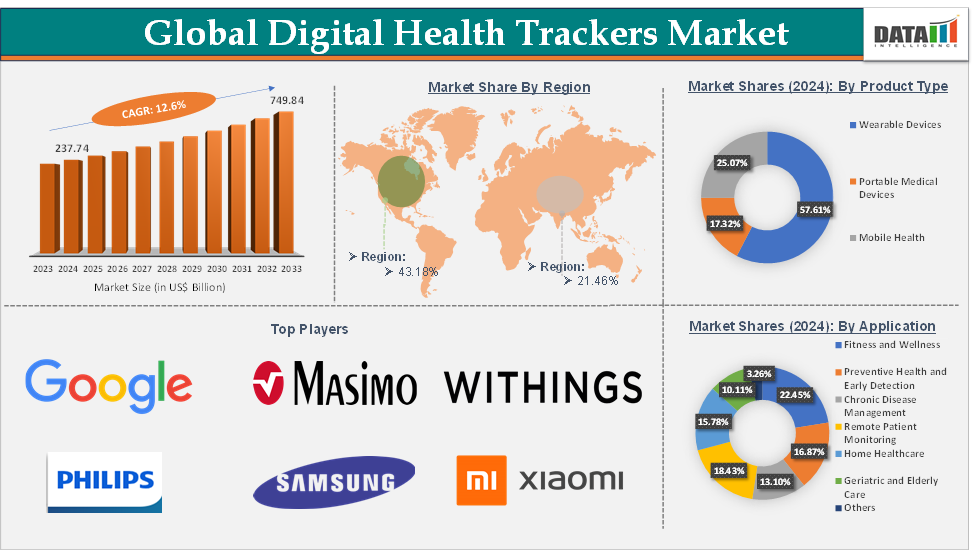
Digital Health Trackers Market Size reached US$ 237.74 Billion in 2024 and is expected to reach US$ 749.84 Billion by 2033, growing at a CAGR of 12.6% during the forecast period 2025-2033.
Digital Health Trackers Market Overview
The digital health trackers market encompasses wearable devices and mobile applications designed to monitor and manage various health metrics, including physical activity, heart rate, sleep patterns, and chronic disease indicators. These tools empower individuals to take proactive control of their health and wellness, offering real-time data and insights. The market is experiencing rapid growth, fueled by technological advancements, increased health consciousness, and the integration of artificial intelligence (AI) and machine learning into health tracking solutions.
Key trends influencing this growth include advancements in wearable technology, integration with healthcare systems, and increasing consumer demand for personalized health insights. However, addressing challenges related to data privacy, regulatory compliance, and technological accessibility will be crucial for sustained market expansion.
Digital Health Trackers Market Executive Summary
For more details on this report, Request for Sample
Digital Health Trackers Market Scope
| Metrics | Details | |
| CAGR | 12.6% | |
| Market Size Available for Years | 2022-2033 | |
| Estimation Forecast Period | 2025-2033 | |
| Revenue Units | Value (US$ Bn) | |
| Segments Covered | Product Type | Wearable Devices, Portable Medical Devices, and Mobile Health |
| Technology | Bluetooth Enabled Devices, Wi-Fi Enabled Devices, GPS Enabled Devices, Artificial Intelligence, and Wearable Sensors | |
| Age Group | Geriatric/Elderly, Adults and Infants, and Children | |
| Application | Fitness and Wellness, Preventive Health and Early Detection, Chronic Disease Management, Remote Patient Monitoring, Home Healthcare, Geriatric and Elderly Care, and Others | |
| Regions Covered | North America, Europe, Asia-Pacific, South America, and the Middle East & Africa | |
Digital Health Trackers Market Dynamics: Drivers & Restraints
Rising aging population and elderly care needs are significantly driving the digital health trackers market growth
Aging brings higher risks of chronic diseases, such as cardiovascular issues, diabetes, arthritis, and cognitive decline, which require prior health care for elders. This rising aging population with age-related issues and elderly care needs creates an urgent need for continuous health monitoring, which digital health trackers can provide.
For instance, according to the World Health Organization, one in six individuals will be 60 years of age or older by 2030 worldwide. There will be 1.4 billion people over 60 by 2030, up from 1 billion in 2020. The number of individuals in the world who are 60 or older is expected to increase to 2.1 billion by 2050. By 2050, the population of people 80 years of age or older is predicted to triple, reaching 426 million. This rising aging population creates an urgent need for digital health trackers for continuous health monitoring, which further drives the market growth.
Aging is highly linked with an increased prevalence of chronic diseases, where there is high use of digital health trackers. For instance, according to the National Council on Aging, nearly 95% of adults 60 and older have at least one chronic condition, while nearly 80% have two or more. Managing these requires consistent monitoring, making digital health trackers essential. Many older adults prefer to live independently rather than in assisted living facilities. Digital health trackers support this independence by offering fall detection, emergency alerts, and continuous monitoring.
Privacy and data security concerns are hampering the market growth
Digital health trackers collect a variety of sensitive data points, such as heart rate, activity level, sleep patterns, and, in certain cases, more specific health information like blood pressure, glucose levels, and ECG readings. Concerns about how companies could use consumers' private health information are common, particularly because some of it may reveal lifestyle choices or health conditions.
Additionally, hackers may get access to real-time health data or personal identifiers, which might lead to identity theft, fraud, or the unauthorized selling of health data. Inadequate security measures might make devices and the mobile apps that are connected to them vulnerable to attacks. For instance, a Colorado-based pathology laboratory is notifying more than 1.8 million patients that their sensitive information was compromised in one of the largest breaches reported by a medical testing lab to US federal regulators, making the healthcare industry especially vulnerable to hackers.
Additionally, according to the HIPAA Journal, in March 2025, 1,754,097 individuals had their protected health information exposed, stolen, or impermissibly disclosed in a healthcare data breach, 2,277,555 individuals were affected in February 2025, and 3,121,358 individuals in January 2025. These rising data breaches may hesitate patients about their personal data, which hinders the market growth.
Digital Health Trackers Market Dynamics
Rising Aging Population and Elderly Care Needs
The growing elderly population is creating substantial demand for continuous and convenient health monitoring. Older adults have a higher incidence of chronic conditions and may require regular monitoring of cardiovascular health, physical activity, sleep, and other health indicators.
Digital health trackers can support independent living through fall detection, emergency alerts, activity monitoring, and continuous health tracking, making elderly care an important application area.
Increasing Prevalence of Chronic Diseases
The increasing burden of cardiovascular diseases, diabetes, hypertension, obesity, and other chronic conditions is encouraging consumers and healthcare providers to adopt continuous monitoring solutions.
Trackers can provide frequent health measurements outside traditional healthcare settings, supporting patient engagement, lifestyle management, and remote monitoring.
Increasing Health and Wellness Awareness
Consumers are increasingly focused on physical fitness, sleep quality, stress management, nutrition, and preventive health. This is shifting digital trackers from simple step-counting devices toward comprehensive health-management platforms.
Privacy and Data Security Concerns
Digital health trackers collect sensitive information, including activity patterns, sleep, heart rate, and potentially blood pressure, glucose, or ECG-related data. Concerns regarding unauthorized access, data sharing, cybersecurity, and ownership of health information can restrict adoption.
Digital Health Trackers Market Segment Analysis
The global digital health trackers market is segmented based on product type, technology, age group, application, and region.
The wearable devices from the product type segment are expected to hold 57.61% of the market share in 2024 in the digital health trackers market
The wearable devices segment holds a major portion of the digital health trackers market share and is expected to continue to hold a significant portion of the market share over the forecast period due to their convenience, advanced technology integration, and unique ability to offer real-time health data. These devices play a pivotal role in personal health management, offering users a hands-free, accessible way to monitor vital signs, fitness levels, and other health metrics.
Top and emerging market players are developing various wearable devices for health monitoring. For instance, in February 2025, OPPO unveiled its latest flagship smartwatch, the OPPO Watch X2. Built to redefine wearable tech, the OPPO Watch X2 combines comprehensive health and fitness monitoring capabilities, premium design, and exceptional battery life. Equipped with cutting-edge sensors, the Watch X2 enables ECG Analysis, blood oxygen tracking, and a revolutionary 60-second health checkup for a comprehensive wellness experience. It also offers up to 5 days of use in Smart Mode and 16 days in Power Saver Mode with the use of next-gen silicon-carbon battery technology. These novel product launches are expanding the segment growth.
Digital Health Trackers Market Geographical Analysis
North America is expected to dominate the global digital health trackers market with a 43.18% share in 2024
The North America region is expected to hold the largest market share over the forecast period owing to owing to technological innovations and availability of advanced digital health solutions, and strong consumer adoption. North America, particularly the United States, is a global leader in technological advancements. The region’s focus on innovation has led to the development of advanced digital health solutions, including highly sophisticated wearable devices that leverage cutting-edge technologies.
For instance, in May 2025, Whoop unveiled two new wearable devices, Whoop 5.0 and Whoop MG, marking a significant leap in personal health and fitness tracking. Accompanied by a redesigned digital interface and a flexible membership model, the new launch is designed to help users better understand their long-term health and performance. Both devices are 7% smaller, boast a 14-day battery life, and come equipped with powerful new tools through the Whoop app. This development of advanced digital health wearables is accelerating the market growth in North America.
Digital Health Trackers Market Competitive Strategy Analysis
Product Innovation
Companies are developing smaller, lighter, more comfortable devices with improved sensors, longer battery life, and broader health-monitoring capabilities.
AI Integration
AI is becoming a major competitive differentiator as companies seek to provide personalized health insights rather than simply displaying raw measurements.
Healthcare Partnerships
Partnerships with hospitals, healthcare providers, insurers, telehealth companies, and research organizations can help manufacturers expand clinical applications.
Software Ecosystem Development
Integrated applications, health dashboards, digital coaching, cloud platforms, and subscription services can improve customer retention.
Subscription Models
Recurring revenue can be generated through premium analytics, advanced health reports, personalized coaching, and specialized monitoring features.
Strategic Acquisitions
Acquisitions of AI, sensor, software, analytics, and digital-health companies can accelerate product development and strengthen technology portfolios.
Geographic Expansion
Companies can target emerging markets through affordable products, localized applications, regional partnerships, and simplified digital-health solutions.
Digital Health Trackers Market Top Companies
Top companies in the digital health trackers market include Apple Inc., Google, Samsung Electronics Co., Ltd., Garmin Ltd., Xiaomi Corporation, Huawei Device Co., Ltd., Withings, OMRON Healthcare, Inc., Koninklijke Philips N.V., Masimo Corporation, and among others. The emerging players include WHOOP, Oura Health Oy, Zepp INC., Biofourmis, Movano Health, and others.
Recent Developments in the Digital Health Trackers Market
- August 2026: Apple Inc. continued expanding its health and fitness ecosystem, with Apple Watch and health-monitoring capabilities increasingly positioned around activity tracking, sleep, cardiovascular monitoring and personalized wellness insights.
- July 2026: Samsung Electronics Co., Ltd. continued strengthening its Galaxy Watch health platform, expanding AI-powered wellness features and health-monitoring capabilities across its wearable ecosystem.
- July 2026: Google continued advancing its wearable-health ecosystem through Fitbit and Google Health, with increasing emphasis on AI-driven health insights, sleep tracking, fitness monitoring and personalized wellness recommendations.
- June 2026: Garmin Ltd. continued expanding its health and fitness wearable portfolio, focusing on advanced sleep, recovery, heart-rate, training and wellness metrics for consumers and athletes.
- June 2026: Huawei Device Co., Ltd. continued expanding its wearable-health portfolio, incorporating advanced monitoring capabilities and wellness analytics into its smartwatch and fitness-device ecosystem.
- May 2026: Xiaomi Corporation continued expanding its smart-band and smartwatch portfolio, strengthening health and fitness tracking capabilities while targeting broader consumer adoption through competitively positioned devices.
- May 2026: WHOOP continued strengthening its wearable health-monitoring platform, focusing on continuous physiological monitoring, recovery analysis, sleep insights and personalized coaching.
- May 2026: Oura Health Oy continued expanding the Oura Ring ecosystem, focusing on sleep, readiness, activity and women's-health insights supported by continuous biometric tracking.
- April 2026: Withings continued expanding its connected-health portfolio, integrating wearable and home-health monitoring technologies designed to provide users with continuous health and wellness data.
- April 2026: OMRON Healthcare, Inc. continued developing connected blood-pressure and cardiovascular-monitoring solutions, supporting the integration of home health measurements with digital health platforms.
- April 2026: Masimo Corporation continued advancing wearable and remote-monitoring technologies, focusing on continuous physiological measurements and connected healthcare applications.
The global digital health trackers market report delivers a detailed analysis with 70 key tables, more than 68 visually impactful figures, and 168 pages of expert insights, providing a complete view of the market landscape.
Why Choose DataM?
Comprehensive Market Intelligence: Provides detailed analysis of the Digital Health Trackers Market across product type, technology, age group, application, regional markets, market dynamics, competitive landscape, and emerging opportunities.
Technological Developments: Examines advancements in wearable sensors, Bluetooth, Wi-Fi, GPS, artificial intelligence, machine learning, mobile health applications, cloud platforms, and connected healthcare technologies.
Performance and Market Position: Evaluates major and emerging companies based on product portfolios, technology capabilities, health-monitoring features, geographic presence, partnerships, software ecosystems, and innovation strategies.
Applications of Digital Health Trackers: Covers fitness and wellness, preventive health and early detection, chronic disease management, remote patient monitoring, home healthcare, geriatric care, rehabilitation, and other emerging applications.
Market Trends and Industry Changes: Tracks product launches, technology upgrades, AI integration, wearable innovations, healthcare partnerships, remote-monitoring developments, and changing consumer preferences.
Competitive Strategies: Analyzes product innovation, AI integration, healthcare partnerships, software ecosystems, subscription models, acquisitions, geographic expansion, and technology differentiation.
Pricing & Market Access: Examines device pricing, component costs, subscription models, distribution, healthcare integration, regulatory requirements, and market-access considerations.
Market Entry & Expansion: Identifies opportunities across North America, Europe, Asia-Pacific, South America, and the Middle East & Africa, including opportunities in remote monitoring, elderly care, chronic disease management, and consumer wellness.
Investment Intelligence: Highlights opportunities across wearable technologies, AI-powered health analytics, digital biomarkers, remote patient monitoring, healthcare cybersecurity, connected devices, and personalized digital-health platforms.
Supply Chain & Risk Analysis: Assesses component sourcing, semiconductor availability, sensor supply, manufacturing, software infrastructure, distribution, and other factors that can influence product availability and market competitiveness.
Regional Growth & Investment: Identifies high-growth regions and evaluates the technological, healthcare, demographic, and infrastructure factors shaping regional adoption.
Target Audience
- Digital Health & Wearable Device Companies
- Medical Device Manufacturers
- Healthcare Providers & Hospitals
- Telehealth & Remote Patient Monitoring Companies
- AI, IoT & Health-Tech Companies
- Pharmaceutical & Biotechnology Companies
- Investors, VC & Private Equity Firms
- Government & Regulatory Bodies
- Research Institutions & Healthcare Consultants



























































