



Tire Cord Market Size
Tire Cord Market reached US$ 12.61 Billion in 2025 and is expected to reach US$ 46.00 Billion by 2033, growing with a CAGR of 17.60 % during the forecast period 2026-2033
Tire cords reinforce the tired used to maintain a tire's shape. Tire cords are primarily made of nylon, aramid, polyester, steel, rayon, and hybrid. These materials offer several beneficial properties: controlled deformation and abrasion resistance and high tensile strength, contributing to their use as core components. The tire cord is crucial in providing strong support to rubber tires. It offers support and aids in the maintenance of tire form, handles a vehicle's overall weight & provides elongation and absorption performance, thus, making it a crucial tire element.
Based on material type, the tire cord market is segmented into Nylon, Polyester, Rayon, Hybrid, and Polyethylene Terephthalate (PET). Nylon has shown the highest market growth potential due to its high tenacity, toughness, superior fatigue resistance, and good adhesion to rubber. Based on the Tire category, the Radial segment is growing at the fastest pace in the market owing to the rising production of passenger cars across the globe. Radial tires have different springiness characteristics than bias-ply tires and a different degree of steering slip.
Market Summary
| Metrics | Details |
| CAGR | 17.6% |
| Size Available for Years | 2023-2033 |
| Forecast Period | 2026-2033 |
| Data Availability | Value (US$) |
| Segments Covered | By Material, By Process, By Tire, By Application, and By Region |
| Regions Covered | North America, Europe, Asia-Pacific, South America, and Middle East & Africa |
| Largest Region | Asia-Pacific |
| Report Insights Covered | Competitive Landscape Analysis, Company Profile Analysis, Market Size, Share, Growth, Demand, Recent Developments, Mergers and Acquisitions, New Product Launches, Growth Strategies, Revenue Analysis, Porter’s Analysis, Pricing Analysis, Regulatory Analysis, Supply-Chain Analysis and Other key Insights. |
Tire Cord Market Dynamics
Growing demand for eco-friendly manufacturing has escalated the tire cord market share
The demand for eco-friendly manufacturing is driving the global tire cord. Furthermore, Sustainable manufacturing technologies provide significant financial, environmental, and product quality benefits to many manufacturers. Therefore, leading companies such as Continental, Kordsa, and Teijin have been working on various sustainable practices to manufacture eco-friendly tires for sustainability and the environment and adhere to regulatory bodies.
For instance, long back (2008), Teijin Fibers Limited announced to start of supplying chemically recycled Ecopet Plus polyester fibers for the cords of Toyo Tire & Rubber's Proxes Ne tires, which are special tires designed for environmentally oriented passenger cars. Adopting eco-friendly and sustainable tire manufacturing helps to improve operational efficiency by reducing costs and waste, responding to or reaching new customers and increasing competitive advantage, protecting and strengthening brand and reputation, building public trust, and responding to regulatory constraints and opportunities without causing environmental damage.
The tremendous growth in research and development is being conducted to create new opportunities for waste with continuous government support. In 2019, Kordsa Technik Teksil A.S. and Continental A.G. developed a sustainable technology with rubber compounds for bonding textile reinforcing materials. The technology is aimed at use in tire cord materials. Moreover, in 2016, Kordsa Teknik Tekstil A.Ş. launched its green tire cord fabric product based on its sustainable and innovative approach without the involvement of toxic chemicals that affect human health.
Furthermore, companies are also bringing new sustainable technologies such as; on September 6, 2021; Continental unveiled its innovative Conti GreenConcept tire concept at IAA MOBILITY 2021. As another illustration of Continental's wide-ranging operations in pursuit of sustainability, this conceptual study by the premium tire maker combines current and new technology approaches to producing sustainable tires for passenger cars.
Growing stringent regulations and lesser penetration of tire cords restrict the growth of the tire cord market
The market for tire cords is significantly affected by shifts in the cost of the raw materials required to make tires. Manufacturers must carefully consider the cost and availability of raw materials when establishing their cost structure.
Tire cords' raw materials, such as nylon and polyethylene, are produced from petroleum-based derivatives and, therefore, are subject to price changes. Oil prices have been highly volatility for the past decade, with increasing demand globally affecting the cost structure of the tire cord market.
Furthermore, While tires account for less than 2% of total municipal solid waste, approximately 5 million tons of tire garbage were generated in 2007 alone, according to U.S. Environmental Protection Agency; on average, only around 35% of tire rubber is recycled. Only 11 states prohibit all tire trash from being disposed of in landfills, resulting in millions of tons of tire waste being dumped in already overburdened landfills. However, tires have become smaller and more durable due to technological advancements, resulting in more recycled tires and fewer landfills.
Tire Cord Market Segmentation Analysis
The global tire cord market is segmented by material, process, tire, application, and region.
Nylon material offers excellent strength in tire cords which has escalated the product’s demand in the tire cord industry
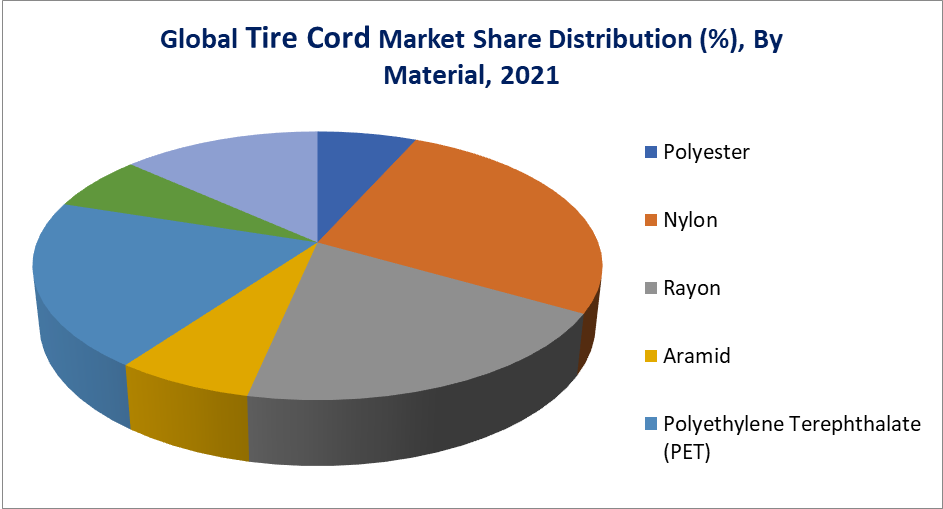
Based on material, the global tire cord market is segmented into polyester, nylon, rayon, aramid, polyethylene terephthalate (PET), steel, and hybrid. The nylon segment is a major type of tire cord market. The nylon tire cord fabric provides the necessary strength to a tire. The tire industry is the largest consumer and utilizes 98% of all nylon tire cords produced globally.
In the tire industry, nylon tire cable fabric gradually replaced rayon and polyester cords. Nylon tire cord is manufactured from high-tenacity constant filament yarn by twisting and then plying. Two (2) major types of nylons are used as tire cords, i. e. nylon-6 and nylon-6,6. The properties of nylon-6 and nylon-6,6 vary marginally and are controlled by the manufacturing process, type of stabilizers, and additives used. In India, only nylon-6 is produced commercially for tire cords.
Nylon-6 is utilized in Europe and other developing countries, while nylon-6,6 is more prominent in the U.S. mainly due to the availability of basic raw materials and established manufacturing facilities. During the last ten to twelve years, developers have been largely evolutionary, aiming to overcome the limitations of existing tire fibers and make them acceptable for wider use. The tenacity of NTC locally available to Indian tire manufacturers varies from 8. 4 to 9. 4 with an average value of 9. 2 gpd.
Nylon 6 grey and dipped tire cord fabrics are mostly used to reinforce bus or truck tires because of their high strength, fatigue resistance, impact resistance, and strong adhesion qualities.
Tire Cord Market Geographical Share
Expanding automotive and electronics industry of Asia-Pacific boosts the market share for the tire cord market in the region
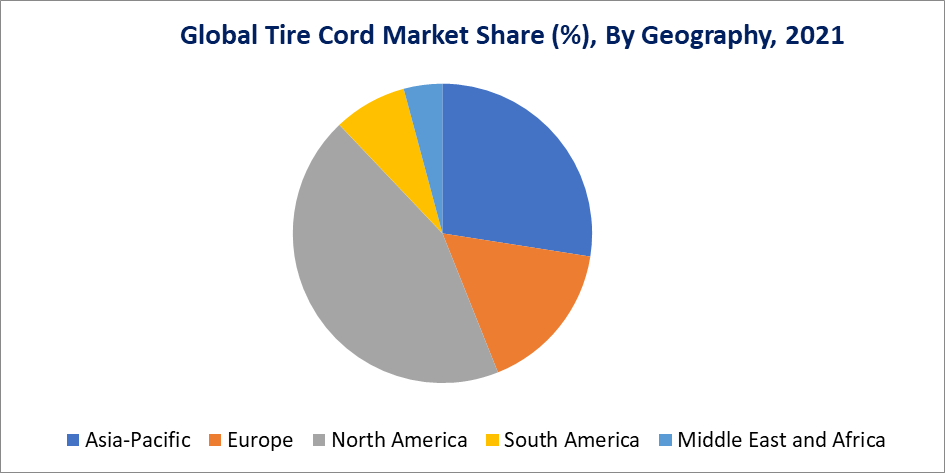
Asia-Pacific holds the largest market share for the tire cord market globally due to the region's expanding automotive and electronics industry. Furthermore, the growing demand for automobiles, mainly in China and India, will boost the tire cord market.
China has shown the largest automobile market worldwide in terms of supply and demand. The emerging demand for heavy commercial vehicles will steadily improve the demand for tire cords in the region. For instance, In 2019, China produced nearly 21 million cars and 4.36 million commercial vehicles, making it the world's largest vehicle manufacturer. Moreover, over 2.9 million commercial vehicles and passenger cars in India were sold in 2020.
The recent initiatives are further enhancing the growth of the tire cord market in the region. For instance, in 2020, India's Central Board of Indirect Taxes and Customs (CBIC) announced revoking anti-dumping duty on nylon tire cord fabric imported from China.
The leading players have expanded their regional production facilities to satisfy the end-users needs. For instance, in 2021, Kolon Industries expanded its polyester tire cord plant in Vietnam to expand its annual volume by 19,200 tons. The company had a PET tire cord plant with 16,800 tons capacity in Binh Duong Province of Vietnam in 2018.
Tire Cord Companies and Competitive Landscape
The global tire cord market is highly competitive with local and global key players. The key players contributing to the market's growth are Indorama Ventures, SRF Limited, Kolon Industries Inc, Tire Cord USA, TEIJIN LIMITED, HYOSUNG, Kordsa Teknik Tekstil A.S., Toray Hybrid Cord, Inc, Century Enka Limited, Firestone Fibers & Textile Company, among others.
The major companies are adopting several growth strategies, such as product launches, acquisitions, and collaborations, contributing to the global growth of the tire cord market.
On January 12, 2021, Kolon Industries announced on January 12 that it has decided to expand its polyester tire cables production plant in Vietnam to increase its annual production capacity by 19,200 tons. The company built a PET tire line factory with an annual capacity of 16,800 tons in Binh Duong province of Vietnam in 2018. Kolon Industries will spend 68 billion won (US$ 62 million) in its fully-owned Kolon Industries Binh Duong Company Ltd. to assist the Vietnamese affiliate in expanding the factory by September 2022. The expansion works will be completed in September 2022. Once completed, the company's total tire production capacity will be increased to 103,200 tons per year.
Kolon Industries Inc
Overview: Since the first production of nylon in Korea in 1957, KOLON Industries, Inc. has grown considerably and is now an independent company after the KOLON Group adopted a joint-stock structure in 2010. The company focuses on four main business divisions: industrial materials, chemicals, film / electronic materials, and fashion
KOLON Industries, Inc. plans to globalize its automotive materials, advanced materials, optical film, chemical, and fashion industries by increasing investment in high-value products. KOLON Industries, Inc. has been identified for its quality and technology by national and international companies such as Michelin, Bridgestone, Goodyear, and Continental.
Product Portfolio: Elemental Fluorine (F2): The company produces high dimensional stability, few flat marks, excellent heat resistance, and controllable tire belts, Mainly used in passenger car travel tires.
Recent Developments
- In February 2026, Kordsa expanded its tire cord fabric production capacity in Indonesia. The investment focuses on increasing supply to Southeast Asian tire manufacturers. It strengthens the company’s global footprint and supports rising automotive demand.
- In January 2026, Hyosung Advanced Materials announced a new high-strength polyester tire cord line. The development enhances durability and fuel efficiency in next-generation tires. The launch targets premium and electric vehicle segments.
- In December 2025, Kolon Industries invested in advanced aramid tire cord technology. The initiative aims to improve heat resistance and tire lifespan. It supports growing demand for high-performance and sustainable tires.
Why Purchase the Report?
- Visualize the global tire cord market segmentation by material, process, tire, application, and region, highlighting key commercial assets and players.
- Identify commercial opportunities in the tire cord market by analyzing trends and co-development deals.
- Excel data sheet with thousands of global tire cord market-level 4/5 segmentation points.
- PDF report with the most relevant analysis cogently put together after exhaustive qualitative interviews and in-depth market study.
- Product mapping in Excel for the key product of all major market players
The global tire cord market report would provide approximately 69 market data tables, 67 figures, and 214 pages.
Target Audience 2026
- Service Providers/ Buyers
- Residential
- Research Laboratory
- Restaurant Business
- Energy & Utilities Companies
- Distributors


