


Skincare Market Size & Industry Outlook
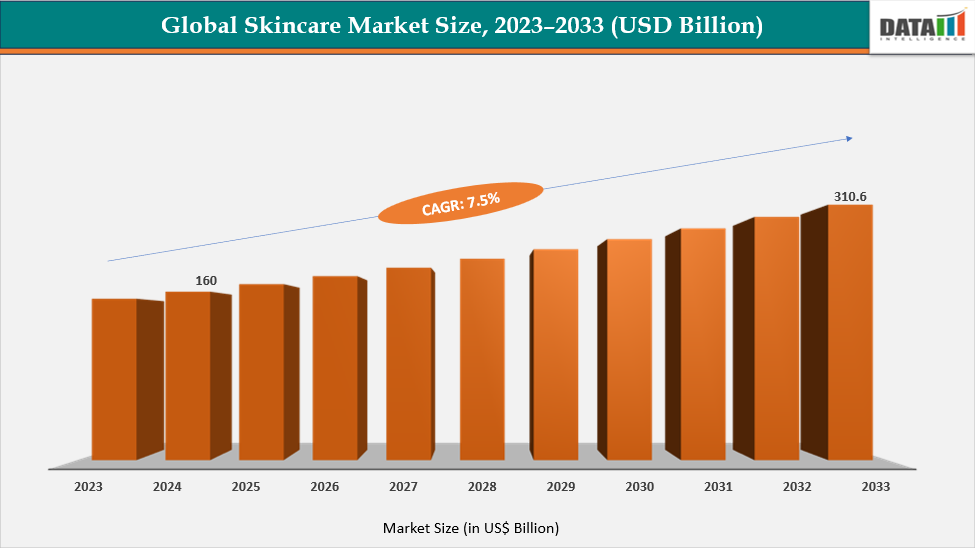
The global Skincare market size reached US$172.0 Billion in 2025 and is expected to reach US$310.6 Billion by 2033, growing at a CAGR of 7.5% during the forecast period 2026-2033. The global skincare market is experiencing robust growth, driven by the rising consumer awareness regarding personal grooming, appearance, and skin health. Increasing demand for anti-aging, sun protection, and hydrating products, along with growing concerns about skin problems such as acne, pigmentation, and dryness, are significantly contributing to market expansion.
The surge in disposable incomes, particularly in emerging economies, has enabled consumers to invest more in premium skincare products. Moreover, the growing influence of social media, beauty influencers, and celebrity endorsements has heightened consumer interest in skincare routines and product innovation. The market is also witnessing a strong shift toward natural, organic, and sustainable skincare formulations, as consumers increasingly prefer clean beauty products free from harmful chemicals. Technological advancements, such as AI-based skin analysis and personalized skincare solutions, further enhance product effectiveness and customer engagement, driving consistent growth across global markets.
Key Market Highlights
- Asia-Pacific dominates the Skincare market with the largest revenue share of 43.65% in 2024.
- North America is the fastest-growing region and is expected to grow at the fastest CAGR of 9.67% over the forecast period.
- Based on the product type, the creams segment led the market with the largest revenue share of 31.8% in 2024.
- The major market players in the Skincare market are Unilever, L’Oréal Professional, Procter & Gamble, Estée Lauder Inc., Beiersdorf AG, Shiseido Co., Ltd., Coty Inc., Natura & Co., Kao Corporation, Johnson & Johnson, among others
Market Dynamics
Drivers: Rising Awareness of Skin Health and Appearance is significantly driving the Skincare market growth
Consumers across the globe are placing ever-greater emphasis on the health and appearance of their skin, and this shift is creating a powerful momentum behind the skincare market. Awareness of skin health has surged globally, with major organisations recognising and acting on the far-reaching impact of skin conditions beyond mere aesthetics. For instance, the World Health Organization (WHO) states that skin diseases account for nearly 5 billion incident cases of skin and subcutaneous conditions worldwide and represent one of the top 10 causes of disability. Moreover, the WHO-led global initiative on skin health, combined with the World Skin Health Coalition’s “Not Just My Skin” campaign, reached over 5.1 million people in six WHO regions and facilitated 17.8 million content views and more than 2.7 million social media engagements.
These developments reflect heightened public and professional recognition that skin health is integral to overall wellness, driving consumer demand for preventive, corrective, and skincare products. As consumers become more informed about skin disease risks, environmental triggers (such as pollution and UV exposure), and ingredient efficacy, they are adopting broader and more frequent skincare routines. In turn, this elevates product innovation, formulation quality, and market growth.
In closing, the expanding global consciousness about the importance of skin health, backed by policy, public-health campaigns, and consumer education, is a key engine fuelling the growth of the skincare market from a niche aesthetic concern into a mainstream health and wellness priority.
Restraints: The High Cost of Premium and Organic Products is hampering the growth of the market
The premiumization of skincare, particularly within the organic segment, has emerged as a significant barrier to broader market expansion. In India, for example, organic personal care products are typically 1.5 to 2 times more expensive than conventional alternatives due to the high cost of organic ingredients and sustainable sourcing practices. Leading premium brands such as The Body Shop, Tata Harper, and Herbivore Botanicals exemplify this trend, offering high-quality organic skincare products that command significantly higher price points, such as Tata Harper’s Regenerating Cleanser, which retails at over US$80, compared to mass-market cleansers priced under US$20. While consumer demand for clean, natural, and sustainable skincare continues to rise, the steep price tags of premium and organic offerings limit accessibility for a large segment of the population, especially in middle-income and emerging markets, thereby restraining the overall growth potential of the global skincare market.
For more details on this report – Request for Sample
Skincare Market, Segmentation Analysis
The global Skincare market is segmented based on product, packaging type, by gender, by distribution channel, and by region.
Product Type: The creams segment is dominating the Skincare market with a 31.8% share in 2024
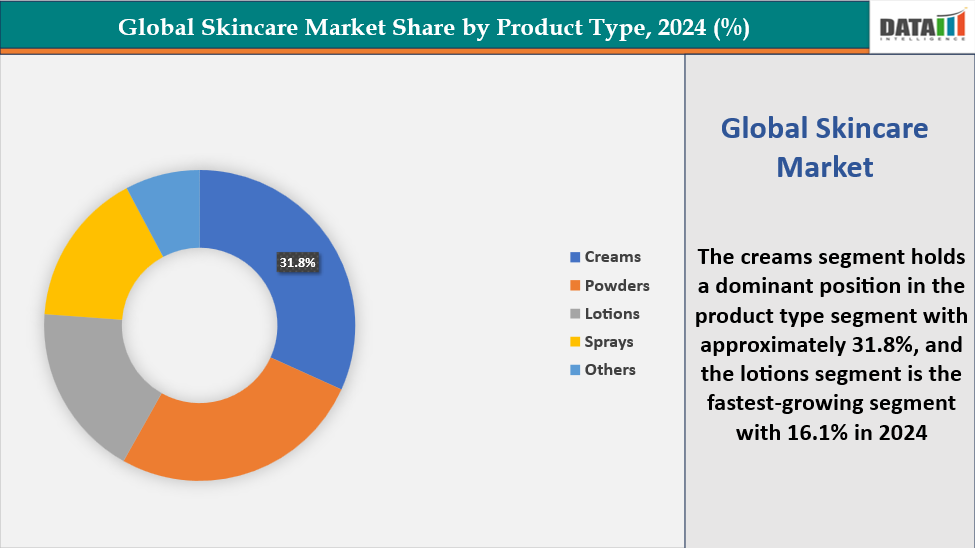
The creams segment holds a dominant 31.8% share of the global skincare market in 2024, driven by its widespread use, versatility, and effectiveness in addressing a broad range of skin concerns. Creams remain the most preferred skincare formulation due to their rich texture, superior hydration properties, and ability to deliver active ingredients deeply into the skin. They are commonly used for moisturizing, anti-aging, sun protection, and skin-repair purposes, making them an essential part of daily skincare routines across all age groups.
Moreover, the segment benefits from continuous product innovation, including multi-functional creams that combine SPF protection, anti-pollution benefits, and natural or organic ingredients. Major players such as L’Oréal, Unilever, Procter & Gamble, and Estée Lauder are heavily investing in developing advanced cream formulations that target specific skin types and regional needs, further strengthening market penetration. The growing consumer preference for anti-aging and brightening creams, particularly in Asia-Pacific and North America, has also fueled segment dominance.
The creams segment continues to lead the skincare market due to its broad application range, proven efficacy, and strong consumer trust, supported by ongoing innovation and premium product launches from leading global brands.
The lotions segment is the fastest-growing in the Skincare market, with a 16.1% share in 2024
The lotions segment, accounting for 16.1% of the global skincare market in 2024, is emerging as the fastest-growing category owing to its lightweight texture, quick absorption, and suitability for daily use across diverse skin types and climates. Unlike heavier creams, lotions provide effective hydration without leaving a greasy residue, making them particularly appealing to consumers in tropical and humid regions such as Asia-Pacific and Latin America. The increasing consumer shift toward non-greasy, multi-functional, and dermatologically tested products is driving strong demand in this category.
Furthermore, the rise in awareness of preventive skincare and daily moisturization routines, especially among younger consumers and men, is expanding the lotions market base. Key players such as Johnson & Johnson (Neutrogena, Aveeno), Beiersdorf AG (Nivea), and Unilever (Vaseline) are introducing innovative formulations infused with natural extracts, SPF protection, and vitamin-enriched ingredients, catering to evolving consumer preferences for clean and effective skincare. The growing popularity of body and hand lotions with added benefits such as anti-aging, brightening, and soothing properties is further accelerating sales.
In conclusion, the lotions segment is witnessing rapid growth due to its versatility, convenience, and alignment with modern skincare trends focused on lightweight, quick-absorbing, and multifunctional solutions, positioning it as a key growth driver in the global skincare market.
Skincare Market, Geographical Analysis
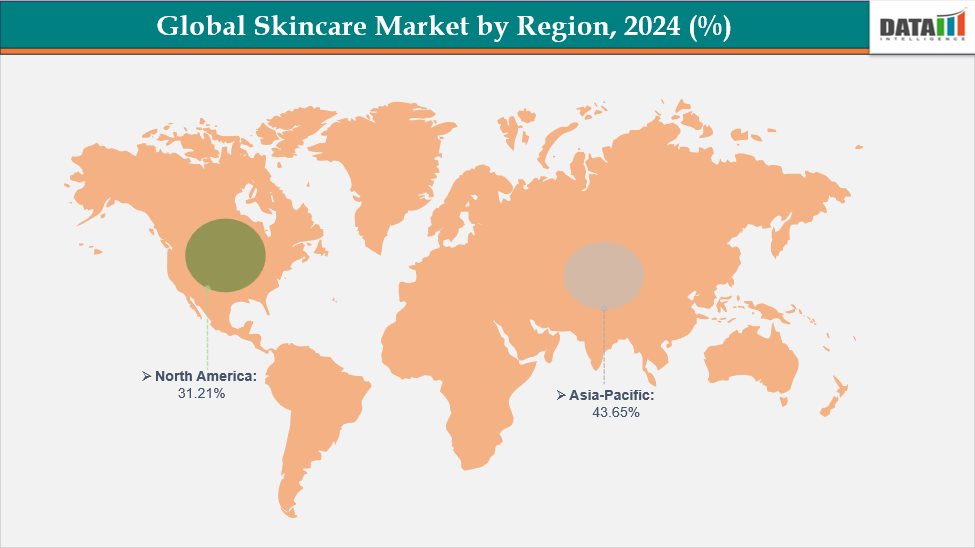
Asia Pacific is expected to dominate the global Skincare market with a 43.65% in 2024
The Asia-Pacific region holds a dominant position in the global skincare market, driven by a combination of a large consumer base, strong beauty culture, and rapid product innovation. Countries such as China, Japan, South Korea, and India are major contributors to regional dominance, owing to their deep-rooted skincare traditions and increasing consumer spending on personal care products. The region benefits from a high level of awareness about skincare routines, with consumers prioritizing prevention, brightening, and anti-aging solutions.
Additionally, South Korea and Japan serve as global innovation hubs for skincare, leading the way in advanced formulations, K-beauty and J-beauty trends, and the use of natural and functional ingredients. The growing influence of social media and beauty influencers, along with the popularity of multi-step skincare routines, has further fueled demand across all age groups. Moreover, the expanding middle-class population and rising disposable incomes in emerging economies such as India, Indonesia, and Vietnam have significantly boosted sales of both mass-market and premium skincare products.
Asia-Pacific region’s dominance in the skincare market stems from its cultural emphasis on skin health, innovation-driven product offerings, and increasing consumer purchasing power, making it the most influential and dynamic market globally.
The North America region is the fastest-growing region in the global Skincare market, with a CAGR of 9.67% in 2024
The North American region is emerging as the fastest-growing market in the global skincare market, registering a robust CAGR of 9.67% in 2024. This growth is primarily driven by rising consumer awareness about skin health, increasing demand for premium, dermatologically tested, and clean-label skincare products, and the rapid adoption of advanced skincare technologies. Consumers in the U.S. and Canada are increasingly seeking personalized and science-backed formulations, supported by dermatologists and skin specialists.
The market is also witnessing strong traction from the men’s skincare segment and anti-aging, sun protection, and hydration-focused products, reflecting changing lifestyle and grooming habits. Furthermore, the growing influence of digital marketing, e-commerce platforms, and beauty influencers has significantly accelerated brand visibility and consumer engagement. Leading players such as Estée Lauder, Procter & Gamble, Johnson & Johnson, and L’Oréal USA are investing heavily in product innovation, sustainable packaging, and AI-based skincare analysis tools, catering to evolving consumer preferences.
North America’s position as the fastest-growing region in the skincare market is underpinned by its technological advancements, premiumization trends, and heightened focus on skin wellness and sustainability, making it a key driver of global market expansion.
Europe Skincare Market Trends
In Europe, the skincare market is witnessing steady growth, supported by increasing consumer preference for natural, sustainable, and ethically produced skincare products. European consumers are becoming more conscious of ingredient transparency, driving demand for clean beauty and eco-friendly formulations. Regulatory frameworks such as the EU Cosmetics Regulation (EC) No. 1223/2009 ensure high safety and quality standards, which enhance consumer trust and brand credibility.
The market is also influenced by the aging population in countries like Germany, France, and the United Kingdom, leading to rising demand for anti-aging, firming, and hydrating products. Additionally, the strong presence of leading skincare brands such as Beiersdorf AG (Nivea), L’Oréal Paris, Unilever, and The Body Shop continues to shape product innovation and market stability. The increasing adoption of vegan, cruelty-free, and organic skincare products, along with the expansion of online retail and personalized skincare solutions, is further contributing to market consistency.
Europe’s skincare market maintains steady and sustainable growth due to its mature consumer base, regulatory excellence, and strong focus on sustainability and product quality, making it one of the most reliable markets for long-term skincare investments.
Competitive Landscape
Top companies in the Skincare market include Unilever, L’Oréal Professional, Procter & Gamble, Estée Lauder Inc., Beiersdorf AG, Shiseido Co., Ltd., Coty Inc., Natura & Co., Kao Corporation, Johnson & Johnson, among others.
Skincare Market Scope
| Metrics | Details | |
| CAGR | 7.5% | |
| Market Size Available for Years | 2025-2033 | |
| Estimation Forecast Period | 2026-2033 | |
| Revenue Units | Value (US$ Bn) | |
| Segments Covered | Product | Creams, Powders, Lotions, Sprays, Others |
| Packaging Type | Tube, Bottle, Jar, Others | |
| Gender | Men and Women | |
| Distribution Channel | Cosmetic Stores, Supermarkets/Hypermarkets, Online Channels, Others | |
| Regions Covered | North America, Europe, Asia-Pacific, South America and the Middle East & Africa | |
The global Skincare market report delivers a detailed analysis with 70 key tables, more than 60 visually impactful figures, and 159 pages of expert insights, providing a complete view of the market landscape.
Recent Developments:
- May 2026: L’Oréal expanded its AI-powered skincare personalization platform globally, integrating skin diagnostic tools and dermatologist-grade recommendation systems to strengthen direct-to-consumer skincare engagement.
- April 2026: Estée Lauder Companies launched next-generation biotech-driven skincare formulations focused on skin barrier repair, anti-aging peptides, and microbiome-friendly ingredients across premium product lines.
- March 2026: Unilever scaled sustainable skincare portfolio expansion, increasing plant-based formulations and reducing carbon footprint across major brands such as Dove and Simple.
- February 2026: Procter & Gamble advanced clinical skincare innovation through dermatology-backed R&D programs, strengthening Olay’s anti-aging and skin renewal product pipeline.
- January 2026: Shiseido enhanced AI-driven skin analysis technologies and premium skincare product development, focusing on personalized skincare regimens for aging and sensitive skin segments.
- December 2025: Johnson & Johnson expanded dermatologist-recommended skincare solutions under its consumer health portfolio, targeting acne, eczema, and sensitive skin treatment categories.
- November 2025: Beiersdorf accelerated innovation in dermatological skincare through NIVEA and Eucerin brands, focusing on skin barrier restoration and clinically tested formulations.
- October 2025: Coty Inc. strengthened skincare portfolio diversification through premium skincare acquisitions and expansion into active ingredient-based cosmetic dermatology products.
- September 2025: Amorepacific Corporation expanded K-beauty innovation leadership with fermented ingredient-based skincare solutions and advanced hydration technologies targeting global markets.
- August 2025: Galderma advanced medical-grade skincare and aesthetic dermatology solutions, strengthening its portfolio in injectable aesthetics and prescription skincare treatments.
- July 2025: CeraVe (L’Oréal) expanded global reach of barrier-repair skincare products supported by dermatologists, increasing penetration in sensitive-skin care segments worldwide.
Suggestions for Related Report
For more consumer-packaged goods-related reports, please click here


























































