


Single-Use Bioreactors Market Size & Forecast 2026
The global single-use bioreactors market was valued at USD 5.05 billion in 2025 and is forecast to reach USD 11.73 billion by 2035, expanding at an 8.8% compound annual growth rate during 2026–2035. The market covers disposable bioreactor systems, sterile media bags and bioprocess containers, single-use filtration and fluid-management assemblies, sensors, tubing and related components sold for research, process development and bioproduction.
A single-use bioreactor replaces the fixed product-contact surface of a stainless-steel vessel with a sterile disposable chamber installed in reusable hardware. The configuration reduces cleaning and sterilization requirements, shortens changeovers and limits cross-batch contamination risk. These benefits are especially important in multiproduct plants, clinical manufacturing, contract development and manufacturing organizations, vaccines and emerging cell and gene therapies.
The technology is moving beyond small clinical batches. Stirred-tank platforms now span benchtop development through several-thousand-liter commercial production, and suppliers are improving oxygen transfer, mixing, turndown ratio and automation. Thermo Fisher Scientific offers DynaDrive systems from 5 liters to 5,000 liters, while ABEC's customized CSR platform extends to 6,000 liters. Scale is no longer the sole limitation; film qualification, extractables and leachables, bag integrity, sensor reliability and consumable supply continuity now dominate procurement reviews.
Market revenue has a recurring structure. Hardware and controllers establish the platform, but sterile bags, filters, tubing sets and sensors are replaced for each batch. Once a process is validated around a bag film, connector architecture and control system, changing suppliers can require engineering studies, comparability work and regulatory documentation. This creates durable customer relationships but also exposes biomanufacturers to sole-source consumable risk.
Single-Use Bioreactors Market Key Highlights
- Market revenue increases by USD 6.68 billion between 2025 and 2035.
- Media bags and bioprocess containers lead product revenue with 44%, equal to USD 2.22 billion in 2025.
- Stirred-tank single-use bioreactors hold 68%, representing USD 3.43 billion.
- Monoclonal antibodies generate 48% of demand, or USD 2.42 billion.
- Mammalian-cell processes account for 64%, equal to USD 3.23 billion.
- North America leads with 41.5%, representing USD 2.10 billion in 2025.
- Consumable assurance, film qualification and scalable process performance determine platform selection.
Market Dynamics
Flexible biologics capacity is replacing fixed single-product assumptions
Biologics pipelines contain monoclonal antibodies, recombinant proteins, vaccines, viral vectors and cell-based products with different volume requirements. A fixed stainless-steel facility may be efficient for a stable blockbuster, but it carries utilization risk when a pipeline changes. Single-use platforms let manufacturers add or reconfigure trains with less fixed piping and fewer cleaning utilities. This flexibility is valuable to CDMOs that must accommodate several customers and to developers commercializing smaller patient-population therapies.
Higher titers and larger disposable systems extend commercial production
Improved cell lines, media and process control deliver greater product output per liter. Suppliers are pairing these gains with larger disposable vessels and intensified seed trains. Thermo Fisher Scientific states that its DynaDrive platform spans 5 to 5,000 liters and can produce more material in the same footprint than legacy configurations. ABEC offers customized systems up to 6,000 liters. These developments make single-use technology viable for more commercial batches, although very high-volume products can still favor stainless steel or hybrid designs.
Recurring bags and assemblies strengthen revenue but create lock-in risk
Each production run requires a qualified product-contact assembly. Bags may include spargers, impellers, ports, tubing, sampling lines and sensors selected for a specific process. The recurring model supports predictable supplier revenue, yet it also creates manufacturing risk if a bag is delayed or fails incoming inspection. Buyers increasingly ask for dual-site manufacturing, resin traceability, safety stock, change-notification controls and evidence that alternate assemblies can be introduced without compromising validation.
Process intensification changes bioreactor performance requirements
Perfusion, high-density seed trains and direct inoculation place greater demands on oxygen transfer, carbon-dioxide stripping, heat removal and sensor range. A platform suited to fed-batch monoclonal antibody production may not automatically support a high-cell-density viral-vector process. Sartorius integrates XCell ATF technology with its Biostat STR Generation 3 platform, while suppliers are adding intensified spargers and process analytical technology. Purchasing decisions are moving from nominal vessel size to verified performance at the target cell density and modality.
Film integrity and extractables remain critical adoption constraints
Disposable chambers introduce polymer contact surfaces into a regulated process. Manufacturers must assess extractables, leachables, particulate risk, adsorption, gas permeability and compatibility with media and product. Bag installation and shipping damage can lead to leaks or batch loss. Qualification packages, weld consistency, pressure testing and operator training therefore carry as much weight as reactor mixing data. Changes in resin, film layers or component suppliers can trigger extensive customer evaluation.
Waste and fossil-plastic exposure intensify sustainability scrutiny
Single-use technology reduces water-for-injection demand, cleaning chemicals and facility utilities but generates solid plastic waste. The environmental result varies by facility design, energy mix, transport and disposal route. Suppliers are responding with lower-carbon films, bio-circular feedstocks, take-back programs and life-cycle data. Sustainability will not replace sterility and performance criteria, but it is becoming part of tender scoring and corporate manufacturing strategy.
Single-Use Bioreactors Market Scope
| Metric | Coverage |
| Base year | 2025 |
| Historical period | 2023–2024 |
| Forecast period | 2026–2035 |
| 2025 market size | USD 5.05 billion |
| 2026 market size | USD 5.49 billion |
| 2035 market size | USD 11.73 billion |
| Forecast CAGR | 8.80% |
| Product coverage | Systems, media bags, filtration assemblies, sensors, tubing and other components |
| Reactor coverage | Stirred tank, wave-induced and bubble-column systems |
| Process coverage | Research, process development and bioproduction |
| Geographic coverage | North America, Europe, Asia-Pacific, Latin America, Middle East and Africa |
Market Segmentation Analysis
By Product
Single-use media bags and bioprocess containers held 44% of 2025 revenue, equal to USD 2.22 billion. Their leadership reflects one-batch replacement, custom configurations and their role as the qualified product-contact layer. Film consistency, port architecture, sterilization validation and delivery reliability directly affect manufacturing continuity.
Bioreactor systems represented 36%, or USD 1.82 billion. This segment includes reusable support hardware, drive systems, controllers and automation required to operate disposable vessels. Single-use filtration assemblies contributed 13%, equal to USD 657 million, as upstream and harvest workflows rely on sterile filters and closed fluid paths. Sensors, tubing, connectors and other components generated 7%, or USD 354 million. Consumables collectively hold the larger revenue pool and grow with installed-system utilization.
By Reactor Type
Stirred-tank systems led with 68%, equivalent to USD 3.43 billion. Their geometry resembles conventional stainless-steel reactors, supporting scale-up, process transfer and familiar control strategies. They serve monoclonal antibody, vaccine, recombinant-protein and selected advanced-therapy workflows from development through commercial scale.
Wave-induced or rocking-motion reactors held 22%, equal to USD 1.11 billion. They are widely used for seed culture, inoculum preparation, cell expansion and processes requiring gentle mixing. Bubble-column and other non-mechanical systems represented 10%, or USD 505 million, serving shear-sensitive or specialized applications where simplified mixing and lower mechanical complexity are valuable.
By Molecule Type
Monoclonal antibodies accounted for 48% of 2025 revenue, equivalent to USD 2.42 billion. Large development pipelines, established CHO processes and demand for flexible commercial capacity sustain the segment. Vaccines held 20%, or USD 1.01 billion, supported by rapid campaign changeover and regional manufacturing investment.
Gene-modified cells and viral-vector-related processes represented 13%, equal to USD 657 million. Stem-cell applications accounted for 9%, or USD 455 million, while recombinant proteins, enzymes and other molecules contributed 10%, equal to USD 505 million. Advanced therapies are smaller in revenue but impose demanding requirements for gentle handling, closed processing and small-batch flexibility.
By Cell Type
Mammalian cells generated 64%, equal to USD 3.23 billion, because they dominate antibody and complex therapeutic-protein production. Bacterial systems held 16%, or USD 808 million, with demand in recombinant proteins, enzymes and plasmid DNA. Yeast represented 11%, equal to USD 556 million, while insect, plant, stem and other cell systems accounted for 9%, or USD 455 million.
By Application and End User
Commercial and clinical bioproduction held 55%, equivalent to USD 2.78 billion. Process development represented 27%, or USD 1.36 billion, while research and discovery generated 18%, equal to USD 909 million. Suppliers benefit when a platform provides consistent geometry and control from development through manufacturing, reducing technology-transfer work.
Biopharmaceutical manufacturers accounted for 48% of end-user revenue, equal to USD 2.42 billion. CDMOs held 32%, or USD 1.62 billion, because multiproduct flexibility and shorter turnaround are central to their operating model. Academic and government research organizations represented 11%, equal to USD 556 million, while vaccine institutes, emerging biotechnology companies and other users contributed 9%, or USD 455 million.
Regional and Country-Level Analysis
North America
North America led with 41.5% of global revenue in 2025, equal to USD 2.10 billion. The United States represented 36% of the global market, or USD 1.82 billion, supported by large biologics pipelines, CDMO capacity, venture-backed biotechnology clusters and advanced-therapy manufacturing. Canada generated 4%, equal to USD 202 million, and Mexico held 1.5%, or USD 76 million. Expansion in Research Triangle Park, Boston, the San Francisco Bay Area and other biomanufacturing clusters sustains demand for standardized single-use platforms and secure domestic consumable supply.
Europe
Europe accounted for 20.4%, equivalent to USD 1.03 billion. Germany represented 4.5% of global revenue, or USD 227 million; the United Kingdom held 3.5%, equal to USD 177 million; Switzerland generated 3%, or USD 152 million; France contributed 2.5%, equal to USD 126 million; and Ireland held 2%, or USD 101 million. The rest of Europe represented 4.9%, equal to USD 247 million. European adoption combines advanced biologics capacity with stronger pressure to document plastic use, carbon impact and end-of-life management.
Asia-Pacific
Asia-Pacific held 18.9%, equal to USD 954 million, and is the fastest-growing regional market. China represented 5.5% of global revenue, or USD 278 million, driven by biosimilar, vaccine and CDMO investment. Japan held 3.5%, equal to USD 177 million, with demand in antibodies, regenerative medicine and high-quality clinical manufacturing. South Korea generated 3%, or USD 152 million, while India contributed 3%, equal to USD 152 million. Singapore held 1.5%, or USD 76 million, and the rest of Asia-Pacific represented 2.4%, equal to USD 121 million. Greenfield facilities can adopt disposable trains without retrofitting legacy stainless-steel infrastructure.
Latin America
Latin America accounted for 10.5%, or USD 530 million, with Brazil and Argentina leading regional biologics and vaccine manufacturing. Public-health production, biosimilar investment and local fill-finish expansion support demand, while imported consumable dependence and foreign-exchange exposure constrain adoption. Local stocking and application engineering are important supplier advantages.
Middle East and Africa
The Middle East and Africa held 8.7%, equal to USD 439 million. Saudi Arabia, the United Arab Emirates, South Africa and selected North African countries are investing in local vaccines and biologics. Single-use technology lowers the infrastructure barrier for new facilities, but training, validation support and reliable sterile-assembly delivery remain essential.
Competitive Landscape
The market is concentrated among companies that combine reactor hardware, proprietary bags, fluid-management components, automation and process support. Platform breadth helps suppliers carry a process from screening to commercial production. Customers, however, increasingly resist closed ecosystems that leave them dependent on one film, sensor or connector source. Open automation, documented interchangeability and transparent change control improve competitive positioning.
Scale competition has shifted from whether disposable reactors can exceed 2,000 liters to whether larger systems can sustain mixing, mass transfer and bag reliability. Thermo Fisher Scientific reaches 5,000 liters with DynaDrive, and ABEC reaches 6,000 liters with customized CSR systems. Sartorius emphasizes integrated intensification and automation, while Cytiva combines Xcellerex reactors with broader upstream and downstream workflows. Service, application development and global consumable capacity influence awards alongside equipment performance.
Key Players
Major participants include Thermo Fisher Scientific Inc., Sartorius AG, Cytiva, ABEC, Merck KGaA/MilliporeSigma, PBS Biotech, Inc., Eppendorf SE, Getinge AB, Celltainer Biotech B.V., Distek, Inc., Pall Corporation, Repligen Corporation and other specialist single-use technology providers.
Thermo Fisher Scientific Inc.
Thermo Fisher Scientific's portfolio includes HyPerforma and DynaDrive single-use bioreactors, BioProcess Containers, controllers, TruBio control software and related fluid-management products. DynaDrive spans 5 to 5,000 liters and uses a multi-impeller drive train, drilled-hole sparging and a broad turndown range. The platform is positioned for consistent scale-up, high oxygen-transfer demand and fewer seed-train steps. Thermo Fisher's competitive advantage comes from connecting reactors with cell-culture media, process liquids, analytical tools, CDMO services and a global consumable supply network.
Sartorius AG
Sartorius supplies Biostat STR stirred-tank and Biostat RM rocking-motion systems, Flexsafe bags, BioPAT analytical tools and Biobrain automation. Biostat STR Generation 3 supports working volumes from 12.5 to 2,000 liters and can integrate Repligen XCell ATF technology for intensified processing. Flexsafe bags with intensified sparging address high-cell-density cultures. Sartorius differentiates through scale continuity from Ambr development platforms to commercial reactors and through integration of upstream, filtration, fluid-management and data systems.
Cytiva
Cytiva's Xcellerex XDR portfolio covers single-use stirred-tank bioreactors from 50 to 2,000 liters, supported by mixers, bioprocess containers, sensors and automation. The company combines reactor systems with cell-culture media, chromatography, filtration and digital bioprocessing tools. Its position within Danaher's life-sciences portfolio supports broad workflow integration. Cytiva competes on process-development continuity, installed biopharma relationships and the ability to supply both upstream equipment and downstream consumables.
ABEC
ABEC supplies customized CSR single-use bioreactors from 25 to 6,000 liters and disposable containers manufactured within its controlled supply chain. Its systems use established stirred-tank principles and support open control architectures from Emerson, Rockwell or Siemens. The 6,000-liter platform targets high output per unit of floor space and rapid container changeover. ABEC also offers the Advanced Therapy Bioreactor for cell-therapy manufacturing and expanded its Process Sciences group in May 2026 to strengthen scale-up, optimization and technology-transfer support.
Recent Developments
- July 27, 2026 - Sartorius reported a connected bioprocess milestone: Sartorius detailed the operation of multiple Pionic modules as one coordinated downstream process for 72 hours in May 2026. The development signals a move from isolated single-use units toward connected, automated and continuous biomanufacturing.
- July 16, 2026 - Merck opened a European BioReliance testing facility: Merck invested EUR 25 million in a 2,000-square-meter Darmstadt facility for commercial drug-substance and drug-product release testing and GMP stability studies. Expanded biologics testing supports the wider manufacturing ecosystem that uses single-use production systems.
- June 3, 2026 - Thermo Fisher marked 20 years of HyPerforma development: The company documented the platform's progression from early disposable upstream systems to 2,000-liter HyPerforma production and the current DynaDrive family. Its 2026 materials emphasize integrated sensors, improved sparging, heat transfer and larger-scale single-use manufacturing.
- May 26, 2026 - Thermo Fisher published a footprint-optimization strategy: The company outlined how closed single-use facilities, high-density inoculation and DynaDrive systems from 5 to 5,000 liters can reduce seed-train equipment and increase output within existing space.
- May 5, 2026 - ABEC expanded its Process Sciences group: The expansion increased ABEC's capacity to support process development, scale-up, optimization and technology transfer for biopharmaceutical manufacturers using single-use and hybrid systems.
Strategic Takeaways
- Treat bags and assemblies as the core recurring revenue pool; they held 44% in 2025.
- Qualify secondary consumable sources before locking a commercial process to one platform.
- Evaluate oxygen transfer, heat removal and carbon-dioxide stripping at target cell density.
- Use scale-consistent platforms to reduce development-to-manufacturing transfer risk.
- Match reactor architecture to modality instead of selecting on nominal volume alone.
- Document film, extractables, integrity and change-control evidence early in validation.
- Build sustainability claims from facility-wide life-cycle data, not plastic weight alone.
Market Size and Trends
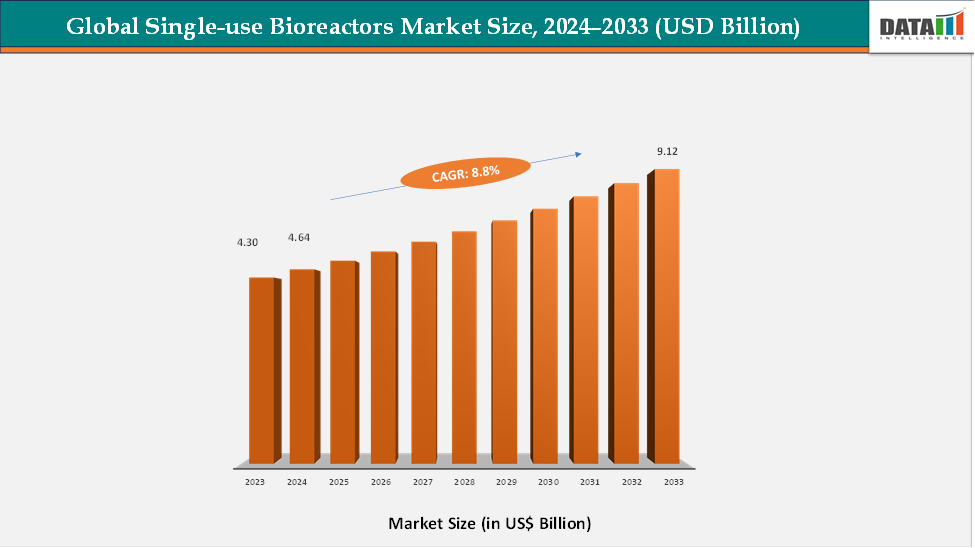
The global single-use bioreactors market reached US$ 4.30 billion in 2023, with a rise to US$ 4.64 billion in 2024, and is expected to reach US$ 9.12 billion by 2033, growing at a CAGR of 8.8% during the forecast period 2025–2033. The global single-use bioreactors market is witnessing consistent growth, driven by the rising demand forbiologics, vaccines, and advanced cell and gene therapies, along with the increasing number of contract manufacturing organizations (CDMOs) and biopharmaceutical R&D facilities. Greater emphasis on flexible, scalable, and contamination-free production processes is accelerating the adoption of single-use bioreactors across laboratories, pilot plants, and commercial-scale manufacturing facilities. Technological advancements, such as integrated sensors, automated control systems, and larger-volume disposable reactors, are enhancing process efficiency, reproducibility, and product safety.
The shift toward modular and flexible manufacturing, combined with the need to rapidly scale production for emerging therapies, has further elevated the preference for single-use bioreactor systems. Additionally, sustainability trends and the development of recyclable or low-waste disposable materials are creating new opportunities for innovation. With continuous product improvements, increasing biologics production, and expanding global biopharma infrastructure, the Single-use Bioreactors market is set to strengthen its position as a critical component of modern biomanufacturing.
Key Market highlights
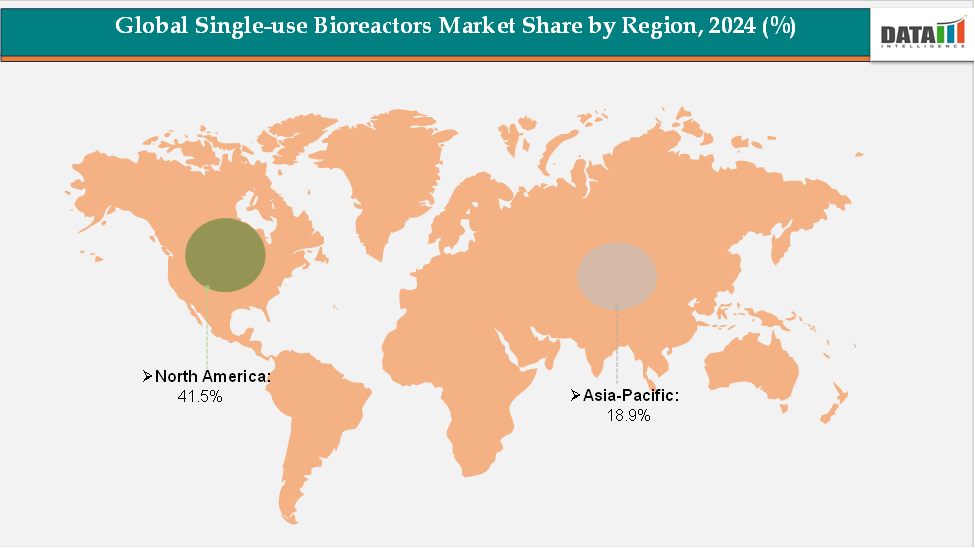
- North America accounted for approximately 41.5% of the global Single-use Bioreactors market in 2024 and continues to hold the leading position. The region’s dominance is driven by the strong presence of key biopharmaceutical companies, advanced manufacturing infrastructure, and high investment in biologics and vaccine production. In addition, the United States and Canada benefit from favorable regulatory frameworks, robust R&D activities, and a growing number of contract manufacturing organizations (CDMOs), all of which support widespread adoption of single-use bioreactor technologies. The increasing demand for flexible, contamination-free production processes for monoclonal antibodies, vaccines, and cell and gene therapies further strengthens market growth in North America.
- The Asia-Pacific region held around 18.9% of the global market in 2024 and is projected to be the fastest-growing region. Market expansion is fueled by rising healthcare expenditure, expanding biopharmaceutical infrastructure, and increased biologics manufacturing in countries such as China, India, Japan, and South Korea. The region is witnessing significant adoption of single-use technologies in both greenfield and existing facilities due to their cost-effectiveness, scalability, and reduced contamination risk. The rapid growth of contract manufacturing, biosimilars, and vaccine production is also contributing to the rising demand for single-use bioreactor systems in Asia-Pacific.
- By product, the single-use bioreactor system segment dominated the global single-use bioreactors market, accounting for a significant share of total revenue in 2024. This dominance is attributed to the integrated nature of single-use systems, which combine reactor vessels, control modules, sensors, and accessories into a ready-to-use platform. These systems offer enhanced process efficiency, scalability, and reproducibility, making them ideal for commercial-scale production of monoclonal antibodies, vaccines, and advanced cell therapies.
Market Size & Forecast
- 2024 Market Size: US$4.64 Billion
- 2033 Projected Market Size: US$9.12 Billion
- CAGR (2025–2033): 8.8%
- North America: Largest market in 2024
- Asia Pacific: Fastest-growing market
Source: DataM Intelligence
Global Single-use Bioreactors Market Dynamics: Drivers & Restraints
Driver: Growing Demand for Biologics
The growing demand for biologics is a major factor driving the expansion of the single-use bioreactors (SUB) market. As biopharmaceutical companies increasingly develop complex biologic therapies, they require production systems that are flexible, scalable, and safe. SUBs meet these needs because they reduce the risk of cross-contamination, enable rapid scale-up, and avoid the high capital and maintenance costs associated with traditional stainless-steel bioreactors.
For instance, as monoclonal antibody (mAb) therapeutics proliferate (driven by their broad use in oncology and immunology), CDMOs and biomanufacturers increasingly prefer single-use bioreactors optimized for mammalian cell cultures.
Moreover, SUBs like 5,000 L single-use bioreactors now bridge the gap between lab-scale and commercial-scale biologic production, giving companies flexibility to scale up or down based on fluctuating demand without major infrastructure changes. In addition, single-use bioreactors are being adopted more by CDMOs, which are scaling up biologics manufacturing to support both emerging biotech firms and large pharma.
This trend is underscored by rising partnerships: over 50% of single-use bioreactor deals reportedly involve stirred-tank configurations, reflecting the strong alignment with commercial biologics production. Overall, the surge in biologics is pushing companies to choose single-use bioreactors for their speed, flexibility, and cost effectiveness, thereby fueling strong growth in the SUB market..
Restraint: Extractables & Leachables Risk
The risk of extractables and leachables poses a significant challenge for the single‑use bioreactors market because materials used in disposables (like plastic films, tubing, and connectors) can release chemical compounds into the cell culture. These contaminants may affect product quality, safety, and regulatory compliance, particularly for sensitive biologics such as monoclonal antibodies or cell therapies. As a result, manufacturers may hesitate to scale up with single-use systems unless they can rigorously validate and control for leachables, increasing development costs and slowing adoption.
For more details on this report, Request for Sample
Global Single-use Bioreactors Market, Segmentation Analysis
The global single-use bioreactors market is segmented by product, type, molecule type, cell type, application, end-user and region.
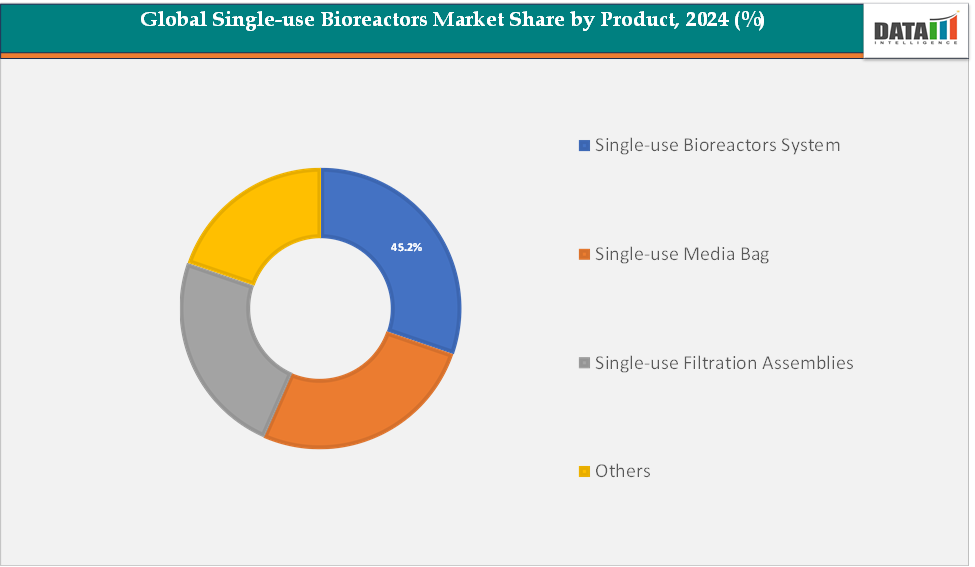
Product: The single-use bioreactors system segment is estimated to have 29.4% of the single-use bioreactors market share.
Source: DataM Intelligence
The single‑use bioreactor systems segment is expected to remain dominant in the market because these systems offer the most complete, scalable, and flexible solutions for biomanufacturing. Unlike standalone components such as media bags or filtration assemblies, whole single‑use systems integrate the reactor vessel, control modules, sensors, and other accessories into one ready-to-use platform. This helps biopharma companies reduce capital costs, minimize cross-contamination risk, and eliminate the need for time‑consuming cleaning and sterilization procedures.
For instance, many manufacturers favor these systems for commercial-scale production of monoclonal antibodies and vaccines, because they can scale up easily from lab to large volumes while maintaining process control and reproducibility. Additionally, the modular nature of these systems, combined with advances such as integrated sensors and automated control, makes them highly attractive for CDMOs and biotech firms that need to switch rapidly between products.
Market - Geographical Analysis
Source: DataM Intelligence
The North America single-use bioreactors market was valued at 41.5% market share in 2024
North America stands as the largest and most advanced market for single-use bioreactors, driven by its long-established biopharmaceutical ecosystem, extensive R&D spending, and the presence of major biologics manufacturers and CDMOs. The United States contributes the majority share due to its concentration of biotech hubs such as Boston–Cambridge, San Diego, the San Francisco Bay Area, and Research Triangle Park, where companies rely heavily on single-use systems to enhance production flexibility, reduce cross-contamination risks, and accelerate scale-up timelines.
Regulatory agencies like the FDA also encourage manufacturing practices that align well with disposable systems, making single-use technologies increasingly attractive for both clinical and commercial manufacturing. For instance, companies such as Thermo Fisher Scientific, Cytiva, and Sartorius have expanded their U.S. production capacity with large-scale SUB lines, while investments like Fujifilm Diosynth’s expansion in North Carolina illustrate how manufacturers are shifting toward modular, single-use–driven facilities to meet rising demand for monoclonal antibodies, vaccines, and gene therapy materials.
The European Single-use Bioreactors market was valued at 20.4% market share in 2024
Europe holds a significant and highly sophisticated share of the global single-use bioreactors market, supported by a strong network of biotech companies, biosimilar developers, and pharmaceutical giants that operate within stringent regulatory and quality frameworks. Countries such as Germany, the UK, Switzerland, and the Netherlands serve as major biotechnology clusters, where manufacturers increasingly adopt single-use bioreactors to improve operational flexibility, reduce cleaning and validation burdens, and enable faster changeovers in multiproduct facilities.
Europe is also distinctive for its strong emphasis on sustainability and environmental stewardship, which drives the development and adoption of recyclable or lower-waste single-use materials. This has led to a rise in hybrid manufacturing models, where companies combine stainless-steel reactors for large-scale operations with single-use bioreactors for clinical or mid-scale production. For instance, Boehringer Ingelheim’s facilities in Germany incorporate advanced disposable bioreactors alongside digital manufacturing tools, reflecting Europe’s commitment to technologically sophisticated but eco-conscious production environments. This puts Europe in a unique position, balancing innovation, regulatory rigor, and sustainability while maintaining strong adoption of single-use platforms across various biologics segments.
The Asia-Pacific single-use bioreactors market was valued at 18.9% market share in 2024
The Asia-Pacific region is the fastest-growing and most rapidly transforming market for single-use bioreactors, propelled by massive expansions in biopharmaceutical manufacturing across China, India, South Korea, Singapore, and Japan. Unlike North America and Europe APAC is building a large number of greenfield biomanufacturing plants, which makes it easier to integrate single-use systems from the beginning. This reduces capital expenditure, shortens construction time, and gives manufacturers greater flexibility to produce diverse biologics including biosimilars, vaccines, and novel cell therapies.
China and India in particular are driving large-scale adoption, as local CDMOs increasingly rely on disposable bioreactors to meet global outsourcing demand while avoiding the high costs and maintenance requirements of stainless-steel infrastructure. At the same time, South Korea and Japan are using single-use technologies to support advanced biologics pipelines such as cell therapy, CAR-T production, and regenerative medicine. For instance, many Chinese and Indian facilities now operate large-volume single-use reactors for rapid biosimilar manufacturing, while Japanese companies leverage SUBs to maintain strict sterility and agility in cell-based products. With strong government support, increasing R&D investment, and rapid infrastructure growth, APAC is evolving into a major global hub for flexible, cost-efficient biomanufacturing through widespread single-use adoption.
Competitive Landscape
The major players in the single-use bioreactors market include ABEC, Thermo Fisher Scientific, Inc., Sartorius AG, Celltainer, Distek, Inc., Merck KGaA, PBS Biotech, Inc., Cytiva, Eppendorf SE, Getinge AB, among others.
Market Scope
| Metrics | Details | |
| CAGR | 8.8% | |
| Market Size Available for Years | 2022-2033 | |
| Estimation Forecast Period | 2025-2033 | |
| Revenue Units | Value (US$Bn) | |
| Segments Covered | Product | Single-use Bioreactors System, Single-use Media Bag, Single-use Filtration Assemblies, Others |
| Type | Bubble Column Single-use Bioreactors, Stirred Tank Single-use Bioreactors, Wave Induced Single-use Bioreactors | |
| Molecule Type | Monoclonal Antibodies (MABs), Vaccines, Stem Cells, Gene–Modified Cells, Other Molecules | |
| Cell Type | Mammalian Cells, Bacteria Cells, Yeast Cells, Other Cells | |
| Application | Research and Development, Process Development, Bio production | |
| End-User | Hospital, Specialty Clinic, Emergency Centre, Ambulatory Surgical Centers, Other | |
| Regions Covered | North America, Europe, Asia-Pacific, South America, and the Middle East & Africa | |
The global single-use bioreactors market report delivers a detailed analysis with 70 key tables, more than 66 visually impactful figures, and 195 pages of expert insights, providing a complete view of the market landscape.
Suggestions for Related Report
- Global Viral Vector and Plasmid DNA Testing Services Market
- Viral Vector and Plasmid DNA Manufacturing Market
For more biotechnology-related reports, please click here





























































