


Polyurethane Market Size
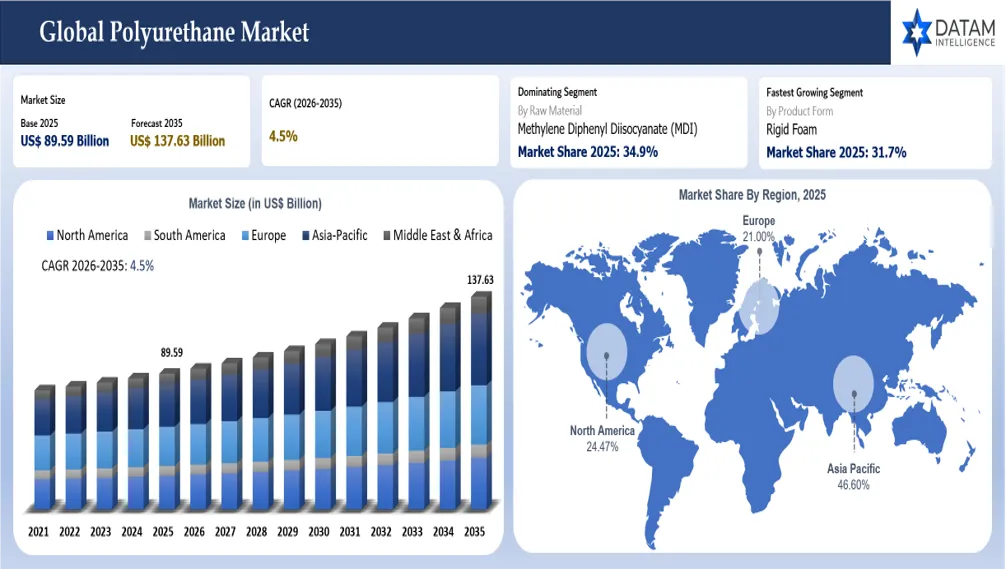
The global Polyurethane market reached US$ 89.59 billion in 2025 and is expected to reach US$ 137.63 billion by 2035, growing with a CAGR of 4.5% during the forecast period 2026-2035.
Polyurethane is a versatile polymer that finds widespread applications in various end-use industries such as construction, automotive, furniture, electronics and footwear. The market's growth is driven by the increasing demand for lightweight and durable materials, energy efficiency and superior performance characteristics. Polyurethane products, including foams, coatings, adhesives and elastomers, offer a wide range of properties, such as insulation, flexibility and resilience, making them integral components in numerous consumer and industrial products.
Asia-Pacific experienced significant industrial expansion, particularly in construction, automotive and electronics sectors, fostering collaborations that drive the growth of the polyurethane market. A noteworthy example is TMT, a leading polyurethane manufacturer, which, on December 2, 2022, successfully launched polyurethane wind turbines in partnership with Covestro. The milestone aligns with China's ambitious five-year plan aiming to double its wind and solar power output by 2025. The use of polyurethane in wind turbine blades presents an innovative and cost-effective alternative to traditional epoxy, showcasing its pivotal role in advancing sustainable solutions within the renewable energy sector.
Polyurethane Market Key Takeaways
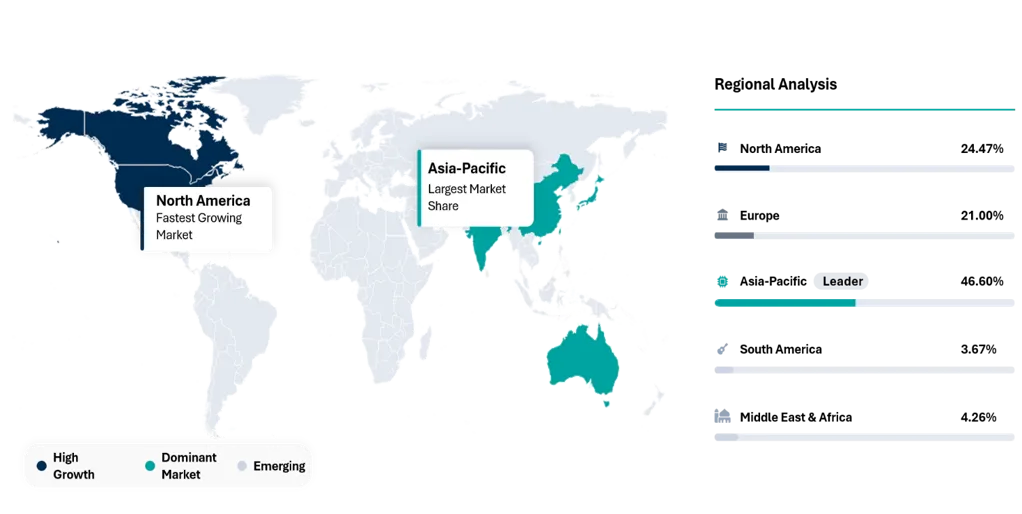
- Asia-Pacific dominates the global polyurethane market, accounting for approximately 46.60%, driven by rapid industrialization, expanding construction activities and strong automotive manufacturing demand.
- Rigid foam represents over 31% of the product segment, supported by increasing demand for thermal insulation in residential and commercial construction.
- Construction contributes more than 26% of total market demand, owing to widespread use of polyurethane in insulation, sealants, coatings and structural applications.
- Methylene Diphenyl Diisocyanate (MDI) accounts for nearly 35% of raw material consumption, making it the leading feedstock for polyurethane production.
- Sustainable and bio-based polyurethane materials are gaining momentum, as manufacturers focus on reducing carbon emissions, improving recyclability and supporting circular economy initiatives.
Polyurethane Market Scope
| Metrics | Details | |
| 2025 Market Size | US$ 89.59 Billion | |
| 2035 Projected Market Size | US$ 137.63 Billion | |
| CAGR (2026-2035) | 4.5% | |
| Largest Market | Asia-Pacific | |
| Fastest Growing Market | Asia-Pacific | |
| By Raw Material | Toluene Diisocyanate, Polyols, Methylene Diphenyl Diisocyanate and Others | |
| By Product Form | Adhesives & Sealants, Coatings, Elastomers and Foam | |
| By End-User | Automotive & Transportation, Appliances & White Goods, Bedding & Furniture, Building & Construction, Footwear, Packaging and Others | |
| By Region | North America | U.S., Canada, Mexico |
| Europe | Germany, UK, Russia, France, Spain, Italy, Poland | |
| Asia-Pacific | China, India, Japan, Australia, South Korea, Indonesia, Malaysia, Singapore, Vietnam, Thailand, Philippines, Taiwan | |
| South America | Brazil, Argentina | |
| Middle East and Africa | UAE, Saudi Arabia, South Africa, Israel, Turkiye, Nigeria | |
| Report Insights Covered | Competitive Landscape Analysis, Company Profile Analysis, Market Size, Share, Growth | |
Polyurethane Market White Space & Investment Opportunities
- Bio-based and low-carbon polyurethane: There are plenty of opportunities for investment in bio-based polyols, recycled material feedstock and low-carbon polyurethanes as companies develop sustainable materials.
- Recyclable polyurethane technologies: Chemical recycling, reprocessing and closed-loop systems for polyurethane foams can be a solution for end-of-life issues and provide opportunities in the circular economy.
- Energy-efficient insulation: Building efficiency standards lead to white space opportunities in rigid and spray polyurethane foams that are used as insulations in residential, commercial and industrial applications.
- Lightweight automotive applications: Investments in high performance polyurethane foams, elastomers, coatings and adhesives are useful in lightweighting automotive interiors and seat systems.
- High-performance specialty polyurethane: High-performance coatings, adhesives, sealants and elastomers that are used in electronics, renewable energy, medical, footwear and industrial applications can be explored.
Polyurethane Market Buyer Decision-Making Criteria
Polyurethane buyers assess their suppliers on the basis of performance of the product, pricing, material quality, technical assistance, compliance with regulations and environmental sustainability, among others. Although the selection process is dependent on the particular application of the products, most polyurethane manufacturers tend to emphasize product performance, reliability of supply, application suitability and compliance with regulations.
Major Buyer Decision-Making Criteria:
- Product Performance and Quality
- Price and Total Cost of Ownership
- Raw Material Consistency and Availability
- Technical Support and Customization
- Regulatory Compliance and Product Safety
- Supply Reliability and Production Capacity
- Sustainability and Recyclability
- Supplier Reputation and After-Sales Support
Polyurethane Market BCG Matrix: Company Evaluation
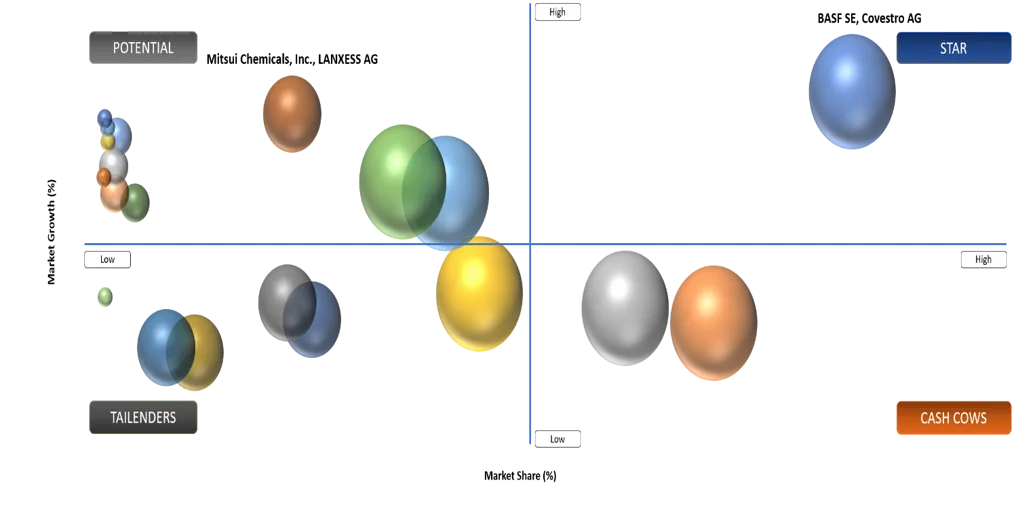
STAR
The five companies, namely BASF SE, Covestro AG, Huntsman Corporation, Wanhua Chemical Group Co., Ltd. and Dow Inc., could be considered stars due to their strong product portfolio in polyurethanes, international business, integrated production and involvement in high-growth applications, including insulation, automotive, coating, adhesive and elastomer products.
POTENTIAL
Potential quadrants would be occupied by Mitsui Chemicals, Inc., LANXESS AG, The Lubrizol Corporation, Woodbridge Foam Corporation and Manali Petrochemicals Ltd. due to the potential for their growth through specializing in polyurethanes as well as other aspects that would enable growth.
Polyurethane Market Dynamics
Driver Impact Analysis
| Driver | Market Growth Impact (%) | Demand Concentration | Impacted Use Case | Strategic Impact |
Rising demand for energy-efficient building insulation | 24% | Building & Construction | Rigid foam, spray foam, insulation panels | Drives adoption of high-performance polyurethane insulation |
Growing automotive demand for lightweight materials | 21% | Automotive & Transportation | Seating, interiors, acoustic insulation, structural components | Supports vehicle lightweighting, fuel efficiency and comfort |
Expansion of furniture and bedding industries | 18% | Bedding & Furniture | Flexible foam, mattresses, cushions, upholstered furniture | Sustains high-volume polyurethane foam consumption |
Increasing demand for sustainable and bio-based polyurethane solutions | 15% | Construction, Automotive, Furniture | Bio-based foams, coatings, adhesives & sealants | Accelerates product innovation and lower-carbon polyurethane adoption |
Driver: Rising Demand for Energy-Efficient Building Insulation
The increasing focus on energy efficiency and thermal performance of buildings across residential, commercial and industrial sectors is an important factor driving growth in the polyurethane market. Both rigid and spray polyurethane foam offer efficient thermal insulation due to minimal thickness of material and thus are used in walls, roofs, floors, refrigeration and insulated panels. The increase in construction activities and the need for building efficiency are driving demand for polyurethane-based insulations.
Restraint Impact Analysis
| Restraint | Drag on Market Growth (%) | Primary Impact Area | Impacted Use Case | Strategic Impact |
| Volatility in raw material prices | 22% | Production costs | Foams, coatings, adhesives & sealants | Pressures margins and increases polyurethane product costs |
Environmental and regulatory concerns over isocyanates and chemicals | 19% | Compliance & manufacturing | Foams, coatings, elastomers | Increases compliance costs and encourages safer formulations |
Recycling challenges for polyurethane products | 16% | End-of-life management | Flexible and rigid foams | Limits circularity and increases demand for recycling technologies |
Availability of alternative insulation and polymer materials | 13% | Material substitution | Construction insulation, automotive components | Intensifies competition and encourages performance-driven product innovation |
Restraint: Volatility in Raw Material Prices
Price instability in the prices of important raw materials required for producing polyurethane is one of the major restraints in the growth of the market. Instability in the prices of crude oil and petrochemical raw materials along with supply and demand mismatch, production interruptions and geopolitical tensions may lead to higher costs of production and put pressure on margins for the producers of polyurethane. This may lead to higher prices for the end-user products like foams, coatings, adhesives, sealants and elastomers.
Polyurethane Market Geographical Penetration
U.S. Polyurethane Market Landscape
The US polyurethane market will be driven by increasing demand for building and construction, automotive and transportation, furniture and bedding, appliances and industrial applications. Increasing investment in energy-efficient construction will increase the demand for polyurethane insulation, whereas automotive companies will use polyurethane foam, coatings, adhesives, sealants and elastomers for lightweighting, comfort and durability. There will also be an increasing focus on sustainable material solutions, low-emission products, recycling and regulatory compliance.
Japan Polyurethane Market Outlook
The polyurethane market in Japan is driven by demands from the automotive & transportation, building & construction, appliance, furniture and bedding, footwear and industrial segments. The sophisticated automotive and manufacturing industry in Japan ensures the demand for polyurethane foams, coatings, adhesives, sealants and elastomers. Moreover, the demand for energy-efficient buildings promotes demand for insulation products. Additionally, the efforts of Japan to conserve materials and resources and promote recycling technologies have promoted the development of sustainable polyurethanes in the country.
Polyurethane Market Competitive Landscape
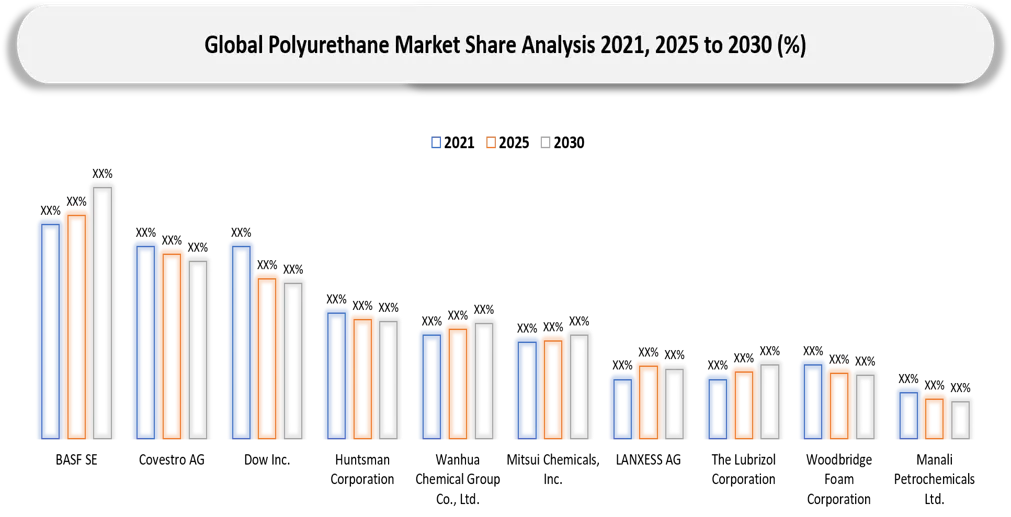
- The companies BASF SE, Covestro AG, Dow Inc., Huntsman Corporation and Wanhua Chemical Group Co., Ltd. have solid competitive advantages because of their wide polyurethane portfolio, global production footprint and capability in producing raw materials.
- Innovations in the product line is another competitive tool employed by companies which produce advanced foams, coatings, adhesives, sealants and elastomers for automotive, construction, furniture and industrial segments.
- Environmental sustainability becomes an increasing driver of competition, motivating companies to explore bio-based feedstocks, recycling solutions, more environmentally friendly formulations of polyurethane and end-of-life solutions.
- Capacity expansion and investments in manufacturing in certain regions are still essential methods that can be employed to cater to increasing demand and enhance supply chain reliability.
- Collaborations, mergers and acquisitions, as well as innovations in technology, have been used to diversify product offerings and build up expertise to cater to increasing demand for sustainable polyurethane solutions.
Key Companies of Polyurethane Market
- BASF SE
- Covestro AG
- Dow Inc.
- Huntsman Corporation
- Wanhua Chemical Group Co., Ltd.
- Mitsui Chemicals, Inc.
- LANXESS AG
- The Lubrizol Corporation
- Woodbridge Foam Corporation
- Manali Petrochemicals Ltd.
Polyurethane Market Recent Developments
- BASF SE - September 2026: BASF has launched Lupragen BisDMAPU, which is a low-volatile and low-odor polyurethane catalyst for flexible polyurethane foams that find use in furniture, mattresses and automobiles.
- Covestro AG - July 2026: Covestro concluded the acquisition of former Vencorex production facilities in Thailand and U.S., expanding their product range and production capacity for HDI derivatives in coatings, adhesives and sealants.
- Wanhua Chemical Group Co. Ltd. - July 2026: Wanhua declared strong profits for H1 2026 driven by better operating conditions, especially MDI & polyurethane chemicals business units.
- Huntsman Corp. - June 2026: Huntsman declared an all-stock merger of equals with Olin Corp. which is a significant strategic move on their part involving polyurethane chemicals business segments.
- Covestro AG - June 2026: Covestro made an announcement regarding their plans for constructing a new world-scale MDI production unit in Shanghai, China and simultaneously started a feasibility study for another MDI production unit in UAE for securing future raw material supply for polyurethane production.
What DATAM Uniquely Provides
- Detailed Market Segmentation: The market is segmented micro-level based on the type of material, form of products, applications and region-wise, helping in understanding the key areas that offer opportunities in the polyurethane market.
- Quantitative Market Intelligence: It helps in analyzing the size of the market, year-on-year growth rate, compound annual growth rate, segment share and regional contribution.
- Competitive Benchmarking: It involves benchmarking the top companies based on their product offerings, strategies, market positioning and growth strategies.
- Investment & White-Space Analysis: Spotlights upcoming prospects in sustainable polyurethanes, recyclables, energy-saving insulations, weight-reduced automotive uses and high-performance specialty items.
- Strategic Decision Support: Integrates an analysis of the impacts of drivers and restraints, buyer considerations, organization analysis and regional trends to aid stakeholders in exploring opportunities for market penetration, growth, product development and investment.





























































