


Pharmaceutical Visual Inspection Systems Market Overview
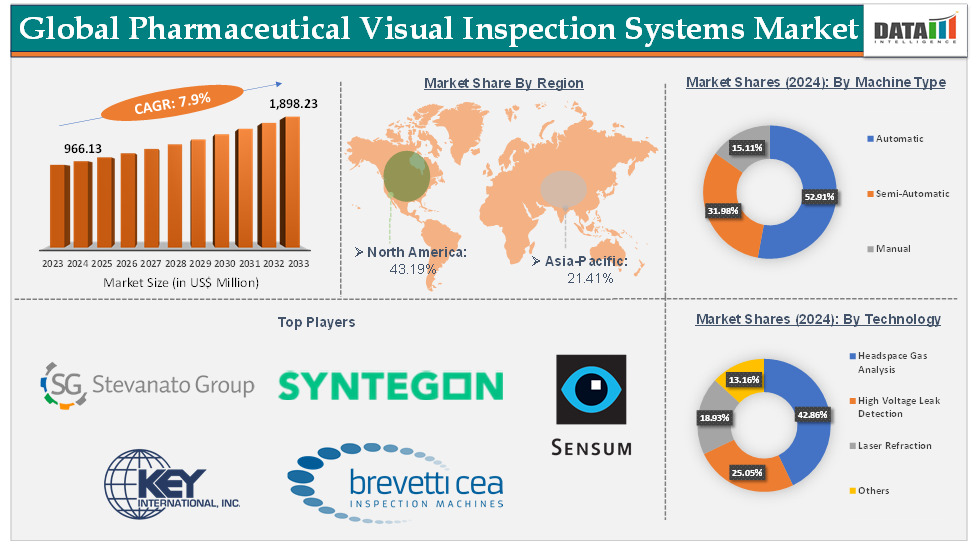
Pharmaceutical Visual Inspection Systems Market size reached US$ 1,042.46 Million in 2025 and is expected to reach US$ 1,915.28 Million by 2033, growing at a CAGR of 7.9% during the forecast period 2026-2033.
Pharmaceutical Visual Inspection Systems Market Trends
The pharmaceutical visual inspection systems market is poised for continued growth, with advancements in AI and machine learning leading to more sophisticated and efficient inspection solutions. As the pharmaceutical industry evolves, the demand for reliable, automated inspection systems will remain critical to ensuring product quality and compliance.
Integration of AI and machine learning enhances defect detection accuracy and efficiency. For instance, Syntegon Technology's AI-powered systems offer real-time defect detection, improving product quality. Market players are enhancing their offerings with AI capabilities, expanded service portfolios, and global support networks to differentiate their solutions.
Pharmaceutical Visual Inspection Systems Market Key Takeaways
- Asia-Pacific is witnessing strong adoption, supported by pharmaceutical manufacturing growth, regulatory compliance, and investments in automated inspection technologies.
- North America remains a major market, driven by stringent quality standards, increasing automation across pharmaceutical facilities, and the need for reliable defect detection.
- Europe continues to prioritize advanced visual inspection systems as pharmaceutical manufacturers strengthen quality control, serialization, and regulatory compliance.
- AI and machine vision are improving inspection accuracy by enabling automated detection of particles, container defects, fill-level variations, labeling errors, and other quality issues.
- Integration with automated production lines is increasing as pharmaceutical manufacturers seek faster inspection, reduced manual intervention, and consistent quality assurance.
- Regulatory requirements from agencies such as the FDA and EMA are encouraging manufacturers to adopt validated inspection systems capable of maintaining high-quality standards.
- Advanced cameras, sensors, and software are supporting high-speed inspection of vials, ampoules, syringes, cartridges, and other pharmaceutical packaging formats.
- The shift toward flexible and modular inspection platforms is gaining traction as manufacturers handle diverse product formats and increasingly complex production requirements.
Pharmaceutical Visual Inspection Systems Market Executive Summary
For more details on this report – Request for Sample
Pharmaceutical Visual Inspection Systems Market Dynamics: Drivers & Restraints
Rising demand for advanced machines is significantly driving the pharmaceutical visual inspection systems market growth
Modern drugs like biologics, biosimilars, and cell/gene therapies often come in complex delivery formats (e.g., prefilled syringes, autoinjectors, lyophilized vials). These require high-resolution imaging and 3D vision systems to inspect subtle defects such as air bubbles in transparent solutions, protein aggregation in biologics, and improper stopper placement in vials. Advanced PVIS machines with AI-enhanced cameras and 360° inspection are essential to handle these formats reliably.
As drugs become more sensitive, production speeds increase, and compliance demands tighten, advanced visual inspection machines are no longer optional; they're a strategic necessity. This rising demand directly fuels the growth of the pharmaceutical visual inspection systems market. Large pharmaceutical companies run high-throughput production lines (e.g., 300+ vials per minute). Manual inspection is not feasible at this speed. Automated visual inspection machines with real-time defect detection, AI, and machine learning (ML)-based classification are being adopted to maintain speed without compromising quality.
Challenges with transparent and visually subtle defects are hampering the pharmaceutical visual inspection systems market
Detecting transparent and visually subtle defects, such as micro-cracks in glass vials, hairline delamination, tiny air bubbles, or protein aggregates in clear solutions, is exceptionally difficult for standard vision systems. These imperfections often fall below the pixel-resolution or contrast thresholds of 2D cameras, leading to both false negatives (missed defects) and false positives (innocuous variations flagged as faults). This may hamper the market growth.
A leading vaccine manufacturer experienced a series of undetected hairline cracks in its single-dose vials. Standard 2D inspection failed to catch these sub-millimeter fractures, resulting in a costly recall and eroding confidence in automated systems. Biotech firms producing monoclonal antibodies reported that traditional bright-field imaging missed translucent protein clumps suspended in clear buffers. Reliance on human inspection for these critical lots slowed throughput, discouraging full automation.
Pharmaceutical Visual Inspection Systems Market Segment Analysis
The global pharmaceutical visual inspection systems market is segmented based on machine type, technology, application, end-user, and region.
The headspace gas analysis from the technology segment is expected to hold 42.86% of the market share
The headspace gas analysis segment has emerged as the dominant slice of the pharmaceutical visual inspection systems market because it directly addresses the most critical quality attributes of parenteral and lyophilized products, container‐closure integrity, and residual oxygen/moisture levels. Modern filling lines running >200 vials/min integrate headspace sensors inline, enabling 100% inspection without slowing throughput. The ability to “sample” and reject off-spec units in real time drives its dominance. Thus, the market players are developing various systems with headspace gas analysis technology, which is driving the segment growth.
For instance, in April 2025, Antares Vision Group offers live demonstrations of a high-speed system providing 100% inspection and leak detection for liquid-filled glass containers at Interphex. Antares Vision Group’s automatic Visual Rotating Inspection (VRI) system is capable of inspecting up to 400 liquid-filled glass containers per minute. The machine combines sophisticated particle and cosmetic detection that can integrate with high voltage, vacuum, and headspace gas analysis (HSGA) technology-driven closure integrity verification at an exceptionally rapid production pace.
Pharmaceutical Visual Inspection Systems Market, Geographical Share
North America is expected to dominate the global pharmaceutical visual inspection systems market with a 43.19%
Owing to factors such as the strong presence of major players and the increasing technological advancements in the region is expected to boost the market in North America. North America, especially the United States, is known for its strong presence of major players that actively focus on visual inspection machines, especially for tablets/capsules and softgels. The strong presence of major players in the region helps to develop products with technological advancements to improve the visual quality with 100% visual inspection, introducing AI technologies, and many others.
For instance, Key International Inc., the company’s Next Generation Enclony PLANET 6G machine is a world-class inspection machine that takes up to 12 pictures of every tablet or capsule that passes through the machine. The 6G compares each tablet or capsule against a “golden image” to assure 100% visual inspection, keeping the good product and rejecting any defective product.
With its combined state-of-the-art features, the Enclony PLANET 6G is capable of inspecting any shape, size, or color tablet or capsule. It also boasts 350,000 tablets per hour or 150,000 capsules per hour output to streamline efficiency. This cutting-edge machine is designed with a cGMP design in mind, so can rest assured it complies with necessary regulations.
Asia-Pacific is growing at the fastest pace in the pharmaceutical visual inspection systems market, holding 21.41% of the market share
The Asia-Pacific region, especially Japan, India, and China, is the fastest-growing in the pharmaceutical visual inspection systems market due to rapid industrialization of pharma manufacturing, growing regulatory tightening, and increasing investments in automation. Countries like India and China are major global suppliers of generic drugs and vaccines, with thousands of manufacturing plants scaling up for both domestic and export demand. For instance, India’s largest injectable manufacturers (e.g., Sun Pharma, Aurobindo) are automating quality control across multiple lines with inline visual inspection systems to meet U.S. FDA and EU GMP requirements for exports.
Pharmaceutical Visual Inspection Systems Market Top Companies
Top companies in the pharmaceutical visual inspection systems market include DAIICHI JITSUGYO VISWILL CO., LTD., Stevanato Group, Syntegon Technology, Sensum d.o.o., Yenchen Machinery Co., Ltd., United Pharmatek USA, Key International, Inc., Meliscout GmbH, Brevetti Cea spa, and SaintyCo, among others.
Pharmaceutical Visual Inspection Systems Market Scope
Metrics | Details | |
CAGR | 7.9% | |
Market Size Available for Years | 2023-2033 | |
Estimation Forecast Period | 2026-2033 | |
Revenue Units | Value (US$ Mn) | |
Segments Covered | Machine Type | Automatic, Semi-Automatic, and Manual |
Technology | Headspace Gas Analysis, High Voltage Leak Detection, Laser Refraction, and Others | |
Application | Tablets, Capsules, Softgels, Syringes, Ampoules, Vials, and Others | |
End-User | Pharmaceutical Companies, Medical Device Companies, Biopharmaceutical Companies, and Others | |
Regions Covered | North America, Europe, Asia-Pacific, South America, and the Middle East & Africa | |
Pharmaceutical Visual Inspection Systems Marke Recent Developments-
- December 2025: Syntegon Technology GmbH expanded its automated visual inspection portfolio by integrating AI-based defect detection capabilities into its inspection systems, enhancing accuracy in identifying particulate contamination and cosmetic defects in parenteral drugs, as highlighted in its official product updates.
- October 2025: Körber AG strengthened its pharmaceutical inspection solutions through advancements in its Werum PAS-X platform, enabling seamless integration of visual inspection data with manufacturing execution systems (MES) to improve compliance and batch traceability.
- August 2025: Antares Vision Group introduced upgraded high-speed visual inspection machines for injectable products, capable of handling complex containers such as prefilled syringes and vials, with improved machine learning algorithms for defect classification, as per updates shared on its corporate platform.
The global pharmaceutical visual inspection systems market report delivers a detailed analysis with 69 key tables, more than 73 visually impactful figures, and 157 pages of expert insights, providing a complete view of the market landscape.



























































