


Orthopedic Surgical Robots Market Overview
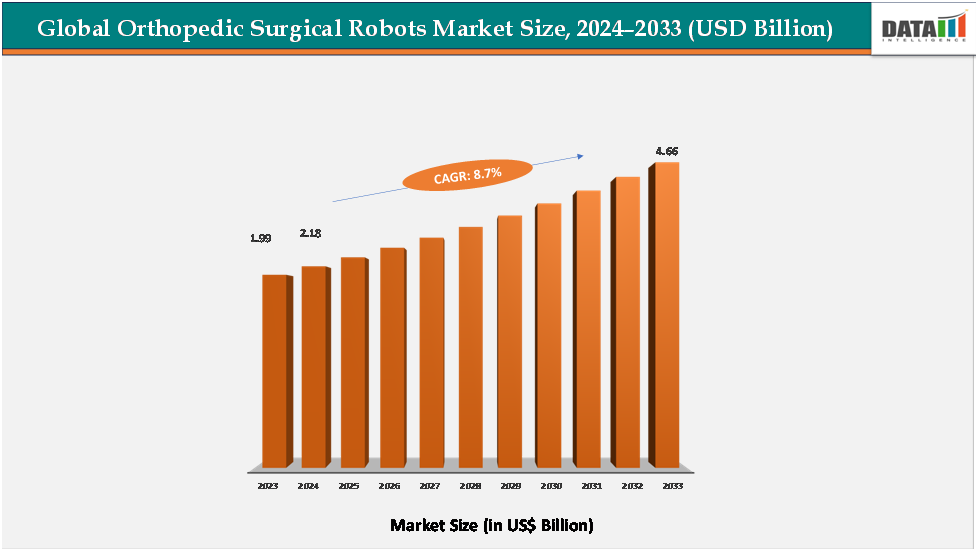
The global orthopedic surgical robots market reached US$ US$ 1.99billion in 2023, with a rise to US$ 2.18billion in 2024, and is expected to reach US$ 4.66billion by 2033, growing at a CAGR of 8.7%during the forecast period 2025–2033.
The global orthopedic surgical robots market is witnessing robust expansion, driven by the rising volume of joint replacement surgeries, the growing prevalence of musculoskeletal disorders, and the increasing demand for precision-driven surgical interventions. As populations age and the incidence of osteoarthritis and bone degenerative diseases continues to climb, the need for accurate and minimally invasive orthopedic procedures has become more pronounced.
Robotic-assisted systems are transforming traditional orthopedic surgeries by enhancing surgical precision, reducing intraoperative errors, and improving patient recovery times. The integration of AI-based preoperative planning, advanced imaging, and haptic feedback technologies is further optimizing surgical workflows and implant alignment. Increasing hospital investments in automation and the shift toward value-based healthcare are accelerating the adoption of these systems across orthopedic centers and high-volume surgical facilities. Major players such as Stryker, Zimmer Biomet, Smith+Nephew, and Johnson & Johnson MedTech are leading innovation through next-generation platforms offering real-time analytics and multi-joint application capabilities.
Key Market highlights
- North America accounted for approximately 42.3% of the global Orthopedic Surgical Robots market in 2024 and is expected to maintain its leading position throughout the forecast period. The region’s dominance is attributed to the strong presence of established medical device companies, advanced healthcare infrastructure, and a high rate of adoption of technologically advanced surgical systems.
- The Asia-Pacific region held around 18.9% of the global market in 2024 and is projected to be the fastest-growing region over the forecast period. The rapid expansion is driven by rising healthcare expenditure, growing awareness of advanced orthopedic procedures, and increasing investments in hospital infrastructure.
- By product type, the Instruments & Accessories segment dominated the global Orthopedic Surgical Robots market, accounting for approximately 59% of total revenue in 2024. This dominance is driven by the recurring use of instruments and accessories in every robotic-assisted orthopedic procedure, generating consistent revenue for manufacturers.
Orthopedic medical robots market Size & Forecast
- 2024 Market Size: US$2.18Billion
- 2033 Projected Market Size: US$4.66Billion
- CAGR (2025–2033): 8.7%
- North America: Largest market in 2024
- Asia Pacific: Fastest-growing market
source : datam intelligence Email : [email protected] Source: DataM Intelligence
Orthopedic Surgical Robots Market Dynamics:
Source : DataM Intelligence
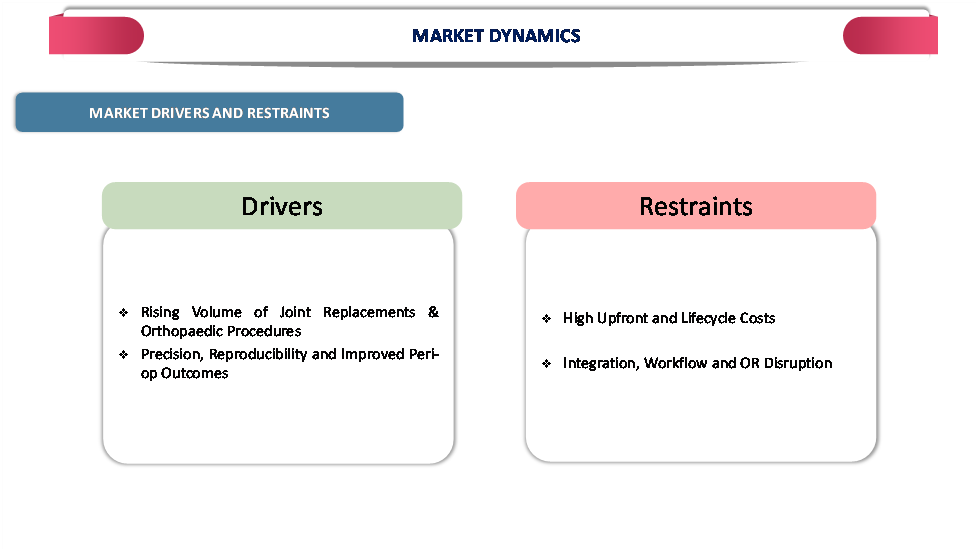
Global Orthopedic Surgical Robots Market Dynamics: Drivers & Restraints
Driver:
Rising Volume of Joint Replacements & Orthopedic Procedures
The growing number of joint replacement and orthopedic procedures worldwide is a major factor propelling the growth of the orthopedic surgical robots market. As populations age and the prevalence of musculoskeletal disorders such as osteoarthritis continues to rise, the demand for total knee and hip replacements has increased sharply. In the United States alone, approximately 790,000 total knee replacements and 544,000 hip replacements are performed each year, with projections indicating continued growth due to longer life expectancy and higher activity levels among older adults. This surge in surgical volume places greater emphasis on precision, consistency, and postoperative outcomes.
Robotic platforms enhance the accuracy of bone preparation, optimize implant alignment, and reduce variability in surgical performance, which is particularly important when procedure volumes are high. As hospitals and surgical centers face increasing caseloads, robotics help streamline workflows, shorten recovery times, and improve implant longevity. Moreover, with joint replacements recognized as one of the most reliable and durable treatments, often lasting 20 years or more, surgeons are seeking technologies that can sustain such longevity through precision execution. Major manufacturers such as Stryker, Zimmer Biomet, and Smith+Nephew are responding to this rising procedural demand by expanding robotic capabilities for knee, hip, and spine surgeries. For instance, Stryker’s Mako Smart Robotics platform has seen widespread adoption across hospitals to meet growing arthroplasty volumes, while Zimmer Biomet’s ROSA® Robotics and Smith+Nephew’s CORI™ System are being deployed in both primary and revision procedures. Consequently, the rising global volume of orthopedic surgeries directly amplifies the need for surgical robots, driving continuous system installations and procedure-linked accessory sales across major healthcare markets.
Restraint:
High Cost of Advanced Digital Otoscopes
The high cost of foot and ankle implants and surgical procedures is expected to hinder market growth, particularly in developing regions. Advanced implants made from premium materials like titanium and bioresorbable polymers, along with the use of navigation-assisted or robotic surgical systems, significantly increase treatment expenses. Additionally, post-operative rehabilitation and follow-up care further add to patient costs, making these procedures less accessible to those without comprehensive insurance coverage. This cost barrier limits adoption rates and restrains the overall expansion of the Orthopedic Surgical Robots market.
For more details on this report, Request for Sample
Orthopedic Surgical Robots Market Segmentation Analysis
The global orthopedic surgical robots market is segmented by product type, application, end user and region.
Product Type:
The instruments & accessories segment is estimated to have 59% of the orthopedic surgical robots market share.
The instruments & accessories segment currently dominates the orthopedic surgical robots market, accounting for the largest share of total revenue. This dominance is primarily due to the recurring nature of these products, which are required for every surgical procedure. Each robotic-assisted joint replacement or spine surgery involves the use of specialized instruments, disposable components, and calibration tools that ensure surgical precision and sterility. As procedure volumes continue to increase globally, the demand for these accessories has grown proportionally. Hospitals and surgical centers consistently procure new sets for every operation, creating a continuous revenue stream for manufacturers.
Furthermore, as robotic systems expand into additional orthopedic applications such as partial knee, hip resurfacing, and spine procedures, the number of compatible instrument kits has multiplied. Companies like Stryker, Zimmer Biomet, and Smith+Nephew have introduced procedure-specific consumables designed for their respective robotic platforms (such as Mako SmartRobotics, ROSA Knee, and CORI Surgical System). These expansions not only reinforce the dependence on instruments and accessories but also strengthen customer retention through recurring purchases. Hence, the instruments & accessories segment remains the core revenue generator of the market, underpinning steady growth through consumable demand and rising surgical volumes.
The systems segment is estimated to have 41% of the orthopedic surgical robots market share.
The systems segment, comprising robotic platforms, consoles, and navigation hardware, is emerging as the fastest-growing segment of the orthopedic surgical robots market. This growth is fueled by the increasing adoption of robotic technology across hospitals and orthopedic centers that aim to enhance precision, reduce revision rates, and improve patient outcomes. With the steady rise in total joint replacement surgeries and minimally invasive orthopedic procedures, healthcare providers are investing heavily in advanced robotic platforms to improve surgical efficiency and accuracy.
Recent technological advancements are accelerating system installations. Leading players are expanding their product portfolios and partnering with hospitals to scale adoption. For instance, Zimmer Biomet’s collaboration with THINK Surgical to distribute the TMINI Handheld Robotic System and Stryker’s continuous upgrade of the Mako Smart Robotics platform exemplify the ongoing surge in system deployments. Although the initial capital investment for robotic systems is high, the long-term benefits are encouraging more institutions to adopt these systems. Consequently, the systems segment is expected to record the highest growth rate in the coming years as hospitals increasingly integrate robotics into routine orthopedic practices.
Why Orthopedic Medical Robots Market Matters in 2025-2033
The global orthopedic healthcare industry is entering a new era of precision-driven surgery.
Orthopedic medical robots are transforming joint replacement and spine procedures by improving surgical accuracy, enhancing implant positioning, reducing procedural variability, and supporting faster patient recovery. As healthcare systems prioritize value-based care, robotic-assisted orthopedic surgery is becoming an essential investment for hospitals and specialty centers.
Several macroeconomic and technological factors are driving market growth:
- Rising global incidence of osteoarthritis and musculoskeletal disorders
- Increasing demand for minimally invasive orthopedic procedures
- Growing aging population requiring joint replacement surgeries
- Higher adoption of robotic-assisted knee, hip, and spine surgeries
- Continuous advancements in AI-powered surgical planning and navigation
- Improved 3D imaging, real-time intraoperative guidance, and digital workflows
- Rising investments by hospitals in advanced surgical technologies
- Expanding surgeon training and clinical acceptance of robotic platforms
- Increasing focus on improving surgical outcomes and reducing revision procedures
- Favorable reimbursement trends and healthcare infrastructure modernization in developed markets
Orthopedic Surgical Robots Market Geographical Analysis
The North America orthopedic surgical robots market was valued at 42.3% market share in 2024
North America holds the dominant share in the orthopedic surgical robots market, driven by its high procedure volumes, early technological adoption, and strong presence of leading manufacturers. The U.S. performs more than 1.3 million knee and over 790,000 hip replacements annually, creating a large base for robotic-assisted procedures. Hospitals across the U.S. and Canada are increasingly integrating robotic platforms to enhance precision and surgical consistency in total joint arthroplasty. The region also benefits from favorable reimbursement frameworks, advanced healthcare infrastructure, and continuous innovation from key companies such as Stryker, Zimmer Biomet, and Smith+Nephew, all of which are headquartered or have major operations in North America. For instance,
Widespread deployment of systems like Mako Smart Robotics and ROSA Robotics in orthopedic centers across the U.S. has reinforced the region’s leadership. Furthermore, strong surgeon awareness, training programs, and clinical evidence supporting robotic outcomes continue to sustain high adoption rates, making North America the largest contributor to global market revenue.
The European Orthopedic Surgical Robots market was valued at 20.8% market share in 2024
Europe maintains a significant position in the orthopedic surgical robots market, supported by the region’s robust orthopedic surgery volume, growing geriatric population, and rapid digitization of healthcare practices. Countries such as Germany, the U.K., France, and Italy are at the forefront of robotic-assisted orthopedic adoption, with hospitals increasingly investing in robotic systems to meet the demand for precision-driven joint replacements. The region’s emphasis on improving surgical efficiency and reducing revision rates aligns well with the clinical advantages of robotics.
Moreover, the European Union’s focus on advanced medical device integration, coupled with supportive regulatory pathways for innovative surgical technologies, has encouraged widespread system approvals and installations. Leading European healthcare providers such as Nuffield Health (U.K.) and Asklepios Kliniken (Germany) have incorporated robotic platforms like CORI and Mako, highlighting a steady, structured adoption trend. Although price sensitivity remains higher compared to the U.S., strong healthcare infrastructure and government-supported modernization programs sustain Europe’s solid market share.
The Asia-Pacific Orthopedic Surgical Robots market was valued at 18.9%market share in 2024
Asia-Pacific is the fastest-growing region in the orthopedic surgical robots market, supported by the rising incidence of orthopedic disorders, growing healthcare expenditure, and expanding adoption of advanced surgical systems. Countries such as China, Japan, South Korea, and India are witnessing a notable rise in total knee and hip replacement procedures as ageing populations and higher demand for minimally invasive surgeries increase the need for precision-driven technologies.
Healthcare companies across the region are investing in robotic-assisted platforms to enhance surgical accuracy and consistency while improving patient recovery outcomes. For instance, in December 2022, MicroPort NaviBot (Suzhou), a subsidiary of Shanghai Micro Port MedBot (Group) Co., Ltd., became the first China-developed joint replacement robot to receive European CE certification after testing and certification by the British Standards Institution (BSI). This milestone demonstrates the region’s growing technological competence and regulatory advancement in orthopedic robotics. In addition, supportive government programsare accelerating infrastructure improvements and promoting technology integration. With both international manufacturers and domestic innovators expanding operations, the Asia-Pacific is expected to register the highest growth rate in the orthopedic surgical robots market during the forecast period.
Orthopedic Surgical Robots Market Competitive Landscape
The major players in the orthopedic surgical robots market include Stryker, Medtronic,Zimmer Biomet, Micro Port Scientific Corporation, and Globus Medical, among others.
Key Procurement Priorities and Buyer Evaluation Criteria
Healthcare providers, orthopedic hospitals, ambulatory surgical centers (ASCs), and specialty clinics investing in orthopedic surgical robots are increasingly prioritizing suppliers that deliver clinically validated robotic platforms with high surgical precision, seamless workflow integration, and long-term operational reliability. Procurement decisions are now focused on improving patient outcomes, reducing surgical variability, minimizing revision procedures, and enhancing operating room efficiency across joint replacement and spine surgeries.
As the adoption of robot-assisted orthopedic surgery, AI-powered surgical navigation, and minimally invasive procedures continues to grow, buyers seek robotic systems that support multiple orthopedic applications, provide real-time surgical planning, and integrate with existing imaging, navigation, and hospital information systems. Hospitals also evaluate vendors based on comprehensive surgeon training, technical support, software upgrades, and long-term service agreements that maximize return on investment.
Supplier evaluation increasingly includes key performance criteria such as robotic accuracy, clinical outcomes, implant compatibility, ease of use, procedure versatility, installation requirements, cybersecurity, regulatory approvals, interoperability with digital operating rooms, and total cost of ownership. Buyers also assess a manufacturer's ability to provide consistent product innovation, evidence-based clinical data, scalable deployment, and reliable after-sales support.
Procurement strategies are becoming more focused on selecting technology partners that continuously invest in artificial intelligence, computer-assisted surgery, real-time navigation, digital orthopedics, and next-generation robotic platforms. Manufacturers with strong R&D capabilities, proven clinical performance, global regulatory compliance, strategic partnerships with healthcare institutions, and a robust innovation pipeline are increasingly emerging as preferred suppliers in the rapidly expanding Orthopedic Surgical Robots Market.
Key Developments:
- In June 2026, Smith+Nephew announced the first clinical cases performed using its next-generation CORI XT Handheld Robotics Platform across knee and shoulder arthroplasty. The platform expands robotic-assisted orthopedic procedures with a single handheld system designed for hospitals and ambulatory surgery centers.
- In June 2026, Yuanhua Tech completed the first international clinical surgery in Brazil using its KUNWU® Orthopaedic Surgical Robot. The robot successfully assisted a total knee replacement procedure at Santa Casa de Jaú Hospital, marking the company's expansion into the Latin American orthopedic robotics market.
- In May 2026, THINK Surgical announced that its TMINI® Miniature Robotic System surpassed 5,000 total knee replacement procedures. The milestone highlights growing adoption of the company's open-platform robotic system, supported by implant compatibility expansions and its commercial partnership with Zimmer Biomet.
- In February 2026, THINK Surgical expanded the implant compatibility of its TMINI® Miniature Robotic System to include Stryker's Triathlon® Knee System. The enhancement provides orthopedic surgeons with greater implant flexibility while supporting robotic-assisted total knee arthroplasty procedures.
- In January 2026, LEM Surgical received FDA 510(k) clearance for its Dynamis robotic surgical system for spine and hard-tissue procedures. The company showcased the platform at CES 2026, featuring a three-arm robotic architecture designed to improve precision and workflow in orthopedic and spine surgery.
Analyst View
DataM Intelligence Analyst Perspective
The orthopedic medical robots market is evolving from an advanced surgical innovation into a mainstream standard of care for complex orthopedic procedures.
The long-term success of the orthopedic medical robots market will depend on:
- Clinical evidence demonstrating superior patient outcomes
- Surgeon training and adoption of robotic-assisted workflows
- Cost-effectiveness and return on investment for healthcare providers
- Integration with AI, navigation systems, and digital operating rooms
- Expansion of reimbursement policies for robotic-assisted procedures
- Continuous innovation in implant planning and surgical navigation
- Strategic partnerships between medical device manufacturers and healthcare institutions
The United States continues to lead in robotic-assisted orthopedic innovation and adoption, driven by advanced healthcare infrastructure and high procedure volumes. Europe is expanding robotic surgery programs through increased investments in digital healthcare, while Japan and South Korea are accelerating adoption to address aging populations and the growing demand for joint replacement procedures. India is emerging as a high-growth market, supported by expanding multispecialty hospitals, rising orthopedic surgery volumes, increasing healthcare investments, and greater awareness of robotic-assisted surgical technologies.
Orthopedic Surgical Robots Market Investment & Funding Analysis
Global investments in orthopedic surgical robot technologies continue to accelerate, driven by increasing demand for minimally invasive orthopedic procedures, AI-assisted surgical planning, robotic joint replacement systems, precision navigation technologies, and digital operating rooms.
Major Investment Areas Include:
- Robotic-assisted orthopedic surgery platforms
- AI-powered surgical planning software
- Navigation and imaging technologies
- Smart orthopedic implants
- Surgical visualization systems
- Digital operating room integration
- Robotic rehabilitation technologies
- Healthcare automation and surgical robotics
Strategic Recommendations
For Medical Device Manufacturers
Expand robotic orthopedic surgery portfolios by investing in AI-enabled navigation systems, advanced robotic platforms, and next-generation orthopedic implants while strengthening partnerships with hospitals and healthcare providers to accelerate clinical adoption.
For Investors
Focus on companies developing scalable orthopedic robotic platforms, AI-driven surgical technologies, and digital healthcare solutions while monitoring regulatory approvals, reimbursement policies, and long-term adoption across joint replacement and spine surgery.
For Healthcare Providers
Increase investments in robotic-assisted orthopedic surgery to improve surgical precision, reduce complications, shorten hospital stays, enhance patient outcomes, and optimize operating room efficiency.
Why Buy This Orthopedic Surgical Robots Market Report?
This report provides comprehensive market intelligence to help organizations understand emerging orthopedic robotic surgery trends, identify high-growth investment opportunities, evaluate competitive positioning, analyze regulatory developments, optimize business expansion strategies, assess technological innovations, and capitalize on future market opportunities.
What's Included in the Orthopedic Surgical Robots Market Growth?
The report includes detailed market size and forecast analysis, regional growth opportunities, competitive landscape assessment, technology benchmarking, pricing analysis, regulatory and reimbursement insights, supply chain evaluation, market share analysis, investment trends, strategic recommendations, emerging technology developments, and comprehensive company profiles.
Who Should Buy This Orthopedic Surgical Robots Market?
This report is designed for orthopedic surgical robot manufacturers, medical device companies, orthopedic implant manufacturers, AI healthcare technology providers, hospitals and surgical centers, healthcare investors, venture capital firms, contract manufacturing organizations (CMOs), digital health companies, research institutions, market intelligence teams, and government healthcare organizations.
Key Benefits for Stakeholders
The Orthopedic Surgical Robots Market report delivers comprehensive market intelligence that enables stakeholders to make informed strategic decisions, evaluate competitive positioning, identify investment opportunities, and capitalize on the rapidly evolving robotic orthopedic surgery landscape. Through detailed analysis of market trends, technological innovations, regulatory developments, and industry competition, the report supports long-term business growth and market expansion.
Major Benefits Include:
Understanding Emerging Orthopedic Robotic Surgery Trends:
Gain insights into evolving technologies such as robotic-assisted joint replacement, AI-powered surgical planning, computer-assisted navigation, smart implants, and minimally invasive orthopedic procedures that are reshaping modern orthopedic care.
Evaluating Global Market Expansion Opportunities:
Identify high-growth regional markets, increasing adoption across hospitals and ambulatory surgical centers, and emerging opportunities in knee, hip, spine, trauma, and sports medicine robotic applications.
Identifying Technology Innovations and Market Disruptions:
Assess advancements in robotic surgical platforms, real-time navigation systems, artificial intelligence, 3D surgical visualization, digital operating rooms, and data-driven surgical workflow optimization.
Discovering Strategic Investment and Partnership Opportunities:
Evaluate collaboration opportunities among orthopedic device manufacturers, robotic surgery companies, healthcare providers, software developers, and investors to accelerate innovation and commercial growth.
Benchmarking Leading Market Participants:
Compare product portfolios, technological capabilities, innovation strategies, geographic presence, and competitive positioning of key orthopedic surgical robotics companies operating in the global market.
Assessing Market Risks, Challenges, and Growth Drivers:
Understand the impact of regulatory approvals, reimbursement policies, capital investment requirements, surgeon training, healthcare infrastructure, and increasing demand for precision orthopedic procedures on market growth.
Enhancing Product Development and Commercialization Strategies:
Leverage market insights to develop advanced robotic surgical solutions, strengthen commercialization strategies, improve customer engagement, and address evolving clinical requirements across orthopedic specialties.
Supporting Data-Driven Investment and Business Decisions:
Utilize reliable forecasts, competitive intelligence, investment analysis, and market insights to support strategic planning, business expansion, resource allocation, mergers and acquisitions, and long-term growth initiatives in the orthopedic surgical robotics industry.
Global Orthopedic Surgical Robots Market: Scope
| Metrics | Details | |
| CAGR | 8.7% | |
| Market Size Available for Years | 2022-2033 | |
| Estimation Forecast Period | 2025-2033 | |
| Revenue Units | Value (US$ Bn) | |
| Segments Covered | Product Type | Systems, Instruments & Accessories |
| Application | Spine Surgery, Knee Surgery, Hip Surgery, Trauma and Fracture Surgery, Others | |
| End User | Hospitals, Orthopedic Clinics, Ambulatory Surgical Centers | |
| Regions Covered | North America, Europe, Asia-Pacific, South America, and the Middle East & Africa | |
The global orthopedic surgical robots market report delivers a detailed analysis with 70 key tables, more than 66 visually impactful figures, and 195 pages of expert insights, providing a complete view of the market landscape.




























































