


Multi Cancer Early Detection Testing Market Overview
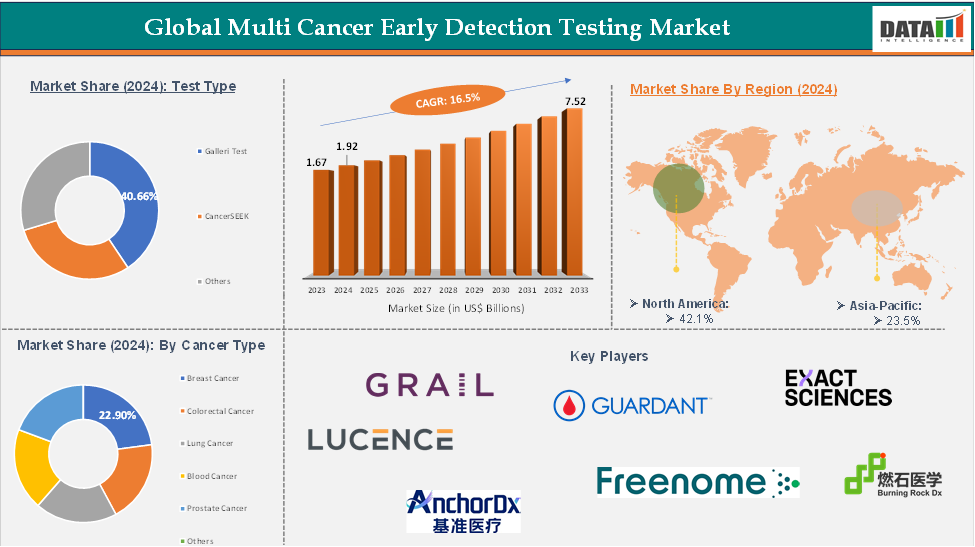
The global multi-cancer early detection (MCED) testing market is experiencing rapid growth due to the growing global cancer burden and demand for accurate, non-invasive diagnostic solutions. Technological advancements in liquid biopsy, genomics, and AI-driven bioinformatics enable multiple cancer detection from a single blood sample, improving patient outcomes and survival rates. Despite challenges like high testing costs, limited regulatory approvals, and false positives, MCED presents significant opportunities in emerging markets, strategic collaborations, and precision oncology.
Executive Summary
Multi Cancer Early Detection Testing Market Dynamics: Drivers & Restraints
Driver: Rising Global Cancer Prevalence
The global cancer prevalence is driving the multi-cancer early detection (MCED) testing market, as it provides effective and comprehensive screening solutions. Healthcare systems prioritize early detection to improve survival rates and reduce treatment costs. MCED tests, such as liquid biopsy, offer the advantage of identifying multiple cancers at early stages, addressing the growing demand for efficient screening. This trend is driving the adoption and expansion of MCED technologies globally.
Restraint: Improving Sensitivity and Specificity
Current MCED tests need improvement, particularly for stage I cancer detection. Novel biomarkers and technologies like cfDNA methylation patterns and miRNAs, ultrasensitive sequencing, and PCR can increase sensitivity. Understanding the causes of false positives in healthy individuals and addressing physiological changes like aging, lifestyle habits, and inflammation is crucial for cancer-related biomarker effects.
Multi Cancer Early Detection Testing Regional Market Analysis
North America Multi Cancer Early Detection Testing Market
North America remains the leading market for multi-cancer early detection testing due to strong investments in precision medicine, advanced healthcare infrastructure, robust clinical research activity, and rapid adoption of innovative molecular diagnostics.
The United States leads the regional market through extensive clinical trials, increasing adoption of liquid biopsy technologies, strong biotechnology innovation, and growing collaborations among diagnostic developers, healthcare providers, and academic institutions.
Major demand-generating end users include:
- Hospitals and Health Systems
- Clinical Diagnostic Laboratories
- Cancer Centers
- Academic and Research Institutions
- Reference Laboratories
- Preventive Healthcare Providers
Asia-Pacific Multi Cancer Early Detection Testing Market
Asia-Pacific is expected to register the fastest growth during the forecast period due to rising cancer incidence, expanding healthcare infrastructure, increasing investments in genomic medicine, and growing awareness of early cancer screening.
China remains the largest market in the region, supported by significant investments in precision diagnostics, expanding biotechnology capabilities, government-backed healthcare modernization initiatives, and increasing cancer research activities.
India is emerging as a major growth opportunity due to:
- Increasing cancer burden
- Expansion of molecular diagnostic laboratories
- Growing investment in precision medicine
- Rising awareness of preventive cancer screening
- Strengthening healthcare infrastructure and genomic research
Japan, South Korea, Australia, and Southeast Asian countries continue investing in advanced molecular diagnostics, genomic technologies, and personalized oncology programs to improve cancer outcomes.
Europe Multi Cancer Early Detection Testing Market
Europe is witnessing steady market growth supported by increasing cancer prevention initiatives, strong healthcare systems, expanding precision medicine programs, and ongoing investments in genomic diagnostics.
Germany, the United Kingdom, France, Italy, and Spain remain key contributors due to active cancer research, favorable healthcare infrastructure, and growing adoption of innovative molecular diagnostic technologies.
The region is increasingly focusing on:
- Precision oncology programs
- Population-based cancer screening initiatives
- Molecular diagnostic innovation
- Genomic research and biomarker development
- Integration of artificial intelligence into diagnostic workflows
These initiatives continue to accelerate the adoption of multi-cancer early detection technologies across Europe.
Latin America Multi Cancer Early Detection Testing Market
Latin America is gradually expanding its molecular diagnostics capabilities through improving healthcare infrastructure, increasing oncology investments, and greater awareness of early cancer diagnosis.
Countries such as Brazil, Mexico, Argentina, and Chile are witnessing growing adoption of advanced cancer diagnostics across hospitals, private laboratories, and specialized oncology centers.
Increasing investments in healthcare modernization and precision medicine are expected to support future market growth across the region.
Middle East & Africa Multi Cancer Early Detection Testing Market
The Middle East & Africa region is experiencing increasing demand for advanced cancer diagnostics due to improving healthcare infrastructure, rising cancer prevalence, expanding precision medicine initiatives, and growing investments in specialized oncology care.
Saudi Arabia and the UAE are leading regional adoption through investments in genomic medicine, healthcare digitalization, and advanced diagnostic technologies as part of broader healthcare transformation programs.
Multi Cancer Early Detection Testing Market Segmentation Analysis
The global multi cancer early detection testing market is segmented based on test type, cancer type, end user, and region.
Test Type:
The galleri test segment the expected to have 40.66% of the multi cancer early detection testing market share.
The Galleri test, developed by GRAIL, is a highly advanced blood-based screening solution for cancer detection. It uses next-generation sequencing and methylation pattern analysis to detect over 50 types of cancer from a single blood draw, often early before symptoms appear. Galleri's strong clinical validation, partnerships with healthcare providers, and integration into large-scale screening programs drive market adoption and accelerate the shift towards proactive and precision oncology.
For instance, GRAIL, a healthcare company, and Quest Diagnostics have announced a program to enhance provider access to GRAIL's Galleri multi-cancer early detection (MCED) test. The initial phase of the program allows providers to order the test directly from GRAIL through the Quest Diagnostics connectivity system. This system allows providers in the US to order and receive laboratory test reports electronically through Quest's Quanum laboratory portal and over 900 electronic health record (EHR) systems.
Multi Cancer Early Detection Testing Market Major Key Players
The major players in the multi cancer early detection testing market include GRAIL, Guardant Health, Exact Sciences , Burning Rock Biotech, Lucence Health, Foundation Medicine (Roche), AnchorDx, Freenome, and Niramai among others.
Recent Developments of the Multi Cancer Early Detection Testing Market
- April 2026 – GRAIL expands Galleri commercialization and health system partnerships
GRAIL strengthened U.S. commercialization of its Galleri multi-cancer early detection (MCED) blood test through expanded partnerships with healthcare providers and employer health programs aimed at improving population cancer screening adoption. - April 2026 – Guardant Health advances Shield and multi-cancer screening platform development
Guardant Health announced continued expansion of its blood-based cancer screening portfolio, including broader clinical validation activities for multi-cancer detection technologies and AI-driven liquid biopsy analytics. - March 2026 – Exact Sciences strengthens oncology screening pipeline with AI-enabled diagnostics
Exact Sciences expanded development of next-generation MCED technologies integrating genomic analysis and AI-powered biomarker interpretation to improve early cancer detection accuracy across multiple tumor types. - March 2026 – Roche’s Foundation Medicine advances comprehensive genomic profiling for early cancer detection
Foundation Medicine expanded collaborations focused on blood-based genomic profiling and precision oncology diagnostics supporting earlier cancer detection and personalized screening strategies. - February 2026 – Freenome progresses AI-powered blood testing platform for early cancer screening
Freenome advanced clinical validation of its multiomics blood testing platform using AI and machine learning to identify early cancer signals and improve non-invasive screening performance. - February 2026 – Burning Rock Biotech expands pan-cancer liquid biopsy research initiatives
Burning Rock Biotech strengthened development of blood-based early cancer detection technologies through expanded clinical research programs and AI-enabled genomic analysis capabilities in Asia-Pacific markets. - January 2026 – Lucence launches enhanced liquid biopsy solutions for early-stage cancer detection
Lucence Health introduced upgraded ctDNA-based liquid biopsy testing solutions focused on improving sensitivity for early-stage cancer detection and monitoring across multiple cancer indications.
Key Takeaways
- The increasing focus on early cancer detection through minimally invasive blood-based diagnostics is emerging as a major industry trend, with healthcare providers and diagnostic developers prioritizing multi-cancer early detection (MCED) technologies capable of identifying multiple malignancies from a single blood sample.
- North America maintains a leading position in the global multi-cancer early detection testing market, supported by strong investments in precision medicine, advanced genomic research infrastructure, widespread adoption of next-generation sequencing technologies, and the presence of leading biotechnology and molecular diagnostics companies.
- Asia-Pacific is projected to witness the fastest market growth, driven by expanding healthcare infrastructure, rising cancer prevalence, increasing government initiatives for cancer screening, growing awareness of preventive healthcare, and greater investments in precision diagnostics across emerging economies.
- The growing global cancer burden and increasing emphasis on detecting malignancies at earlier stages are becoming major factors accelerating the adoption of multi-cancer early detection testing across healthcare systems.
- Advancements in liquid biopsy technologies, artificial intelligence-driven biomarker analysis, next-generation sequencing, and multi-omics research are improving the sensitivity and clinical utility of MCED tests, supporting broader integration into cancer screening programs.
- Industry participants are increasingly evaluating investments based on clinical validation, regulatory progress, biomarker discovery capabilities, analytical accuracy, and scalable genomic testing platforms rather than focusing solely on expanding diagnostic portfolios.
- Expanding collaborations between biotechnology companies, academic research institutions, healthcare providers, and pharmaceutical organizations are creating significant opportunities to accelerate innovation, improve clinical evidence, and support the commercialization of multi-cancer early detection testing worldwide.
Multi Cancer Early Detection Testing Market Scope
Metrics | Details | |
CAGR | 16.5% | |
Market Size Available for Years | 2022-2033 | |
Estimation Forecast Period | 2026-2033 | |
Revenue Units | Value (US$ Bn) | |
Segments Covered | Test Type | Galleri Test, CancerSEEK, Others |
Cancer Type | Breast Cancer, Colorectal Cancer, Lung Cancer, Blood Cancer, Prostate Cancer and others. | |
| End User | Hospitals & Clinics, Diagnostic Laboratories, Academic & Research Institutes |
Regions Covered | North America, Europe, Asia-Pacific, South America, and the Middle East & Africa | |
Why Purchase This Report?
The Multi Cancer Early Detection Testing Market report provides comprehensive intelligence for diagnostic developers, biotechnology companies, healthcare providers, laboratories, investors, pharmaceutical organizations, and policymakers seeking to understand emerging opportunities in multi-cancer screening and precision oncology.
- Gain detailed insights into market drivers, restraints, opportunities, and emerging trends shaping the adoption of multi-cancer early detection (MCED) tests.
- Assess the impact of advancements in liquid biopsy technologies, next-generation sequencing (NGS), methylation analysis, and artificial intelligence on early cancer detection.
- Understand evolving clinical validation efforts, regulatory developments, and reimbursement trends influencing market expansion.
- Evaluate adoption patterns across healthcare systems, diagnostic laboratories, hospitals, cancer screening programs, and research institutions.
- Benchmark leading market participants, strategic collaborations, product development activities, and competitive positioning.
- Identify high-growth opportunities across blood-based screening technologies, multi-omics platforms, and precision diagnostics.
- Support investment planning, product commercialization strategies, clinical development, and long-term business growth initiatives.
The global multi cancer early detection testing market report delivers a detailed analysis with 70 key tables, more than 61 visually impactful figures, and 195 pages of expert insights, providing a complete view of the market landscape.
Target Audience
- Manufacturers/ Buyers
- Industry Investors/Investment Bankers
- Research Professionals
- Emerging Companies
- Strategic consulting and market intelligence organizations.
- Research institutions focused on cancer genomics, molecular diagnostics, and precision oncology.





























































