


Medical Robotics Market Size
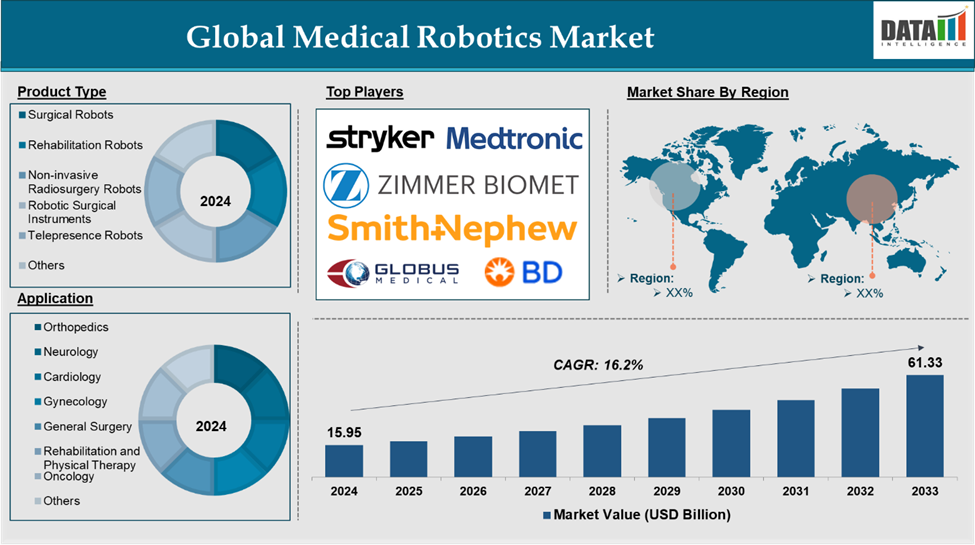
The Global Medical Robotics Market reached US$ 18.68 billion in 2025 and is expected to reach US$ 63.55 billion by 2033, growing at a CAGR of 17.1% during the forecast period 2026-2033.
Medical robotics refers to robotic technology in healthcare for performing, assisting or enhancing medical procedures and healthcare services. These robots can be autonomous, semi-autonomous or remotely controlled, and they are designed to improve the precision, efficiency, safety and outcomes of a wide range of medical applications. Medical robots are used in surgeries, rehabilitation, diagnostics and patient care, and they often integrate cutting-edge technologies such as artificial intelligence (AI), machine learning, computer vision and telecommunication systems.
The market demand for the medical robotics market is growing rapidly, driven by several factors ranging from the increasing prevalence of chronic diseases to the growing need for minimally invasive surgeries. As advancements in technology continue, the demand for robotic systems in healthcare continues to rise. For instance, in August 2024, Johnson & Johnson MedTech announced that DePuy Synthes launched a system called the VELYS Active Robotic-Assisted System (VELYS SPINE), which received 510(k) clearance from the U.S. Food and Drug Administration (FDA) and is intended for use in planning and instrumenting spinal fusion procedures in the cervical, thoracolumbar and sacroiliac spine.
Executive Summary
For more details on this report – Request for Sample
Market Dynamics: Drivers & Restraints
Integration of Artificial Intelligence (AI) & Machine Learning
The integration of artificial intelligence (AI) and machine learning is significantly driving the growth of the medical robotics market and is expected to drive the market over the forecast period. AI and machine learning algorithms enable robotic systems to perform surgeries with increased accuracy and consistency. The ability of AI to analyze patient-specific data (e.g., medical history and imaging scans) ensures that the surgical procedure is optimized for each individual, reducing the chances of human error.
For instance, in July 2024, Medtronic launched its new Live Stream function for the Touch Surgery ecosystem of digital technologies. Touch Surgery Live Stream includes 14 new AI algorithms that are designed to enhance its digital capabilities within post-operative analysis. The algorithms deliver AI-powered surgical insights for laparoscopic and robotic-assisted surgery.
AI can process real-time data from sensors, cameras and diagnostic tools to monitor patient vitals and surgical progress. This capability allows the robot to predict and adapt to unforeseen challenges, optimizing the procedure in real time. For instance, Mazor X by Medtronic, an AI-driven robotic spine surgery system, utilizes machine learning to analyze preoperative images (like CT scans and MRIs) and plan the optimal surgical approach. It then adjusts the procedure based on real-time data collected during surgery, improving spinal surgery accuracy.
High Cost of Robotic Systems
The high cost of medical robotics is one of the major factors that significantly hampers the widespread adoption and growth of the market. While these systems offer considerable benefits, the upfront investment, maintenance costs, and associated expenses make them difficult for smaller hospitals and healthcare providers to adopt, especially in low-resource settings.
Medical robotic systems, especially advanced surgical robots, come with a hefty initial purchase price. These systems can cost millions of dollars, making it difficult for many hospitals, particularly those in developing countries or smaller facilities, to afford them. For instance, the da Vinci Surgical System, one of the most well-known robotic systems used for minimally invasive surgeries, can cost over $2 million, not including annual service costs. Additionally, there are costs for training, maintenance, and software upgrades.
In addition to the purchase price, the maintenance and operation costs of robotic systems are substantial. These costs involve annual maintenance contracts, calibration, training, and software upgrades, all of which contribute to the total expense of owning and operating a medical robot. For instance, the Intuitive Surgical da Vinci system requires annual maintenance that can cost up to $100,000 to $200,000 per year. This doesn't include additional costs for robotic instrument replacements (which can cost $1,500 to $2,000 per procedure).
Market Geographical Analysis
North America is expected to hold a significant position in the medical robotics market share
North America led the global medical robotics market in 2022 with a market size of US$ 5.57 billion and reached further to US$ 6.17 billion in 2023.
The use of robotic-assisted surgeries has increased dramatically in North America especially in the United States, further solidifying the region’s leadership in the medical robotics market. Robotic surgery is especially popular in areas like urology, orthopedics, cardiothoracic and neurosurgery. For instance, the da Vinci Surgical System is now commonly used for prostate cancer surgeries in the U.S., with roughly three out of four prostate cancer surgeries in the U.S. performed using da Vinci Surgery.
North America leads the world in the research and development of medical robotics, with numerous companies and academic institutions investing heavily in the advancement of robotic technologies. Innovations in areas like robotic-assisted surgery, rehabilitation robotics, and robotic diagnostics have propelled the region’s dominance. Companies like Intuitive Surgical, Medtronic, and Johnson & Johnson have heavily invested in robotic surgery platforms. Intuitive Surgical, for instance, spends a significant portion of its annual revenue on R&D to improve its da Vinci surgical robots.
For instance, in March 2024, Intuitive announced that the U.S. Food and Drug Administration (FDA) provided 510(k) clearance for da Vinci 5, the company’s next-generation multiport robotic system. Da Vinci 5 builds on Intuitive’s da Vinci Xi’s highly functional design, which surgeons and care teams around the world have used in more than 7 million procedures to date.
The rising number of surgical procedures in the region particularly in the United States is driving the demand for surgical robotics. For instance, according to the Centers for Disease Control and Prevention, in the United States, a total number of 51.4 million inpatient surgical procedures are performed, which further boosts the demand for robotics in the region.
Asia-Pacific is growing at the fastest pace in the medical robotics market
The increasing demand for minimally invasive surgeries, where robotic systems can significantly reduce recovery times and improve surgical outcomes. As the APAC population faces chronic conditions such as cancer, cardiovascular disease and musculoskeletal disorders, the demand for robotic surgeries has surged in the region, which focuses on the development of advanced medical robotics.
For instance, in December 2024, Fortis Escorts launched a next-generation surgical robot. A cutting-edge piece of medical technology, the surgical robot helps perform intricate procedures with more control and accuracy. By enabling minimally invasive operations that promise quicker recovery periods, a lower risk of complications, and better overall patient outcomes, this robot marks a substantial development in robotic-assisted surgery.
Additionally, in June 2024, SS Innovations launched SSI Mantra 3, enabling affordable access to the next-generation surgical innovation. It achieved a historic feat in Indian medical science by completing India’s maiden human trial in telesurgery. The Mantra 3 is designed to enhance surgical precision, efficiency and patient outcomes. It features 5 slimmer robotic arms and an immersive 3D HD headset that provides surgeons with unmatched optics and a vision cart that provides 3D 4K vision to the entire team for precision and control. Additionally, its cost-effective pricing aims to make advanced surgical technologies more accessible to healthcare institutions across India and globally.
Recent Developments
February 2026: In the United States, increasing demand for minimally invasive surgeries, improved surgical precision, and better patient outcomes significantly accelerated adoption of medical robotics across hospitals and surgical centers.
January 2026: In Japan, strong focus on advanced healthcare technologies, aging population care, and robotics integration boosted demand for surgical, rehabilitation, and assistive robotic systems across multiple medical specialties.
December 2025: Across countries such as Germany and the United Kingdom, leading companies including Intuitive Surgical, Medtronic, Stryker, Zimmer Biomet, and Smith & Nephew expanded their portfolios, focusing on AI-integrated robotic systems, precision surgery platforms, and advanced imaging technologies.
November 2025: In China and India, rapid expansion of healthcare infrastructure, rising chronic disease burden, and increasing adoption of advanced surgical technologies significantly accelerated deployment of medical robotic systems across hospitals.
October 2025: In the United States and Japan, companies accelerated investments in next-generation technologies such as AI-driven decision support, tele-robotics, and haptic feedback systems, improving surgical accuracy and enabling remote procedures.
September 2025: Across regions including North America, Europe, and Asia Pacific, increasing demand for automation in healthcare, rehabilitation robotics, and hospital workflow optimization significantly supported market growth, with surgical robots dominating application segments.
The market is rapidly shifting toward intelligent, precision-driven, and AI-enabled robotic ecosystems, transforming healthcare delivery through minimally invasive procedures, enhanced clinical outcomes, and advanced automation across surgical, diagnostic, and rehabilitation applications.
Major Global Players
The major global players in the medical robotics market include Stryker Corporation, Medtronic plc, Zimmer Biomet, Smith+Nephew, Globus Medical, Becton, Dickinson and Company, Johnson & Johnson, Intuitive Surgical, Diligent Robotics Inc., Ronovo Surgical and among others.
Scope
| Metrics | Details | |
| CAGR | 17.1% | |
| Market Size Available for Years | 2023-2033 | |
| Estimation Forecast Period | 2026-2033 | |
| Revenue Units | Value (US$ Bn) | |
| Volume (Units) | ||
| Segments Covered | Product Type | Surgical Robots, Rehabilitation Robots, Non-invasive Radiosurgery Robots, Robotic Surgical Instruments, Telepresence Robots and Others |
| Component | Hardware, Software, Services and Control Systems | |
| Application | Orthopedics, Neurology, Cardiology, Gynecology, General Surgery, Rehabilitation and Physical Therapy, Oncology and Others | |
| End-User | Hospitals, Ambulatory Surgical Centers, Rehabilitation Centers, Research and Academic Institutes, Home Care Settings and Others | |
| Regions Covered | North America, Europe, Asia-Pacific, South America, and Middle East & Africa | |
Why Purchase the Report?
- Pipeline & Innovations: Reviews ongoing clinical trials, product pipelines, and forecasts upcoming advancements in medical devices and pharmaceuticals.
- Product Performance & Market Positioning: Analyzes product performance, market positioning, and growth potential to optimize strategies.
- Real-World Evidence: Integrates patient feedback and data into product development for improved outcomes.
- Physician Preferences & Health System Impact: Examines healthcare provider behaviors and the impact of health system mergers on adoption strategies.
- Market Updates & Industry Changes: Covers recent regulatory changes, new policies, and emerging technologies.
- Competitive Strategies: Analyzes competitor strategies, market share, and emerging players.
- Pricing & Market Access: Reviews pricing models, reimbursement trends, and market access strategies.
- Market Entry & Expansion: Identifies optimal strategies for entering new markets and partnerships.
- Regional Growth & Investment: Highlights high-growth regions and investment opportunities.
- Supply Chain Optimization: Assesses supply chain risks and distribution strategies for efficient product delivery.
- Sustainability & Regulatory Impact: Focuses on eco-friendly practices and evolving regulations in healthcare.
- Post-market Surveillance: Uses post-market data to enhance product safety and access.
- Pharmacoeconomics & Value-Based Pricing: Analyzes the shift to value-based pricing and data-driven decision-making in R&D.
The global medical robotics market report delivers a detailed analysis with 70 key tables, more than 74 visually impactful figures, and 186 pages of expert insights, providing a complete view of the market landscape.
Target Audience 2025
- Manufacturers: Pharmaceutical, Medical Device, Biotech Companies, Contract Manufacturers, Distributors, Hospitals.
- Regulatory & Policy: Compliance Officers, Government, Health Economists, Market Access Specialists.
- Technology & Innovation: AI/Robotics Providers, R&D Professionals, Clinical Trial Managers, Pharmacovigilance Experts.
- Investors: Healthcare Investors, Venture Fund Investors, Pharma Marketing & Sales.
- Consulting & Advisory: Healthcare Consultants, Industry Associations, Analysts.
- Supply Chain: Distribution and Supply Chain Managers.
- Consumers & Advocacy: Patients, Advocacy Groups, Insurance Companies.
- Academic & Research: Academic Institutions.


