


Latin America Certified Reference Materials Market Overview
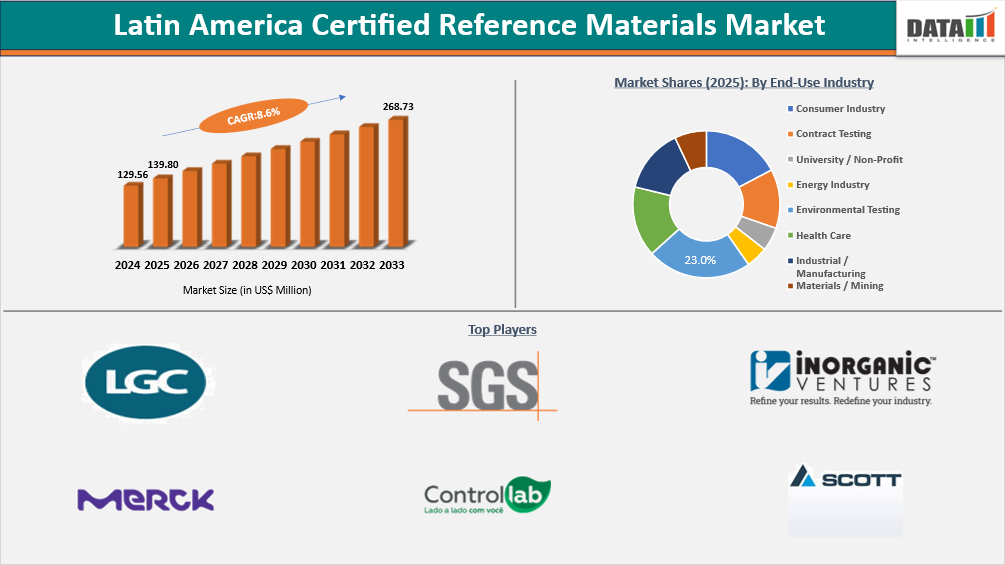
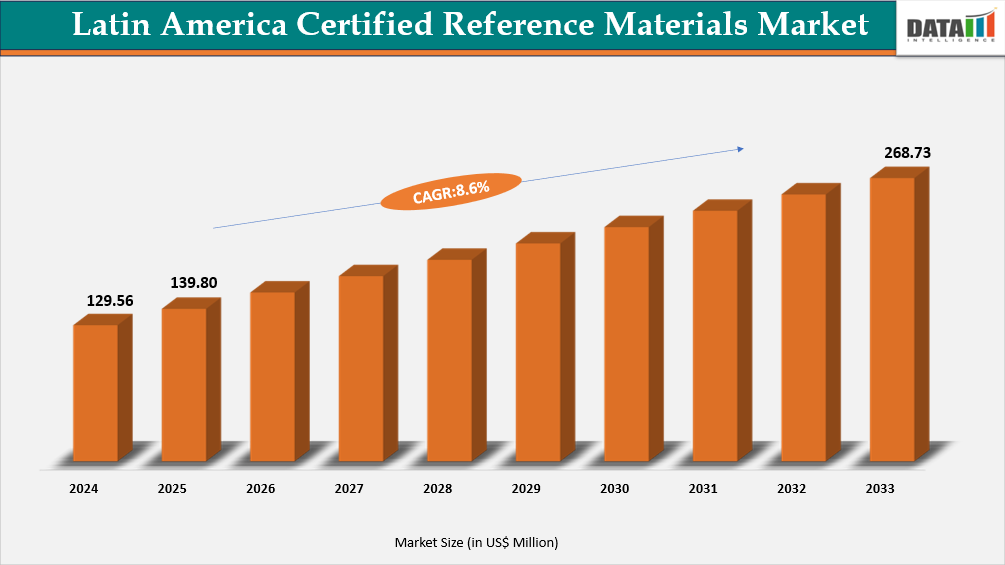
Latin America Certified Reference Materials Market reached US$ 139.80 Million in 2025 and is expected to reach up to US$ 268.73 Million in 2033, growing at a CAGR of 8.6% during the forecasting period (2026-2033). The Latin America certified reference materials (CRM) market is evolving alongside the region’s expanding analytical testing infrastructure across mining, environmental monitoring, pharmaceuticals, and food safety. Laboratories increasingly rely on CRMs to ensure calibration accuracy, method validation, and traceability in line with ISO/IEC 17025 accreditation requirements.
Strong mining activity, particularly in Chile, Peru, and Mexico, drives consistent demand for inorganic and geological matrix CRMs used in mineral analysis. Additionally, the rapid growth of lithium production in the “Lithium Triangle” (Chile, Argentina, Bolivia) is further boosting demand for high-precision analytical standards. As investments in battery materials and resource processing increase, CRM adoption continues to rise across both industrial and regulatory testing environments.
Certified Reference Materials Industry Trends and Strategic Insights
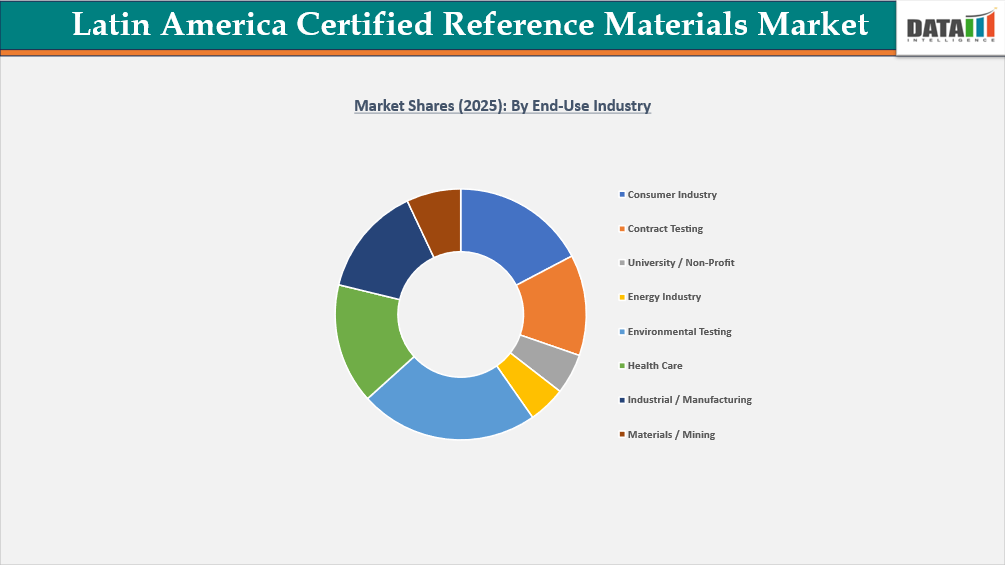
- By end-user industry, the consumer industry is projected to be the largest market, holding a significant share of about 19.36% in 2025.
Latin America Certified Reference Materials Market Size and Future Outlook
- 2025 Market Size: US$ 139.80 Million
- 2033 Projected Market Size: US$ 268.73 Million
- CAGR (2026-2033): 8.6%
Market Scope
| Metrics | Details |
| By Product Type | Organic, Inorganic |
| By Application | Quality Control & Assurance, Method Validation, Regulatory Compliance Testing, R&D & Analytical Development, Calibration & Instrument Validation |
| By End-User Industry | Consumer Industry, Contract Testing, University / Non-Profit, Energy Industry, Environmental Testing, Health Care, Industrial / Manufacturing, Materials / Mining |
| By Country | Brazil, Argentina, Mexico, Chile, Colombia, Rest of Latin America |
| Report Insights Covered | Competitive Landscape Analysis, Company Profile Analysis, Market Size, Share, Growth |
For More Detailed Information, Request For Sample
Market Dynamics
Mining & battery-materials expansion driving inorganic/matrix CRM demand
Latin America’s strong mining base, particularly in copper and lithium, is a key driver of demand for inorganic and geological certified reference materials (CRMs). Countries such as Chile and Peru dominate global copper production, requiring high-precision analytical techniques like ICP-MS and atomic absorption spectroscopy, which depend on traceable calibration standards. These testing requirements across exploration, extraction, and processing stages create consistent demand for CRMs used in elemental analysis and quality control.
Additionally, the rapid growth of lithium production in Chile and Argentina, which together account for a significant share of global supply, is further accelerating CRM demand. Lithium extraction and processing facilities rely on inorganic reference materials to monitor concentrations of lithium and associated elements, ensuring product quality and regulatory compliance. As investments in critical minerals and energy transition technologies increase, expanding mining activities and metallurgical laboratories continue to drive sustained demand for matrix-specific CRMs across the region.
Import dependency for high-end CRMs raises landed cost & procurement friction
Latin America still has a strong dependency on the import of certified reference materials, particularly for complex organic compounds and pharmaceutical impurity reference materials. High purity standards, particularly those used in chromatography and mass spectrometry, are often sourced from specific manufacturers located in North America and Europe. The import of certified reference materials into Latin American countries requires customs procedures, import permits, and regulatory documentation. This adds to the cost of procuring the required materials and also increases the time required for the delivery of the products. Laboratories often face the challenge of having to wait for weeks before the products are cleared at customs and then reach the distributors.
Shipping costs also add to the cost of reference materials. This is because reference materials, such as CRMs, usually need to be shipped at specific temperatures, which makes their transportation expensive, particularly for emerging market laboratories. The logistical issues also mean that laboratories need to keep more reference materials in stock to ensure smooth operations, which might add to the cost of reference materials and, consequently, laboratory operations, particularly for those working with temperature-sensitive materials.
Segmentation Analysis
The Latin America certified reference materials market is segmented based on product type, application, end-user industry, and region.
Stringent Food Safety Regulations and Export Compliance Drive Consumer Industry CRM Demand
The consumer industry segment with 19.36% market share within the Latin America certified reference materials (CRM) market is witnessing steady growth, driven by increasing regulatory scrutiny and the need for high-precision quality assurance across food, cosmetics, and household products. Countries such as Brazil, Mexico, Colombia, and Chile are strengthening safety frameworks, transforming CRM usage from a routine compliance tool into a critical component of analytical validation. The growing alignment with international standards and export requirements is further reinforcing the adoption of CRMs across laboratories supporting consumer-facing industries.
In Brazil, ANVISA’s Resolution RDC No. 722/2022 mandates strict limits on heavy metals and pesticides across a wide range of food categories, significantly boosting demand for high-quality CRMs. Similarly, Mexico’s COFEPRIS emphasizes CRM traceability as a core requirement for laboratory accreditation, while Colombia’s INVIMA oversees extensive product registrations requiring validated analytical data. Chile’s alignment with Codex Alimentarius standards is also pushing laboratories to adopt reliable reference materials, collectively driving CRM demand across the consumer industry in Latin America.
Tightening Environmental Regulations and Monitoring Programs Accelerate CRM Demand
Environmental testing is the fastest-growing segment within the Latin America certified reference materials (CRM) market, driven by increasingly stringent environmental regulations and rising investments in ecological monitoring infrastructure. Governments across the region are enforcing stricter standards for water, air, soil, and sediment quality, requiring laboratories to adopt traceable and highly accurate analytical methods. This regulatory tightening, combined with growing pressure from public health concerns and international compliance requirements, is creating sustained demand for high-quality CRMs across environmental applications.
In Brazil, frameworks such as CONAMA Resolution 430/2011 and Resolution 357/2005 mandate monitoring of a wide range of contaminants, including heavy metals, pesticides, and organic compounds, all requiring CRM-calibrated analysis. Across Latin America, the convergence of regulatory enforcement, mining and extractive industry compliance, and climate accountability initiatives is strengthening the need for multi-matrix and ultra-trace CRMs. As a result, suppliers focusing on low detection limits, regulatory alignment, and localized technical support are well-positioned to capitalize on this expanding segment.
Geographical Penetration
Brazil Certified Reference Materials Market Trends
Brazil dominates the Latin America certified reference materials (CRM) market, supported by a highly developed national quality infrastructure and strong regulatory oversight across multiple industries. Institutions such as Instituto Nacional de Metrologia, Qualidade e Tecnologia (INMETRO), operating under Conselho Nacional de Metrologia, Normalização e Qualidade Industrial (CONMETRO), play a central role in ensuring measurement traceability and conformity assessment. The Brazilian Conformity Assessment System (SBAC) mandates certification across sectors such as electronics, automotive, and medical devices, creating continuous demand for CRMs throughout testing and validation processes.
The regulatory burden is further intensified by dual compliance requirements involving Agência Nacional de Vigilância Sanitária (ANVISA), particularly in medical devices, where adherence to international standards like IEC 60601 necessitates frequent calibration and CRM usage. Additionally, Brazil’s public healthcare system, Sistema Único de Saúde (SUS), conducts billions of laboratory tests annually, generating sustained demand for high-quality reference materials. This combination of regulatory enforcement, industrial diversity, and large-scale diagnostic activity firmly positions Brazil as the leading CRM market in Latin America.
Mexico Certified Reference Materials Market Outlook
Mexico holds a strategically important position in the Latin America certified reference materials (CRM) market, supported by a robust national metrology and accreditation ecosystem. The Centro Nacional de Metrología (CENAM), operating under the Ministry of Economy, serves as the country’s primary reference laboratory, ensuring measurement traceability and uniformity across industries. Backed by the Entidad Mexicana de Acreditación (EMA), which accredits laboratories under ISO/IEC 17025, Mexico has developed a strong framework that drives consistent demand for CRMs across calibration, testing, and clinical applications.
The country’s CRM demand is further reinforced by expanding R&D capabilities and regulatory enforcement across environmental, healthcare, and industrial sectors. Environmental regulations under Secretaría de Medio Ambiente y Recursos Naturales (SEMARNAT) and NOM standards mandate continuous pollutant monitoring, while growing clinical accreditation and research activity supported by Consejo Nacional de Humanidades, Ciencias y Tecnologías (CONAHCYT) are increasing the use of validated reference materials. This combination of institutional strength, indigenous CRM development capability, and expanding scientific infrastructure positions Mexico as a key growth engine in the regional CRM market.
Product and Portfolio Analysis
Expanding Laboratory Accreditation and Environmental Monitoring Drive Dual Demand for Stock and Custom CRMs
Latin America is witnessing a significant rise in ISO/IEC 17025-accredited laboratories, particularly in Brazil and Mexico, driving continuous demand for stock CRMs to support routine calibration and maintain global compliance standards. This growing laboratory network, coupled with increasing multinational research and clinical activities, reinforces the need for readily available, high-quality reference materials. Additionally, widespread environmental and public health challenges, such as heavy metal contamination in countries like Mexico, Chile, and Argentina, are accelerating demand for standardized CRMs in water quality and contaminant monitoring programs.
At the same time, the region exhibits a dual-demand structure where stock CRMs dominate routine, high-frequency testing, while custom CRMs are gaining importance in specialized applications. Public health initiatives, including arsenic monitoring affecting millions and increasing water safety testing, rely heavily on consistent stock materials. Meanwhile, sectors such as pharmaceuticals and advanced mining require highly specific, matrix-matched custom CRMs to meet stringent regulatory and analytical requirements, highlighting a clear shift toward precision-driven testing across Latin America.
Customer Buying Behavior Analysis
CRM Supplier Switching Dynamics Driven by Supply Reliability, Compliance, and Evolving Testing Needs
Supplier switching in the Latin America CRM market is primarily driven by supply chain reliability and local availability constraints, as many laboratories depend on a limited distributor network. Delays caused by import clearance or inventory gaps can disrupt routine QA/QC workflows in mining, environmental, and refinery labs, prompting buyers to shift toward suppliers with stronger in-country stocking capabilities. This results in a redistribution of recurring procurement volumes toward vendors with robust regional logistics and dependable supply assurance.
Additionally, evolving regulatory requirements and accreditation pressures are accelerating supplier transitions. The introduction of new testing programs linked to industrial projects, export compliance, or environmental monitoring pushes laboratories to seek suppliers offering matrix-relevant and application-specific CRMs. At the same time, strict ISO 17025 audit requirements around certification traceability and documentation clarity lead laboratories to prefer globally recognized CRM providers, ensuring compliance, credibility, and seamless audit acceptance.
Regulatory Analysis
Regulatory frameworks across Latin America are strongly driving CRM demand, with countries such as Brazil, Mexico, Chile, Argentina, Peru, and Colombia tightening compliance requirements across food, environmental, and pharmaceutical sectors. In Brazil, ANVISA food safety regulations and IBAMA environmental monitoring standards mandate testing of pesticides, heavy metals, and industrial pollutants, increasing demand for food matrix and inorganic CRMs. Mexico’s COFEPRIS regulations similarly enforce contaminant testing in food supply chains, while Chile’s SMA standards require monitoring of pollutants in mining regions, boosting demand for geological and metal-based reference materials.
In Argentina and Peru, SENASA export quality standards aligned with Codex Alimentarius are driving adoption of pesticide and contaminant CRMs to meet international trade requirements. Colombia is advancing chemical regulation through frameworks such as Decree 1630/2021, alongside mandatory ISO/IEC 17025 accreditation (including Act 1595), reinforcing the need for traceable measurement standards. Across the region, ICH pharmaceutical guidelines are further increasing demand for impurity reference standards in drug validation, while ISO/IEC 17025 continues to anchor CRM usage across laboratories for compliance, calibration, and analytical accuracy.
Competitive Landscape
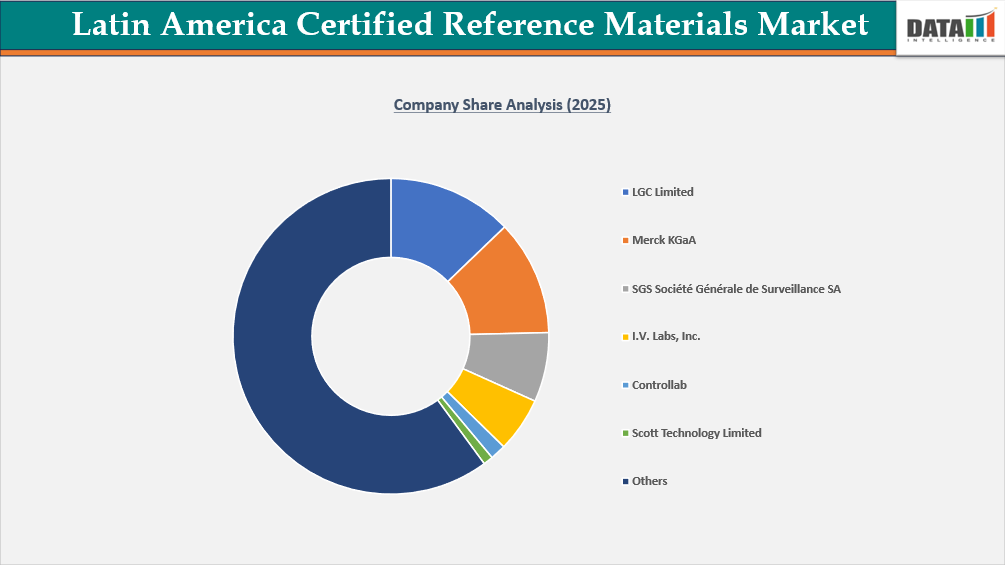
- The Latin America certified reference materials market is characterized by a competitive landscape that includes both established and regional players.
- Key players include LGC Limited, Merck KGaA, SGS Société Générale de Surveillance SA, I.V. Labs, Inc., Controllab, Scott Technology Limited.
Why Choose DataM?
- Data-Driven Insights: Dive into detailed analyses with granular insights such as pricing, market shares and value chain evaluations, enriched by interviews with industry leaders and disruptors.
- Post-Purchase Support and Expert Analyst Consultations: As a valued client, gain direct access to our expert analysts for personalized advice and strategic guidance, tailored to your specific needs and challenges.
- White Papers and Case Studies: Benefit quarterly from our in-depth studies related to your purchased titles, tailored to refine your operational and marketing strategies for maximum impact.
- Annual Updates on Purchased Reports: As an existing customer, enjoy the privilege of annual updates to your reports, ensuring you stay abreast of the latest market insights and technological advancements. Terms and conditions apply.
- Specialized Focus on Emerging Markets: DataM differentiates itself by delivering in-depth, specialized insights specifically for emerging markets, rather than offering generalized geographic overviews. This approach equips our clients with a nuanced understanding and actionable intelligence that are essential for navigating and succeeding in high-growth regions.
- Value of DataM Reports: Our reports offer specialized insights tailored to the latest trends and specific business inquiries. This personalized approach provides a deeper, strategic perspective, ensuring you receive the precise information necessary to make informed decisions. These insights complement and go beyond what is typically available in generic databases.
Target Audience 2026
- Manufacturers/ Buyers
- Industry Investors/Investment Bankers
- Research Professionals
- Emerging Companies

