


Healthcare LLM Platform Market Overview
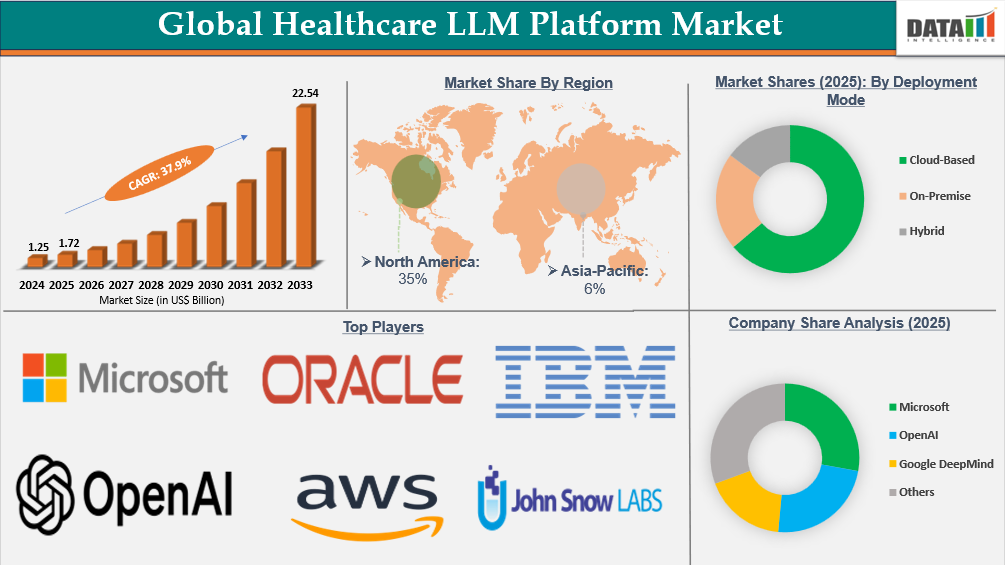
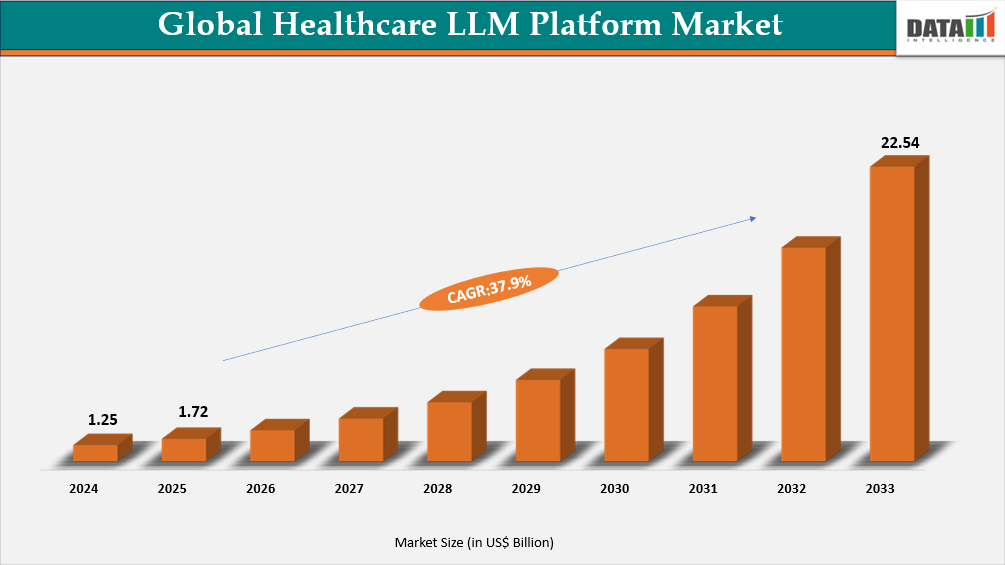
The Global Healthcare LLM Platform Market reached US$1.25 Billion in 2024, rising to US$1.72 Billion in 2025 and is expected to reach US$22.54 Billion by 2033, growing at a CAGR of 37.9% from 2026 to 2033.
The Global Healthcare LLM Platform Market has been introduced by the increased digitalization of healthcare systems, as well as the growing requirement to manage and derive insights from vast amounts of clinical data. Approximately 80% of healthcare organizations have implemented digital health solutions, indicating widespread technology integration across care settings. However, a significant portion of healthcare data remains unstructured, allowing language models to interpret clinical notes, provider narratives, and patient communications. EHR adoption is widespread, having over 95% of non-federal acute care hospitals in the United States using certified HER systems, and many primary care clinics in OECD nations using digital records. The availability of online digital health services reached 82% in 2024, indicating increased patient and provider access. Telehealth usage increased significantly during and after the COVID-19 epidemic, highlighting the continuous demand for virtual treatment. Globally, WHO efforts like the Global Digital Health Monitor help dozens of nations establish interoperable and secure digital health systems. These developments lay a solid foundation for Healthcare LLM systems to automate documentation, improve coding accuracy, support clinical decision-making, and promote patient involvement globally.
Healthcare LLM Platform Industry Trends and Strategic Insights
- North America leads the global Healthcare LLM Platform Market, capturing the largest revenue share of 35% in 2025.
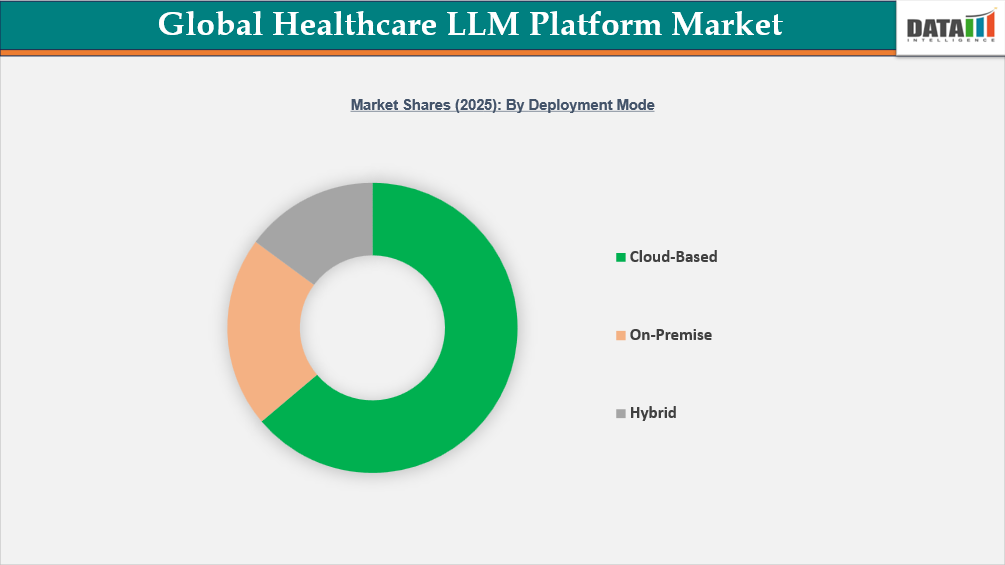
- By Deployment Mode segment, Cloud-Based led the global Healthcare LLM Platform Market, capturing the largest revenue share of 63.84% in 2025.
Global Healthcare LLM Platform Market Size and Future Outlook
- 2025 Market Size: US$1.72Billion
- 2033 Projected Market Size: US$22.54 Billion
- CAGR (2026–2033): 37.9%
- Dominating Market: North America
- Fastest Growing Market: Asia-Pacific
Market Dynamics
Rapid Digitalization of Healthcare Infrastructure
The use of LLM platforms is mostly driven by the global healthcare systems' rapid digital change. AI-powered decision support tools, cloud-based clinical management systems, and electronic health records (EHRs) are being used more and more by hospitals, clinics, and telehealth providers. To improve patient interaction, automate paperwork, and provide advanced insights, LLMs may take advantage of the huge ecosystem of structured and unstructured healthcare data created by this digital transition.
The growing need for adaptable, cloud-based LLM solutions that provide smooth integration with current digital systems is a result of healthcare businesses modernizing their infrastructure. The demand for intelligent language models that can understand clinical data, facilitate workflow automation, and increase operational efficiency is further fueled by the shift toward smart hospitals, interoperable data platforms, and telemedicine services. As a result, the worldwide market expansion for LLM platforms is greatly accelerated by the continuous digitization of healthcare infrastructure.
Segmentation Analysis
The global Healthcare LLM Platform Market is segmented based on component, deployment mode, model type, application, end user, organization size, and region.
Cloud-Based Deployment Dominates the Global Healthcare LLM Platform Market
In 2025, cloud-based deployment represents for 63.84% of the worldwide healthcare LLM platform market, making it the dominant deployment model. This method involves hosting LLM platforms on secure, medically-compliant cloud infrastructure and delivering them via SaaS or API-based services, removing the need for hospitals or healthcare organizations to maintain costly on-premise hardware.
Several reasons contribute to its dominance. LLMs need high-performance GPU clusters, which are more affordable and scalable in the cloud than on-premises. Most healthcare AI technologies, such as clinical documentation assistants, revenue cycle management tools, and patient interaction bots, are SaaS-based and prefer cloud delivery. Furthermore, cloud providers provide HIPAA- and GDPR-compliant environments with regional data residency choices, which reduces regulatory hurdles. Cloud solutions also allow for quick interface with EHRs, telemedicine systems, and analytics platforms, reducing implementation times.
Cloud deployment enables continual model changes, centralized governance, and predictable recurring income via subscription or usage-based models. Although problems such as data sovereignty, cybersecurity threats, and potential vendor lock-in persist, the scalability, compliance, and quick implementation benefits make cloud-based LLM systems the preferred choice for healthcare institutions throughout the world.
Geographical Penetration
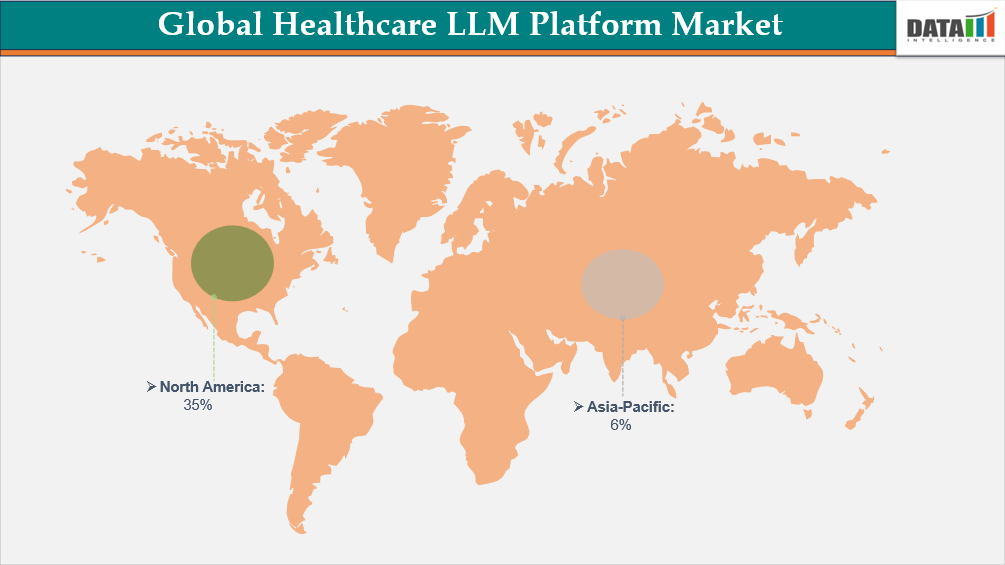
Largest Market:
Demand for Healthcare LLM Platform Market in North America
The need for Healthcare LLM platforms in North America is robust and growing, due to improved digital health infrastructure, extensive EHR usage, and expanding AI integration across healthcare settings. In the United States, more than 95% of non-federal hospitals and 85% of office-based physicians utilize electronic health records, and 71% of hospitals have integrated predictive AI technologies to help with clinical decision-making and administrative processes. In Canada, about 95% of physicians utilize EHRs, and approximately 87% of healthcare organizations use AI in patient care, such as data analysis and documentation automation. Virtual care is a crucial driver in both nations. In 2023, over 40% of Canadian patients accessed virtual consultations, with over 78.5% obtaining the provided appointments. Telehealth adoption in the U.S. continues to be common post-pandemic. These factors, combined with high EHR penetration, rising AI adoption, and sustained virtual care engagement, create a strong market for LLM platforms that can streamline documentation, improve patient communication, enhance clinical decision-making, and optimize administrative efficiency across North America.
U.S. Healthcare LLM Platform Market Outlook
The healthcare industry in the US is continuing to accelerate its digital transformation, setting the stage for wider use of AI-enabled solutions and (LLM) platforms. (EHRs) are already almost ubiquitous in non-federal hospitals, with over 95% of institutions using approved EHR systems, creating a foundational digital architecture that LLMs may expand upon. The use of generative and predictive AI is growing quickly; in 2024, over 31.5% of U.S. hospitals were early adopters of GenAI connected with EHRs, and another 24.7% want to do so within a year, indicating a trend for broader LLM integration. Further evidence of the expanding usage of AI for risk prediction, scheduling, and administrative activities comes from the fact that 71% of U.S. hospitals reported utilizing predictive AI in 2024, up from 66% in 2023.Telehealth is a significant feature of care delivery and digital engagement, with many Americans having utilized virtual care services and continuing to rely on digital platforms. Despite this progress, obstacles including as interoperability, legacy infrastructure limitations, and unequal adoption among smaller and rural hospitals remain. High EHR penetration, increased AI use, and continuous digital care engagement indicates a growing interest in LLM platforms to expedite clinical documentation, help decision-making, decrease administrative load, and improve patient communication in U.S. healthcare systems.
Canada Healthcare LLM Platform Market Trends
Large language model (LLM) platforms are becoming more and more popular in Canada as the healthcare industry continues its digital revolution. There is a strong trend toward intelligent automation, as evidenced by the fact that 87% of Canadian healthcare institutions already employ artificial intelligence in some capacity for patient care, including processing and analyzing medical data and updating records.95% of doctors say they use electronic medical or health records, demonstrating the broad use of digital records that LLM technology may take use of for process automation and documentation. Even with increasing acceptance, there are still issues with interoperability and legacy infrastructure, since many systems remain fragmented and restrict smooth data transmission. With over 40% of patients getting virtual treatment in 2023 and over 78.5% of those offered virtual appointments completing them, virtual care is still a significant part of Canadian healthcare delivery, demonstrating the country's sustained dependence on digital service delivery. The expanding use of AI, the widespread use of digital records, and the ongoing participation in virtual care all contribute to the increased interest in LLM platforms as a means of improving clinical decision-making, patient communication, and documentation efficiency in Canadian healthcare settings.
Fastest Growing Market:
Asia-Pacific Records the Fastest Growth in the Healthcare LLM Platform Market
The market for healthcare LLM platforms is growing at the quickest rate in the Asia-Pacific region because to several factors, such as growing healthcare infrastructure, AI integration, and the quick adoption of digital health. A solid basis for AI-driven platforms is provided by the fact that more than 85% of China's major tier-1 hospitals have adopted electronic health record systems. In India, government programs like the National Digital Health Mission have expanded digital patient data coverage to over 40% of the population, especially in metropolitan areas. In Japan, approximately 95% of large hospitals utilize certified digital health records. In 2023, over 50% of urban patients in key APAC nations reported utilizing virtual consultations at least once, indicating a considerable increase in the use of telemedicine throughout the area.
These developments make it possible for LLM-driven systems to automate clinical documentation, boost patient involvement, and facilitate better decision-making in Asia-Pacific hospitals and clinics.
India Healthcare LLM Platform Market Insights
The India Healthcare LLM Platform Market is expanding rapidly, driven by fast digital health transformation, AI integration, and the growing use of large language models (LLMs) in clinical and administrative workflows. The government's Ayushman Bharat Digital Mission (ABDM) has established a strong digital health ecosystem, with over 67.19 crore health records linked to ABDM accounts and more than 4.18 lakh health institutions registered, offering a large structured database for LLM-powered apps. Telemedicine usage is also rising, with India's national telehealth network eSanjeevani supporting hundreds of millions of remote consultations, producing unstructured patient data that LLM systems may handle for documentation, summarization, and decision assistance.
A favorable climate for LLM integration has been created by the sharp rise in AI usage among Indian physicians, with 41% of them now utilizing AI technologies to improve treatment quality and expedite processes. With over 50% of providers committing 20–50% of IT funds to cutting-edge technology like LLM-enabled documentation, coding, and patient communication systems, hospitals are making significant investments in digital innovation. In India, there is a high demand for LLM platforms to improve clinical documentation, patient engagement, and data-driven decision-making across healthcare facilities. These trends include the widespread adoption of digital health records, the rise in telemedicine use, the growing integration of AI, and the increased investment in healthcare IT.
China Healthcare LLM Platform Market Industry Growth
LLM use in China's healthcare industry is expanding quickly due to the country's extensive digital health infrastructure and growing need for sophisticated clinical solutions. By 2024, around 58% of community health centers and over 85% of top-tier hospitals in China had implemented electronic medical records (EMRs), creating a strong foundation of structured data for LLM-driven clinical documentation and analytics. Telemedicine has expanded rapidly, with 418 million digital healthcare users nationwide, representing about 37% of China’s internet population. More than 3,300 internet hospitals now conduct over 100 million online consultations annually. Additionally, AI integration is growing in patient interaction, workflow automation, and diagnostics, especially in tertiary hospitals and urban healthcare facilities.
High EMR usage, significant telemedicine use, and expanding AI integration are the drivers that are causing China's need for LLM platforms to increase. These variables allow for better decision-making, automated clinical recording, and increased patient engagement across clinics and hospitals.
Competitive Landscape
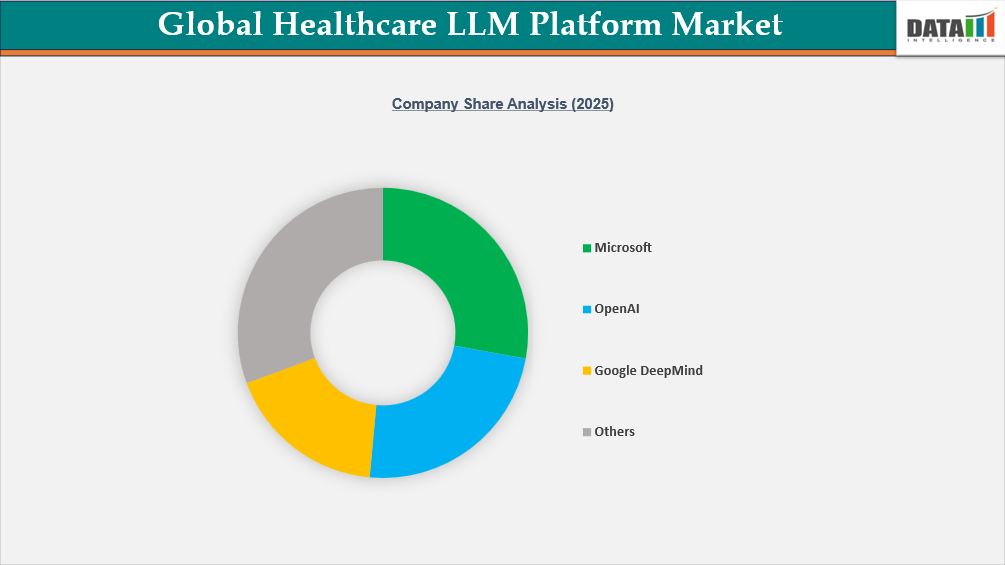
The Global Healthcare LLM Platform market is very competitive, with major technology companies including as Microsoft, OpenAI, and Google DeepMind dominating through foundation models, cloud integration, and strong collaborations with healthcare providers. Amazon Web Services and Anthropic expand the ecosystem by offering scalable, compliant LLM infrastructure for regulated healthcare contexts.
At the same time, healthcare AI companies like John Snow Labs, Truveta, and Yseop specialize in domain-specific medical NLP, EHR-trained language models, and regulatory paperwork automation. Infrastructure providers such as NVIDIA enable large-scale model training and deployment.
Rapid advancement in generative AI is driving competition, as is the growing deployment of clinical documentation copilots, EHR summarizing tools, and AI-powered decision support systems. Strategic alliances, regulatory compliance, and healthcare-specific model fine-tuning continue to be critical for retaining market share and capitalizing on growth prospects.
Key Developments
- In March 2025, Microsoft introduced Dragon Copilot, a unified AI assistant that combines Azure OpenAI capabilities with Nuance's ambient clinical intelligence technologies. The platform offers real-time clinical documentation, automatic note summarization, and workflow support from within electronic health record (EHR) systems. This breakthrough increases Microsoft's position in healthcare AI infrastructure and drives enterprise adoption of LLM-powered clinical workflow automation throughout the world.
- In May 2024, OpenAI unveiled GPT-4o, a sophisticated multimodal foundation model that can interpret text, audio, and visual inputs in real time. The model's applicability for clinical documentation, patient interaction tools, and medical research applications was greatly increased by its better reasoning, structured data interpretation, and enterprise-grade deployment capabilities. This release strengthened OpenAI's position in the growing healthcare LLM ecosystem as a key foundation model supplier.
What Sets This Global Healthcare LLM Platform Market Intelligence Report Apart
- Latest Data & Forecasts – Comprehensive and up-to-date market intelligence with forecasts through 2033, covering global demand by component, deployment mode, model type, application, end user, organization size, with region-wise analysis across North America, Europe, Asia-Pacific, Latin America, and the Middle East & Africa.
- Regulatory Intelligence – In-depth analysis of global healthcare and data regulations that affect LLM adoption, including HIPAA, GDPR, local patient data residency restrictions, telemedicine compliance, AI certification standards, and cybersecurity requirements.
- Competitive Benchmarking – A structured review of prominent LLM platform providers based on product features, AI model sophistication, deployment reach, clinical integration, subscription/pricing strategies, collaborations, and enterprise acceptance across healthcare systems.
- Geographic & Emerging Market Coverage – Regional perspectives on healthcare digitalization, EHR adoption, telehealth penetration, AI readiness, and infrastructure maturity, with a particular emphasis on high-growth possibilities in Asia-Pacific, Latin America, and the Middle East and Africa.
- Actionable Strategies & Cost Dynamics – Strategic assistance on LLM implementation, workflow integration, data governance, cybersecurity management, deployment cost optimization, and adoption strategies, backed up by professional input from healthcare IT specialists, hospital administrators, and AI implementation consultants.

