


AI-Enhanced Electronic Health Records Market Size & Growth
Healthcare providers are under pressure to turn patient records into usable clinical intelligence while reducing documentation burden, improving diagnosis, and controlling operating costs. AI-enhanced electronic health records are becoming strategically important because they combine core EHR infrastructure with predictive analytics, machine learning, deep learning, workflow automation, clinical decision support and patient-generated health data analysis.
AI-Enhanced Electronic Health Records Market is valued at US$ 8.29 billion in 2025 and is projected to reach US$ 84.95 billion by 2035, growing at a CAGR of 26.2% during 2026–2035.
The investment timing is significant because healthcare organizations already have a strong digital foundation. Over 95% of hospitals in the U.S. have adopted EHR systems, creating a large base of structured and unstructured data that can be enhanced through AI. The commercial case is no longer limited to record digitization. Buyers are now evaluating AI-enabled EHR platforms for early disease detection, hospitalization prediction, radiology insight extraction, personalized treatment planning, workflow automation and patient outcome improvement.
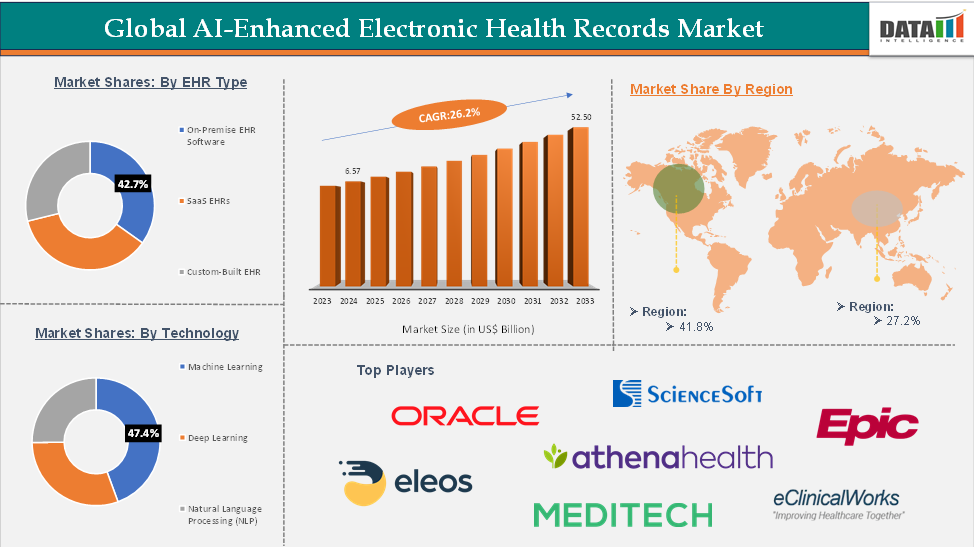
AI-Enhanced Electronic Health Records Market: Key Takeaways
- The AI-Enhanced Electronic Health Records Market 2026 value is recalculated at US$10.46 billion, reflecting accelerating adoption of AI-based clinical intelligence across digital health systems.
- The AI-Enhanced Electronic Health Records Market 2035 value is projected at US$84.95 billion, supported by a 26.2% CAGR from 2026 to 2035.
- North America is expected to hold 41.8% of the global AI-Enhanced Electronic Health Records Market Share. Applied to the 2025 market size, this equals approximately US$3.47 billion.
- On-premise EHR software is expected to hold 42.7% market share. Applied to 2025 value, this represents approximately US$3.54 billion.
- The strongest buyer rationale is linked to predictive analytics, early disease detection, hospital admission risk prediction, clinical workflow automation and personalized care delivery.
- Data privacy and patient data security remain major restraints because AI-enabled EHRs process large volumes of sensitive clinical and personal health information.
- Companies such as eClinicalWorks, ScienceSoft USA Corporation, Oracle, Medical Information Technology, Inc., athenahealth and Eleos Health are competing in a market where differentiation depends on AI integration depth, clinical usability, compliance readiness and workflow fit.
AI-Enhanced Electronic Health Records Market Scope
| Report Attribute | Details |
| Market Size in 2025 | US$8.29 billion |
| Market Size by 2035 | US$84.95 billion |
| CAGR | 26.2% during 2026 to 2035 |
| Historic Years | 2023 to 2024 |
| Base Year | 2025 |
| Forecast Period | 2026 to 2035 |
| Segments Covered | EHR Type, Technology, Application, End User and Region |
| Leading Region | North America |
Clinical Intelligence Is Becoming the Next Layer of EHR Investment
Advanced Data Analytics Is Driving Market Growth
The increasing adoption of advanced data analytics is a central driver of AI-Enhanced Electronic Health Records Market Growth. Healthcare providers are using AI-enhanced systems to extract insights from large volumes of patient data, including medical history, patient-generated health data, diagnostic records, clinician notes and imaging-related information.
Predictive and prescriptive analytics allow clinicians to identify health risks earlier, anticipate hospitalization probability, optimize treatment plans and improve care coordination. For hospitals and health systems, the business value is tied to better clinical outcomes, more efficient workflows and lower avoidable costs. This makes AI-enhanced EHR adoption a strategic technology investment rather than a back-office IT upgrade.
Patient-Generated Health Data Expands the EHR Use Case
Patient-generated health data is becoming more relevant as care delivery shifts beyond hospital walls. Wearables, remote monitoring tools, telehealth platforms and digital patient engagement systems are creating new data streams. AI-enabled EHR platforms help interpret this information and convert it into clinical signals.
For care teams, this improves the ability to monitor chronic conditions, personalize treatment and detect risk patterns before escalation. For executives, the value lies in supporting proactive care models, improving patient satisfaction and enabling more data-driven population health management.
AI-Assisted Diagnosis and Imaging Insights Improve Clinical Utility
AI-enhanced EHR systems can support earlier detection of medical conditions by connecting patient history, clinical data and diagnostic inputs. The source content highlights AI’s ability to help physicians identify health concerns, predict hospitalizations and detect disease early. AI can also extract insights from X-rays, scans and other radiology images, improving the practical value of EHR-connected clinical workflows.
This positions AI-enhanced EHR platforms as decision-support assets. They do not replace physicians, but they can help reduce missed signals, speed up review, prioritize cases and support more consistent patient evaluation.
Data Privacy and Security Shape Procurement Decisions
The main restraint in the AI-Enhanced Electronic Health Records Market Analysis is concern over data privacy and safety. AI integration requires the handling of large volumes of sensitive patient data. Healthcare organizations face reputational, financial and legal risks if data breaches occur, and patients are becoming more cautious about how their health data is used.
This means procurement cycles are likely to remain highly compliance-driven. Vendors must prove strong encryption, access controls, auditability, governance, data protection and regulatory alignment. Buyers are also expected to assess whether AI models can be deployed in ways that preserve patient confidentiality while still delivering meaningful clinical and operational benefits.
AI-Enhanced Electronic Health Records Market Opportunities
AI-enhanced EHR platforms create opportunities for healthcare providers, technology vendors, investors and virtual care companies. For hospitals, the opportunity is to improve clinician productivity, strengthen diagnosis, personalize treatment planning and reduce administrative friction. For EHR vendors, AI integration creates a pathway to defend market share, raise product value and build recurring software revenue.
Technology companies can benefit by offering AI modules for predictive analytics, automated documentation, patient risk scoring, clinical decision support and workflow optimization. Virtual care providers can use AI-enabled EHR infrastructure to build more intelligent telehealth platforms that support triage, patient history summarization and care continuity.
Investors should track companies that combine healthcare workflow knowledge with AI capability. The most valuable opportunities are likely to sit at the intersection of EHR integration, patient data analytics, clinical usability and compliance-led deployment.
Economic and Investment Analysis
Macroeconomic pressure on healthcare systems is increasing interest in technologies that improve productivity and reduce avoidable costs. AI-enhanced EHR systems address several cost-sensitive areas, including clinician documentation time, diagnostic inefficiency, repeated manual workflows and fragmented care coordination.
Capital expenditure is likely to be directed toward EHR modernization, AI modules, analytics engines, security infrastructure and integration services. On-premise deployment remains attractive for organizations requiring direct data control, but cloud-connected and hybrid architectures may gain relevance where scalability and faster implementation are priorities.
The ROI case depends on measurable improvements in clinical workflow efficiency, earlier risk detection, reduced administrative burden, better patient outcomes and lower operational cost. Key economic risks include privacy breaches, integration complexity, clinician resistance, model governance costs and uncertain returns from poorly implemented AI tools.
AI-Enhanced Electronic Health Records Market Segmentation Analysis
The AI-Enhanced Electronic Health Records Market Report is segmented by EHR Type, by Technology, by Application, by End User, and by Region - Share, Trends, and Forecast to 2035.
On-Premise EHR Software Leads by Deployment Preference
The on-premise EHR software segment is expected to hold 42.7% of the global market. Based on the 2025 market size, this equals approximately US$3.54 billion. The segment leads because many healthcare organizations prefer direct control over patient data, security configurations and compliance procedures.
On-premise systems also support integration with existing legacy infrastructure. This is important for hospitals and large healthcare networks that want to add AI functionality without replacing core EHR systems. The ability to customize security, workflows and AI integration makes on-premise EHR software attractive in regions with strict data protection requirements.
Predictive Analytics and Machine Learning Support Clinical Decision-Making
By technology, AI-enhanced EHR platforms rely on predictive analytics, machine learning, deep learning and advanced data analysis. Predictive analytics is especially valuable because it supports early risk identification, hospitalization prediction and care pathway optimization.
Machine learning and deep learning strengthen EHR intelligence by identifying patterns across structured and unstructured patient data. These technologies help improve diagnosis, support personalized treatment planning and assist clinicians with prioritizing patient needs.
Applications Are Expanding from Records Management to Care Optimization
AI-enhanced EHR applications include clinical decision support, patient data analysis, workflow automation, personalized treatment planning, diagnostic support and patient engagement. Clinical decision support is commercially important because it connects directly to physician productivity and care quality.
Workflow automation is also gaining buyer attention. Hospitals and clinics need tools that reduce repetitive administrative tasks, improve documentation, and help clinicians spend more time on patient care. Personalized treatment planning offers longer-term growth potential as healthcare organizations increase focus on proactive and patient-specific care.
End Users Prioritize Efficiency, Compliance and Better Outcomes
Hospitals, clinics, health systems, virtual care providers and healthcare technology organizations are key end users. Large hospitals are more likely to adopt early because they have stronger IT infrastructure, higher patient volumes and greater demand for advanced analytics.
Smaller providers may adopt more selectively due to cost, integration and security concerns. However, as AI-enabled EHR products become more modular and easier to deploy, adoption may broaden across ambulatory care and digital health settings.
AI-Enhanced Electronic Health Records Market Regional Analysis
North America Leads the Market
North America is expected to hold 41.8% of the global AI-Enhanced Electronic Health Records Market Share. Applied to the 2025 market value, this equals approximately US$3.47 billion. The region benefits from high EHR adoption, advanced healthcare IT infrastructure, strong AI vendor presence and rising demand for cost-efficient clinical decision-making.
The United States is the most important country market in the region because over 95% of hospitals have adopted EHR systems. This creates a large digital data foundation for AI-enhanced capabilities. Demand is supported by healthcare organizations seeking predictive modeling, personalized treatment planning, workflow automation and better patient outcomes.
Canada also presents opportunities due to digital health adoption and demand for healthcare efficiency, although country-specific market size is not disclosed in the source content. The main regional barriers include privacy concerns, cybersecurity risk, interoperability challenges and the need for clear ROI evidence.
Europe Focuses on Privacy, Interoperability and Clinical Governance
Europe’s AI-enhanced EHR adoption is likely to be shaped by strict data protection expectations and the need for trusted clinical AI. Healthcare systems in the region are expected to prioritize privacy, patient consent, secure data handling and interoperability before scaling AI-enabled EHR deployments.
Demand will be stronger where hospitals and public health systems are investing in digital records, population health analytics and integrated care delivery. Vendors entering Europe must align product strategy with compliance, auditability and clinical governance rather than relying only on AI performance claims.
Asia-Pacific Offers Long-Term Digital Health Potential
Asia-Pacific is expected to offer long-term market potential as healthcare systems digitize records, invest in hospital modernization and expand AI-enabled care infrastructure. Country-level market values are not provided in the source content, but the region’s opportunity is linked to increasing healthcare digitization, growing patient volumes and demand for more efficient clinical workflows.
India, China, Japan, South Korea and Australia are relevant markets for AI-enhanced EHR adoption, although adoption speed will vary based on data infrastructure, healthcare IT budgets, regulatory maturity and interoperability readiness. Cost sensitivity and fragmented systems may slow adoption in some markets, but the long-term need for scalable digital healthcare tools remains significant.
Country-Level Market Analysis
The United States is the clearest country-level demand center because EHR adoption exceeds 95% among hospitals, creating a strong base for AI integration. Growth drivers include predictive analytics adoption, administrative automation, hospital cost pressure and demand for improved patient outcomes. Key challenges include data privacy, cybersecurity and integration with legacy systems.
Canada is positioned for adoption through healthcare digitization and interest in patient outcome improvement, although country-level market size and growth rate are not disclosed. Europe’s leading healthcare markets are expected to focus on compliant AI deployment, while Asia-Pacific countries may generate future opportunities through expanding digital health infrastructure and rising healthcare IT investments.
Country-specific market values are not available in the source content, so no country revenue figures are added.
Regulatory and Policy Analysis
AI-enhanced EHR platforms operate in a highly regulated healthcare environment because they process sensitive patient data. Regulations related to patient privacy, data protection, cybersecurity, medical records management and healthcare technology procurement influence adoption.
The main business impact is that vendors must demonstrate secure data handling, strong access controls, compliance readiness and reliable governance. Healthcare providers will need clear policies around AI use, patient data protection, model accountability and clinician oversight.
Expected regulatory scrutiny may increase as AI becomes more embedded in clinical workflows. This is likely to favor vendors that can provide transparent, secure and clinically validated solutions.
AI-Enhanced Electronic Health Records Marke Competitive Landscape and Vendor Positioning
The AI-Enhanced Electronic Health Records Market includes companies such as eClinicalWorks, ScienceSoft USA Corporation, Oracle, Medical Information Technology, Inc., athenahealth and Eleos Health. These companies compete across EHR platforms, healthcare software services, AI-enabled clinical workflows, data analytics and documentation support.
Oracle and Medical Information Technology, Inc. are positioned through healthcare IT and EHR infrastructure. eClinicalWorks and athenahealth are relevant because of their EHR and ambulatory care software presence. Eleos Health is positioned around AI-supported clinical documentation and behavioral health workflow use cases. ScienceSoft USA Corporation participates through healthcare software development and AI integration services.
Competitive differentiation will depend on how well vendors integrate AI into real clinical workflows. Buyers are likely to evaluate accuracy, usability, interoperability, data security, implementation support and measurable productivity gains. Strategic partnerships between healthcare software companies and AI infrastructure providers will remain important as hospitals seek advanced AI capabilities within trusted EHR environments.
Recent Developments in AI-Enhanced Electronic Health Records Market
- June 2026 – Oracle expands AI-powered Electronic Health Record capabilities
Oracle enhanced its Oracle Health EHR platform by introducing advanced generative AI, intelligent clinical documentation, AI-assisted chart summarization, and workflow automation to reduce clinician administrative burden and improve care delivery. - June 2026 – athenahealth advances AI-enabled clinical documentation
athenahealth expanded its AI-powered EHR platform with enhanced ambient clinical documentation, AI-generated patient summaries, and intelligent workflow automation, helping healthcare providers improve productivity and patient engagement. - May 2026 – eClinicalWorks strengthens AI-driven EHR workflows
eClinicalWorks enhanced its cloud-based EHR platform by expanding Sunoh AI-powered medical scribing, automated clinical documentation, and AI-assisted patient engagement tools, enabling physicians to reduce documentation time and improve workflow efficiency. - April 2026 – MEDITECH advances Expanse AI capabilities
Medical Information Technology, Inc. (MEDITECH) expanded its Expanse EHR platform with enhanced generative AI features, intelligent search, ambient documentation, and clinical decision support to streamline healthcare operations and improve clinician efficiency. - March 2026 – Eleos Health enhances AI-powered behavioral health documentation
Eleos Health expanded its AI platform with improved automated clinical note generation, session insights, compliance documentation, and quality assurance tools for behavioral health providers, reducing administrative workload and supporting value-based care. - February 2026 – Oracle strengthens AI-assisted healthcare interoperability
Oracle expanded AI capabilities across Oracle Health by enhancing interoperability, clinical data intelligence, and automated care coordination, enabling more efficient health information exchange and personalized patient care.
Strategic Insights and Analyst Perspective
AI-enhanced EHR adoption is becoming a strategic decision for healthcare executives because it affects clinical quality, operational cost, patient engagement and data governance. The market’s growth outlook is strong, but vendors must avoid positioning AI as a generic add-on. Healthcare buyers need tools that solve specific problems, such as documentation burden, diagnostic support, patient risk prediction and workflow inefficiency.
For investors, the most attractive companies are likely to be those with EHR workflow depth, healthcare compliance capability and AI models that can be embedded into daily clinical practice. For healthcare providers, vendor selection should focus on data security, implementation burden, clinician adoption, interoperability and measurable ROI.
The market will reward platforms that combine AI capability with healthcare-specific trust. In this category, clinical reliability and compliance will matter as much as model performance.
Report Benefits
This AI-Enhanced Electronic Health Records Market Report helps healthcare technology vendors assess product direction, market demand and competitive positioning. Investors can evaluate growth opportunities linked to predictive analytics, workflow automation and AI-enabled clinical intelligence. Healthcare providers can use the report to benchmark adoption drivers, barriers and ROI considerations. Procurement teams can compare deployment models, vendor positioning and implementation risks. Strategy teams can identify regional opportunities, target end users and long-term technology trends.
Target Audience
- Electronic Health Record (EHR) vendors
- Healthcare AI companies
- Hospitals and healthcare systems
- Clinics and ambulatory care providers
- Virtual care and telehealth providers
- Integrated health systems
- Healthcare IT service providers
- Cloud and infrastructure companies
- Investors in healthcare IT and digital health sector
- Private equity firms
- Venture capital firms
- Procurement heads
- Chief Information Officers (CIOs)
- Chief Technology Officers (CTOs)
- Chief Financial Officers (CFOs)
- Clinical operations leaders
- Product managers
- Regulatory affairs teams
- Corporate strategy teams



























































