


CAR-T Cell Therapy Market Size and Overview
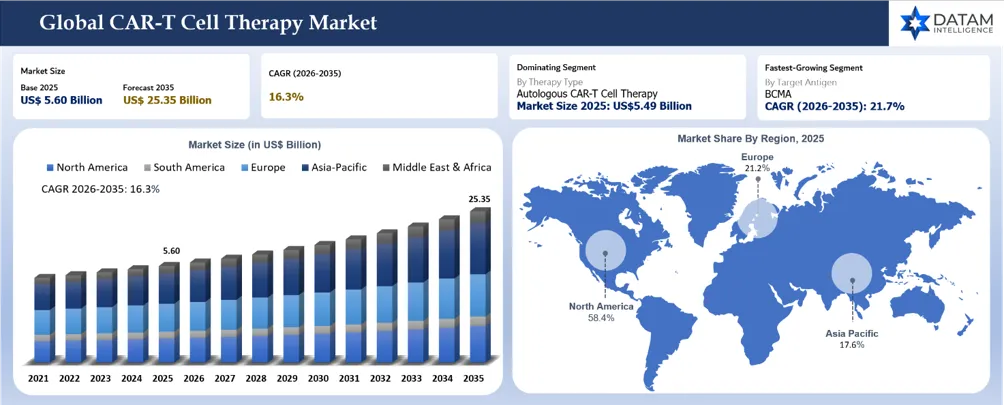
The global CAR-T cell therapy market reached US$5.60 billion in 2025 and is expected to reach US$25.35 billion by 2035, growing with a CAGR of 16.3% during the forecast period 2026-2035.
Market expansion is supported by increasing CAR-T adoption across hematological malignancies, movement into earlier treatment lines and continued indication expansion for commercial therapies. Autologous CAR-T cell therapy remains the market’s revenue foundation, led by established products including Yescarta, Carvykti, Breyanzi, Kymriah and Abecma. CD19-targeted therapies dominate treatment of large B-cell lymphoma, acute lymphoblastic leukemia and follicular lymphoma, while BCMA-targeted therapies are gaining commercial momentum in relapsed or refractory multiple myeloma. Greater physician experience, improved toxicity-management protocols and expansion of accredited treatment centers are supporting broader utilization.
However, autologous manufacturing complexity remains a structural constraint. Lengthy vein-to-vein timelines, manufacturing failures, limited production slots, specialized logistics and patient deterioration before infusion restrict treatment conversion. High therapy costs and the concentration of qualified centers in major cities also create access disparities. These limitations are increasing investment in automated manufacturing, decentralized processing, cryopreservation and allogeneic platforms capable of providing off-the-shelf availability.
The next value-creation cycle will center on earlier-line CAR-T use, dual-target constructs, allogeneic therapies and expansion into solid tumors and autoimmune diseases. Competitive leadership will increasingly depend on durable clinical responses, manageable cytokine-release syndrome and neurotoxicity, reliable manufacturing and favorable reimbursement. Companies integrating scalable production with strong hospital referral networks, real-world evidence generation and effective patient-support programs will be best positioned to capture market share.
CAR-T Cell Therapy Market Key Takeaways
- Sustained Market Expansion Through 2035: The global CAR-T cell therapy market was valued at US$5.60 billion in 2025 and is projected to reach US$25.35 billion by 2035, registering a CAGR of 16.3% during 2026-2035.
- Autologous Therapies Maintain Market Leadership: Autologous CAR-T therapy remains the dominant therapy type, supported by established approvals, expanding earlier-line indications and strong adoption of Kymriah, Yescarta, Breyanzi, Abecma and Carvykti.
- BCMA Becomes the Primary Growth Engine: BCMA-targeted therapies are expected to record the fastest growth through 2035, driven by increasing uptake of Carvykti and Abecma, earlier-line multiple myeloma applications and expanding clinical pipelines.
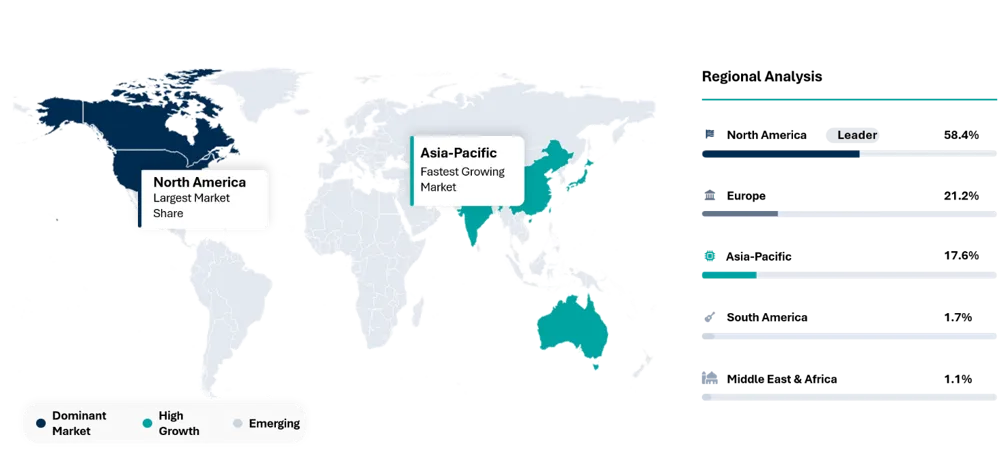
- North America Maintains Regional Dominance: North America leads the global market, supported by multiple approved CAR-T products, established treatment-center networks, strong reimbursement coverage, high oncology expenditure and rapid adoption of advanced cellular therapies.
- Manufacturing Performance Reshapes Competitive Strategy: Future leadership will depend on reducing vein-to-vein time, expanding manufacturing capacity, improving treatment-center access and limiting patient attrition. Companies delivering reliable production, durable clinical outcomes and effective toxicity management will be best positioned to capture market share.
CAR-T Cell Therapy Market Scope
| Metrics | Details | |
| 2025 Market Size | US$5.60 Billion | |
| 2035 Projected Market Size | US$25.35 Billion | |
| CAGR (2026-2035) | 16.3% | |
| Largest Market | North America | |
| Fastest Growing Market | Asia-Pacific | |
| By Therapy Type | Autologous CAR-T Cell Therapy, Allogeneic CAR-T Cell Therapy | |
| By Drug Type | Abecma, Breyanzi, Carvykti, Tecartus, Kymriah, Yescarta | |
| By Target Antigen | CD19, BCMA (B-Cell Maturation Antigen), CD20, CD22, CD30, CD33, GD2, HER2, Others | |
| By Application | Acute Lymphoblastic Leukemia (ALL), Non-Hodgkin Lymphoma, Chronic Lymphocytic Leukemia (CLL), Multiple Myeloma (MM), Follicular Lymphoma, Others | |
| By Region | North America | U.S., Canada, Mexico |
| Europe | Germany, UK, France, Spain, Italy, Poland | |
| Asia-Pacific | China, India, Japan, Australia, South Korea, Indonesia, Malaysia, Singapore, Vietnam, Thailand, Philippines, Taiwan | |
| South America | Brazil, Argentina | |
| Middle East and Africa | Israel, Saudi Arabia, UAE, Turkiye, South Africa, Nigeria | |
| Report Insights Covered | Competitive Landscape Analysis, Company Profile Analysis, Market Size, Share, Growth | |
CAR-T Cell Therapy Market White Space & Investment Opportunities
- Earlier-Line CAR-T Treatment: Invest in clinical programs that move CAR-T therapies from heavily pretreated populations into second-line and first-line settings. Earlier intervention could improve T-cell fitness, reduce disease progression before infusion and expand the treatment-eligible population.
- Allogeneic and Off-the-Shelf Platforms: Develop donor-derived CAR-T therapies capable of eliminating leukapheresis and reducing vein-to-vein time. Gene editing, immune-evasion engineering and scalable manufacturing will be critical for controlling graft-versus-host disease, rejection risk and production costs.
- CAR-T Therapies for Solid Tumors: Advance programs targeting HER2, GD2, CLDN18.2, GPC3 and mesothelin. Investment opportunities include armored CAR-T cells, logic-gated constructs, localized administration and combination strategies that improve trafficking, persistence and activity within immunosuppressive tumor microenvironments.
- Next-Generation Targeting and Relapse Prevention: Develop dual-target, tandem and multi-antigen CAR-T therapies addressing antigen escape and post-treatment relapse. CD19/CD22, BCMA/GPRC5D and other combination constructs could improve response durability across leukemia, lymphoma and multiple myeloma.
- Decentralized and Automated Manufacturing: Invest in closed-system manufacturing, point-of-care production, digital chain-of-identity solutions and predictive quality-control platforms. Shorter production cycles and lower failure rates can reduce patient attrition, expand institutional capacity and improve commercial scalability.
- Geographic Access and Outcome-Based Reimbursement: Expand accredited treatment centers, referral networks and reimbursement coverage across underserved markets. Real-world evidence linking CAR-T therapy with durable remission, reduced transplantation requirements, fewer subsequent treatments and lower lifetime care costs will support broader payer adoption.
CAR-T Cell Therapy Market Buyer Decision-Making Criteria
Major Buyer Decision-Making Criteria:
- Overall Survival and Durability of Response
- Progression-Free Survival and Relapse-Free Survival
- Overall Response Rate and Complete Response Rate
- Effectiveness by Disease Type and Treatment Line
- Eligibility Based on Prior Therapies and Performance Status
- Target-Antigen Eligibility, Including CD19, BCMA, CD22 and Other Antigens
- CAR-T Cell Persistence and Risk of Antigen-Escape Relapse
- Safety, Tolerability and Long-Term Follow-Up Evidence
- Cytokine-Release Syndrome and Neurotoxicity Profile
- Suitability for Patients With Refractory or Rapidly Progressive Disease
- Leukapheresis Requirements and Patient T-Cell Fitness
- Vein-to-Vein Time and Need for Bridging Therapy
- Manufacturing Success Rate and Batch Consistency
- Hospitalization, Monitoring and Adverse-Event Management Requirements
- Treatment-Center Accreditation and Healthcare-Professional Experience
- Improvement in Symptoms, Functional Status and Quality of Life
- Pricing, Reimbursement and Total Episode-of-Care Cost
- Regulatory Approval, Guideline Positioning and Real-World Evidence
- Geographic Availability, Referral Pathways and Treatment-Center Capacity
- Patient-Support Services, Logistics and Long-Term Safety Monitoring
CAR-T Cell Therapy Market BCG Matrix: Company Evaluation
STAR
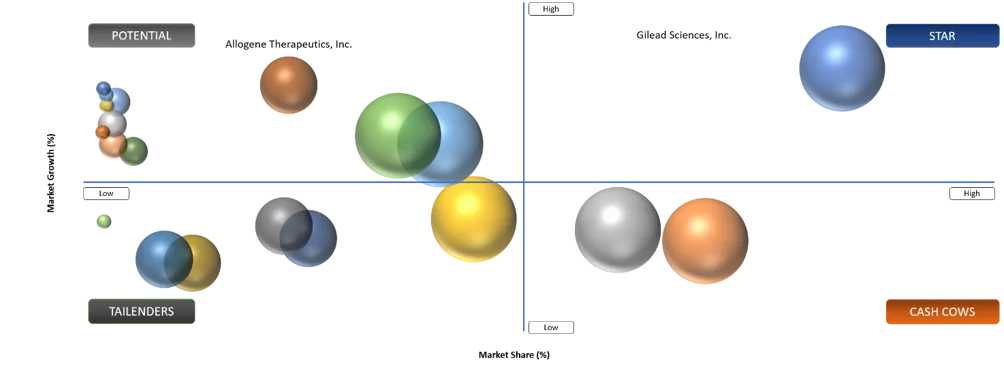
Gilead Sciences, Inc., Bristol-Myers Squibb Company, Novartis AG, Johnson & Johnson and Legend Biotech Corporation can be positioned in the Star category within an analyst-defined framework, reflecting their approved CAR-T therapies, established commercialization capabilities and influence across hematological malignancies. Gilead competes through Yescarta and Tecartus, while Bristol-Myers Squibb offers Breyanzi and Abecma. Novartis participates through Kymriah, and Johnson & Johnson and Legend Biotech jointly commercialize Carvykti. These portfolios provide established positions across selected lymphomas, leukemias and multiple myeloma.
Future leadership will depend on expansion into earlier treatment lines, durable clinical outcomes, manufacturing reliability and broader patient access. Shorter production timelines, dependable treatment scheduling and effective reimbursement strategies will strengthen competitive positioning. Companies that translate clinical differentiation into consistent delivery across specialist treatment networks will be better positioned to sustain leadership and defend their commercial franchises.
POTENTIAL
Allogene Therapeutics, Inc., CRISPR Therapeutics AG, Caribou Biosciences, Inc., Lyell Immunopharma, Inc., Cabaletta Bio, Inc. and Cartesian Therapeutics, Inc. can be positioned in the Potential category, reflecting their investigational CAR-T platforms and opportunities to address limitations in existing therapies. Their development strategies span allogeneic manufacturing, gene editing, dual-antigen targeting and treatment of autoimmune diseases.
Allogene is advancing cema-cel and additional allogeneic programs, while CRISPR Therapeutics is developing zugo-cel, formerly CTX112. Caribou is progressing vispa-cel and CB-011, and Lyell is advancing the CD19 and CD20 dual-targeting candidate ronde-cel. Cabaletta’s rese-cel and Cartesian’s Descartes-08 extend CAR-T development into autoimmune indications. Progression toward the Star category will depend on successful registrational trials, regulatory approvals, durable responses, manageable toxicity, scalable manufacturing and commercially viable delivery models.
CAR-T Cell Therapy Market Dynamics
Driver Impact Analysis
| Driver | Market Growth Impact (%) | Demand Concentration | Impacted Use Case | Strategic Impact |
Earlier-Line CAR-T Approvals Expanding Treatment-Eligible Patient Pools | 18.5% | United States and European markets with applicable approvals | Eligible multiple myeloma and large B-cell lymphoma patients receiving earlier-line treatment | Expands the addressable patient population and shifts CAR-T consideration earlier in treatment sequencing, increasing opportunities before disease progression limits eligibility. |
Higher Manufacturing Success Rates Converting Patient Referrals Into Completed Infusions | 15.2% | Established treatment networks across North America, Europe and selected Asian markets | Autologous CAR-T patients awaiting manufacturing and product release | Improved production reliability and shorter turnaround times can reduce manufacturing-related delays, support treatment scheduling and increase completed infusions. |
Removal Of U.S. REMS Requirements Reducing Treatment-Center Participation Barriers | 10.8% | United States | Delivery of approved autologous CD19- and BCMA-directed CAR-T therapies | Reduces administrative burdens associated with treatment delivery, supporting broader provider participation and patient access while maintaining clinical safety-management responsibilities. |
Additional Lymphoma Indications Increasing Utilization of Established CAR-T Networks | 12.4% | United States initially, with international expansion dependent on local approvals | Additional eligible relapsed or refractory lymphoma populations | Broadens demand across lymphoma subtypes and enables manufacturers to serve additional patient groups through established manufacturing capacity, referral channels and treatment networks. |
Driver: Earlier-Line CAR-T Approvals Expanding Treatment-Eligible Patient Pools
Earlier-line CAR-T approvals are materially expanding the addressable patient pool by moving therapy from a last-resort option toward an earlier treatment choice. This shift is particularly important in multiple myeloma and large B-cell lymphoma, where disease progression, cumulative toxicity and declining performance status can make heavily pretreated patients ineligible for cell therapy. Approval of Carvykti after at least one prior line in selected multiple myeloma patients illustrates how label expansion can bring clinically fitter patients into referral pathways and increase treatment volumes across certified centers.
Commercially, earlier-line use improves the probability that referred patients complete leukapheresis, manufacturing and infusion before rapid deterioration or bridging-therapy failure. It also increases demand visibility for manufacturers, treatment centers and payers, supporting investment in production capacity, care coordination and specialist networks. However, uptake will depend on head-to-head evidence, durable survival outcomes, toxicity management, reimbursement and the ability to deliver therapy without prolonged delays. Companies that secure earlier-line indications while improving turnaround times and outpatient feasibility will capture a larger share of eligible patients and strengthen their position in treatment sequencing across major hematology markets worldwide.
Restraint Impact Analysis
| Restraint | Drag on Market Growth (%) | Primary Impact Area | Impacted Use Case | Strategic Impact |
Autologous Manufacturing Delays Causing Patient Attrition Before Infusion | 17.6% | Treatment completion, manufacturing logistics and referral conversion | Patients with rapidly progressing lymphoma, leukemia or multiple myeloma awaiting individualized manufacturing | Extended vein-to-vein timelines can allow disease progression, infection or declining performance status before infusion. This reduces referral-to-treatment conversion and increases dependence on bridging therapy, rapid manufacturing and off-the-shelf platforms. |
Limited Qualified Treatment-Center Capacity Concentrating Access in Major Cities | 14.8% | Geographic accessibility, specialist capacity and treatment-center onboarding | Eligible patients living outside established metropolitan CAR-T referral networks | Limited center availability increases travel, accommodation and caregiver burdens while delaying patient evaluation. Providers must expand regional referral partnerships, satellite assessment pathways and community-to-specialist coordination to improve access. |
High Episode-Level Costs Creating Reimbursement and Hospital Cash-Flow Constraints | 13.5% | Reimbursement, institutional budgeting and payer authorization | Commercial CAR-T administration involving product acquisition, hospitalization and supportive care | High upfront expenditure and reimbursement uncertainty can discourage hospitals from expanding programs. Sustainable adoption requires predictable payment pathways, outcomes-based agreements and improved alignment between product, facility and follow-up reimbursement. |
Complex Toxicity Management Restricting Decentralized and Outpatient Administration | 10.9% | Clinical monitoring, workforce requirements and site-of-care expansion | Patients at risk of cytokine release syndrome, neurological toxicity, cytopenias and secondary malignancies | Specialized monitoring and emergency-management capabilities limit delivery outside experienced centers. Although U.S. REMS requirements were removed, boxed warnings and long-term surveillance obligations continue to constrain broad decentralization. |
Restraint: Autologous Manufacturing Delays Causing Patient Attrition Before Infusion
Autologous CAR-T manufacturing requires patient-specific leukapheresis, cell transport, genetic modification, expansion, quality testing and return shipment before infusion. This multistep process creates a clinically significant waiting period for patients with rapidly progressing lymphoma, leukemia or multiple myeloma. During this interval, some patients require bridging therapy, develop infections, experience organ deterioration or lose performance status, making them temporarily or permanently ineligible for infusion. Manufacturing failures, scheduling constraints, shipment disruptions and insufficient production slots further widen the gap between referral and completed treatment, reducing addressable demand despite strong clinical eligibility at diagnosis.
From a commercial perspective, patient attrition weakens conversion across the entire treatment funnel and raises the cost of each successfully delivered dose. Delays also pressure hospitals to coordinate interim therapy, monitor unstable patients and reserve infusion capacity without certainty that treatment will proceed. Manufacturers therefore need shorter turnaround times, higher first-pass success rates, geographically distributed capacity and real-time chain-of-identity tracking. Strategic advantages will increasingly accrue to companies that integrate manufacturing with referral forecasting, establish backup capacity and reduce dependence on complex cross-border logistics. Faster allogeneic platforms could materially reduce attrition.
CAR-T Cell Therapy Market Segmentation Analysis
By therapy type, allogeneic CAR-T is expected to dominate because it addresses a major limitation of autologous therapy: long personalized manufacturing time. Off-the-shelf availability can be valuable for patients with aggressive cancers who cannot wait several weeks for individualized cell production.
By application, multiple myeloma holds a major share due to the success of BCMA-targeted therapies. In October 2024, Aurigene Oncology released Phase 1 results for Ribrecabtagene autoleucel from India’s first trial of a novel autologous BCMA-directed CAR-T therapy in relapsed or refractory multiple myeloma.
Non-Hodgkin lymphoma is the fastest-growing application. In May 2024, Bristol Myers Squibb received FDA approval for Breyanzi in relapsed or refractory mantle cell lymphoma after at least two prior lines of systemic therapy, making Breyanzi available across multiple B-cell malignancy subtypes.
CAR-T Cell Therapy Market Geographical Penetration
U.S. CAR-T Cell Therapy Market Landscape
The U.S. CAR-T cell therapy market is transitioning from a highly specialized salvage-treatment segment toward earlier-line use across multiple myeloma and B-cell malignancies. Commercial competition is concentrated among Gilead Sciences, Bristol Myers Squibb, Novartis, Johnson & Johnson and Legend Biotech, supported by expanding indications and certified treatment networks. In June 2025, the FDA eliminated REMS requirements for approved autologous CD19- and BCMA-directed therapies, reducing administrative barriers for hospitals while retaining boxed warnings and clinical monitoring responsibilities. This policy change should facilitate broader provider participation and streamline treatment delivery pathways.
Growth is increasingly constrained by manufacturing throughput, referral timing, payer authorization and patient deterioration before infusion. Market leadership therefore depends not only on response durability but also on manufacturing success, turnaround time and predictable delivery. Legend Biotech reported first-quarter 2026 Carvykti net trade sales of approximately $597 million, with U.S. sales growth of 36%, a 99% manufacturing success rate and more than 95% on-time order releases. These metrics illustrate how operational execution directly converts clinical demand into revenue. Longer-term expansion will depend on outpatient delivery, earlier referrals, center capacity and reimbursement alignment.
Japan CAR-T Cell Therapy Market Outlook
Japan’s CAR-T market is shifting from launch-stage adoption to indication-led scale, supported by universal insurance, transplant centers and a PMDA pathway for regenerative medicines. By May 2026, PMDA records listed five CAR-T brands—Kymriah, Yescarta, Breyanzi, Abecma and Carvykti—spanning CD19-positive leukemias/lymphomas and BCMA-positive multiple myeloma. Breyanzi gained two additional lymphoma indications on April 3, 2026, widening the addressable pool beyond heavily pretreated large B-cell lymphoma. Near-term growth should come from earlier-line use, referral expansion and better patient identification rather than new launches.
Execution remains the commercial bottleneck. Japan’s aging population increases hematologic-cancer demand, but autologous manufacturing, international logistics, bridging therapy and concentration in accredited urban hospitals constrain throughput. Advantage will accrue to companies reducing vein-to-vein time, securing domestic capacity and helping regional hospitals refer patients before deterioration. Pipeline activity is broadening competition: IASO Bio reported PMDA clearance on March 24, 2026 for a Phase III study of eque-cel in second- or third-line lenalidomide-refractory multiple myeloma, following late-line clearance in October 2025. The outlook is favorable, but share gains will depend on operational reliability, reimbursement evidence and center-level activation.
CAR-T Cell Therapy Market Competitive Landscape
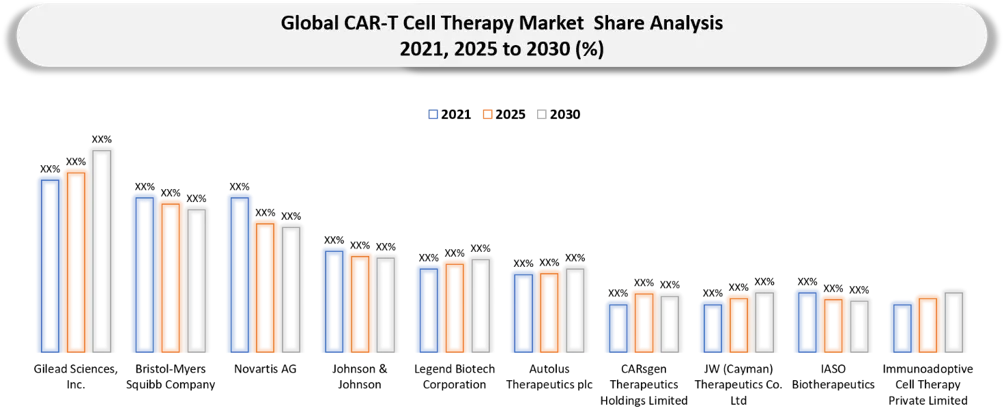
- The global CAR-T cell therapy market features a concentrated commercial segment alongside a diverse pipeline of emerging competitors. Gilead Sciences, Bristol-Myers Squibb, Novartis, Johnson & Johnson, and Legend Biotech anchor competition through established therapies and commercialization capabilities. Autolus, CARsgen, JW Therapeutics, IASO Biotherapeutics, ImmunoACT, and Immuneel broaden the competitive field through differentiated products and regional access strategies. Competitive positioning increasingly depends on clinical differentiation, manufacturing reliability, treatment turnaround, reimbursement access, and specialist treatment networks. For market assessment, partnered products such as Carvykti require careful revenue attribution to prevent double counting.
- Pipeline competition is expanding toward allogeneic platforms, dual-targeting constructs, solid tumors, and autoimmune indications. Allogene, CRISPR Therapeutics, and Caribou are advancing donor-derived approaches, while Lyell targets differentiated tumor recognition. Cabaletta and Cartesian extend competitive activity into autoimmune diseases. AstraZeneca and Roche strengthen their positions through acquired technologies and development portfolios, reinforcing consolidation around promising platforms. Strategically, sustainable advantage will require translating innovation into reproducible outcomes, scalable production, and accessible delivery. Companies that combine compelling clinical evidence with dependable supply and effective market access should be better positioned for sustained adoption.
Key Companies of CAR-T Cell Therapy Market
- Gilead Sciences, Inc. (United States)
- Bristol-Myers Squibb Company (United States)
- Novartis AG (Switzerland)
- Johnson & Johnson (United States)
- Legend Biotech Corporation (United States)
- Autolus Therapeutics plc (United Kingdom)
- CARsgen Therapeutics Holdings Limited (China)
- JW (Cayman) Therapeutics Co. Ltd (China)
- IASO Biotherapeutics (China)
- Immunoadoptive Cell Therapy Private Limited (India)
- Immuneel Therapeutics Private Limited (India)
- AstraZeneca PLC (United Kingdom)
- Roche Holding AG (Switzerland)
- Allogene Therapeutics, Inc. (United States)
- CRISPR Therapeutics AG (Switzerland)
- Caribou Biosciences, Inc. (United States)
- Lyell Immunopharma, Inc. (United States)
- AbelZeta Pharma, Inc. (United States)
- Cabaletta Bio, Inc. (United States)
- Cartesian Therapeutics, Inc. (United States)
CAR-T Cell Therapy Market Recent Developments
- September 2026: IASO Biotherapeutics completed enrollment of 240 patients in FUMANBA-3, its Phase III study evaluating Fucaso in multiple myeloma after one or two prior treatment lines. The milestone supports potential expansion of its BCMA-directed CAR-T therapy into earlier treatment settings.
- September 2026: Lyell Immunopharma completed the manufacturing transfer of LYL273 to its LyFE Manufacturing Center following FDA review. The investigational GCC-targeted CAR-T therapy is being evaluated in metastatic colorectal cancer, with additional clinical data and an end-of-Phase I FDA meeting expected in 2027.
- September 2026: Autolus Therapeutics announced FDA Regenerative Medicine Advanced Therapy designation for obe-cel in systemic lupus erythematosus and lupus nephritis. The designation supports its autoimmune development program, highlighting the potential expansion of CAR-T therapy beyond hematological malignancies.
- August 2026: Australia’s Therapeutic Goods Administration accepted IASO Biotherapeutics’ registration application for Fucaso for evaluation in adults with relapsed or refractory multiple myeloma after at least three prior treatment lines. This regulatory milestone advances the company’s international expansion strategy; marketing approval remains subject to review.
- July 2026: Allogene Therapeutics received FDA Regenerative Medicine Advanced Therapy and Fast Track designations for cema-cel in selected large B-cell lymphoma patients with detectable minimal residual disease after first-line treatment. The investigational allogeneic CAR-T therapy supports development toward earlier intervention and potentially broader treatment access.
What DATAM Uniquely Provides
- In-depth segmentation of the CAR-T cell therapy market by therapy type, product, target antigen, application, treatment line, patient age, manufacturing model, care setting, distribution channel and region.
- Competitive analysis of leading CAR-T developers covering overall survival, progression-free survival, response rate, complete response, response durability, safety profile, target-antigen positioning, manufacturing turnaround time, pipeline maturity and commercialization strategy.
- Comprehensive assessment of diagnosed, relapsed, refractory and treatment-eligible populations across leukemia, lymphoma and multiple myeloma, including prior-treatment exposure, performance status, antigen expression, T-cell fitness, disease progression risk, unmet clinical needs and regional access dynamics.
- Actionable intelligence on therapy pricing, reimbursement, regulatory pathways, treatment-center accreditation, leukapheresis, bridging therapy, vein-to-vein time, adverse-event management, patient-support programs, referral pathways, market-access barriers, licensing activity, strategic partnerships and investment opportunities.
- Analyst forecasts highlighting high-growth target antigens, commercially attractive patient populations, earlier-line opportunities, regional expansion potential and emerging competitive threats across autologous, allogeneic, dual-target, gene-edited, armored and off-the-shelf CAR-T platforms.



























































