


Capnography Devices Market Size & Industry Outlook
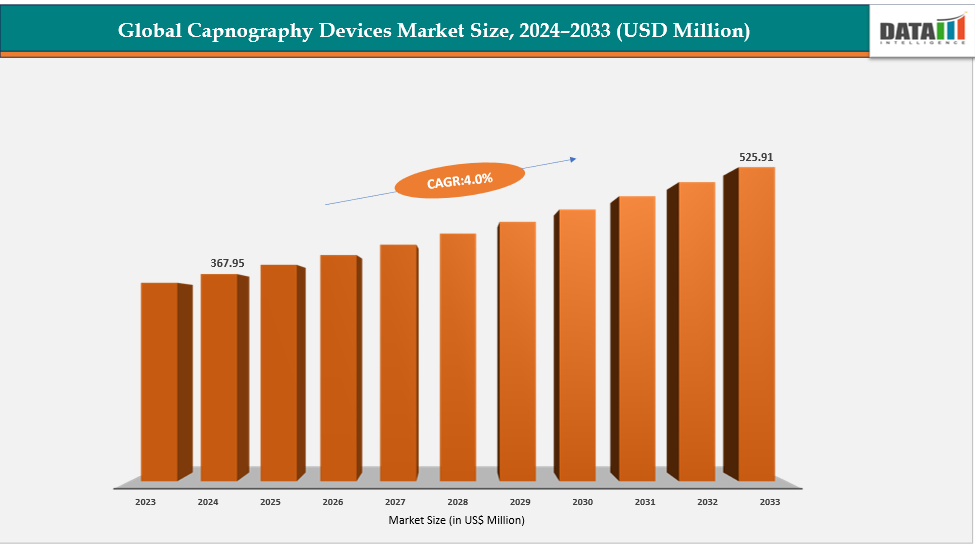
The global capnography devices market size reached US$ 367.95 million in 2024 is expected to reach US$ 525.91 million by 2033, growing at a CAGR of 4.0% during the forecast period 2025-2033. Technological advancements are driving growth in the capnography-device market, with miniaturized and wireless sensors enabling capnographs to be deployed in various settings, including transport, home care, and ambulatory settings. AI/ML-based analytics are transforming capnography from a passive CO₂ monitor into a proactive respiratory-risk detection tool, identifying early signs of hypoventilation, airway compromise, or sedation-related respiratory depression, and alerting clinicians before overt deterioration.
For instance, Respironics has introduced the CAPNOSTAT 5, a lightweight, compact, and lightweight sensor designed for monitoring adult, pediatric, and neonatal patients using various airway adapters.
Moreover, LoFlo, a new Sidestream sensor with a 50cc sampling rate, has been released, featuring an external sample cell attached to the patient interface, rather than inside the monitor.
Key Highlights
- North America dominates the Capnography Devices market with the largest revenue share of 43.5% in 2024.
- The Asia Pacific is the fastest-growing region and is expected to grow at the fastest CAGR of 8.1% over the forecast period.
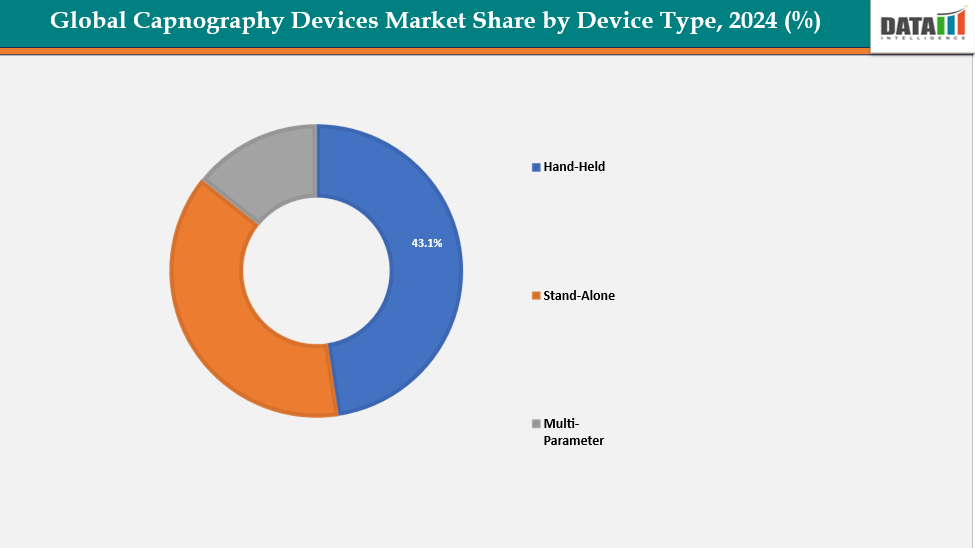
- Based on device type, hand held segment led the market with the largest revenue share of 43.1% in 2024.
- The major market players in the capnography devices market includes Becton, Dickinson and Company, Drägerwerk AG & Co. KgaA, Masimo Corporation, Medtronic, Nihon Kohden Corporation, ICU Medical, Infinium Medical, Inc and among others.
Market Dynamics
Drivers: Rising prevalence of respiratory disorders driving the capnography devices market growth
The global capnography devices market is driven by the increasing prevalence of respiratory disorders like COPD, asthma, and sleep apnea. With rising pollution levels, smoking habits, and post-COVID complications, healthcare providers are adopting advanced monitoring solutions like capnography to assess ventilation efficiency and detect early respiratory compromise. Hospitals and home-care settings are integrating capnography into their standard protocols to improve patient safety and treatment outcomes, particularly during anesthesia, sedation, and critical care.
For instance, in 2024 systematic review found that globally among people aged 40 years and older, the prevalence of Chronic Obstructive Pulmonary Disease (COPD) was approximately 12.64% (95% CI 10.75%-14.65%) when using the fixed-ratio spirometry definition, and 7.38% (95% CI 5.47%-9.55%) when using the lower-limit-of-normal definition.
Restraints: High device cost and maintenance are hampering the growth of the capnography devices market
The global capnography devices market faces significant challenges due to high device costs and ongoing maintenance expenses. Standalone monitors cost between USD 4,500 to USD 8,000 per unit, with additional sampling lines or consumables adding USD 6-10 per procedure. This high initial investment and recurring expenses make adoption difficult, especially in smaller clinics and emerging economies, limiting penetration into resource-constrained markets.
For more details on this report – Request for Sample
Capnography Devices Market, Segment Analysis
The global capnography devices market is segmented based on device type, technology, application, end user and region.
Device Type: The hand-held from device type segment to dominate the capnography devices market with a 43.1% share in 2024
The handheld capnography device market is rapidly growing due to its portability, affordability, and widespread use beyond hospitals. These compact devices enable real-time CO₂ monitoring in emergency transport, ambulatory care, and home-care environments, providing clinicians with greater flexibility in patient management. Their ease of use, quick setup, and battery-operated design make them ideal for point-of-care applications. Advancements like wireless data transfer, Bluetooth connectivity, and integration with electronic health records have enhanced their diagnostic accuracy. The demand for handheld capnographs is expected to rise significantly.
Technology: The main stream segment is estimated to have a 41.1% of the capnography devices market share in 2024
The mainstream segment plays a crucial role in the capnography devices market, primarily due to its high accuracy and rapid response time in measuring end-tidal CO₂ (EtCO₂) levels. Mainstream capnography is widely used in operating rooms, intensive care units, and emergency departments where real-time, continuous monitoring of intubated patients is essential. These devices directly measure CO₂ from the airway through an infrared sensor placed between the endotracheal tube and the breathing circuit, providing precise and immediate readings without gas sampling delays. Their reliability in critical care and anesthesia applications makes them the preferred choice for hospitals. Moreover, ongoing advancements such as compact sensor design, improved durability, and better integration with multiparameter monitors are further boosting their clinical adoption. Despite being costlier than sidestream systems, the mainstream segment continues to dominate high-acuity settings due to its superior performance and clinical accuracy.
Capnography Devices Market, Geographical Analysis
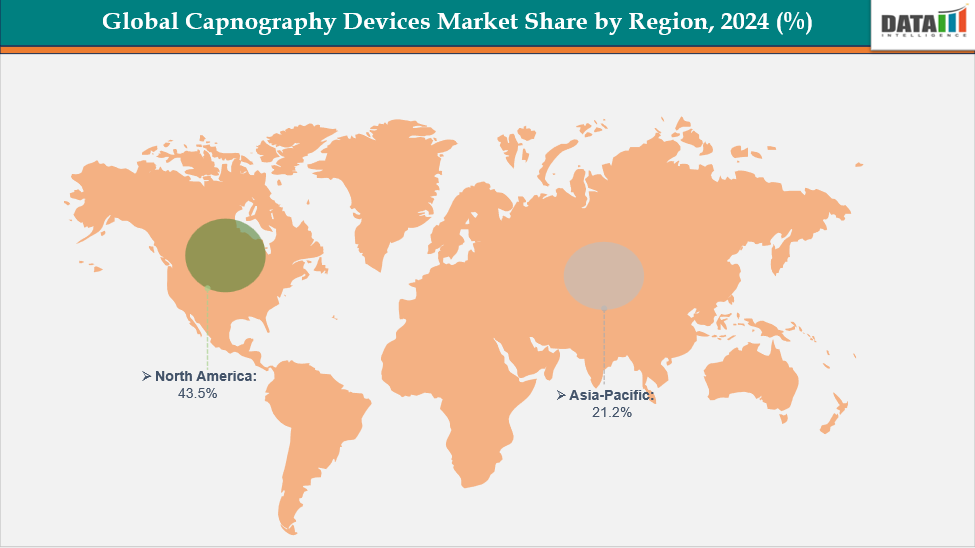
North America dominates the global capnography devices market with a 43.5% in 2024
North America dominates the capnography device market due to respiratory disorders prevalence, advanced healthcare infrastructure, favorable reimbursement policies, regulatory guidelines, and growing investments in EMS and home-care devices, fueling market growth and continuous product innovation.
The U.S. capnography devices market is expanding due to advanced monitoring technologies in hospitals and ambulatory surgical centers, increasing respiratory cases and opioid-induced respiratory depression. Major manufacturers like Medtronic, Philips, and Masimo, along with FDA approvals and AI-enabled monitoring systems, are driving market expansion.
For instance, approximately 11.1 million adults in the U.S. were living with COPD, with prevalence rates remaining steady over the past decade. Rates were higher among non-Hispanic white adults (5.6%), women (5.0%), and individuals aged ≥65 years (9.7%)
Europe is the second region after North America which is expected to dominate the global capnography devices market with a 34.5% in 2024
Europe's capnography devices market is growing due to strict patient monitoring standards, increasing use during procedures, geriatric population, chronic respiratory diseases, and focus on reducing complications, supported by technological innovations and favorable funding.
Germany is a significant player in Europe's capnography market due to its advanced healthcare infrastructure and strong patient safety regulations. Growth factors include high hospital spending on monitoring equipment, rising surgical volume, and increased clinician awareness about early respiratory distress detection. Domestic manufacturers and continuous innovation in portable and wireless capnography devices further strengthen Germany's market position.
For instance, in Germany, chronic respiratory diseases (CRDs), particularly Chronic Obstructive Pulmonary Disease (COPD), represent a significant public health concern. According to the Robert Koch Institute, the annual prevalence of COPD among the adult population is approximately 5.8%, affecting both men and women equally. The prevalence increases with age, from 7.6% among individuals aged 45–64 years to 10.3% among those aged 80 years and older
The Asia Pacific region is the fastest-growing region in the global capnography devices market, with a CAGR of 8.1% in 2024
The Asia-Pacific capnography devices market is experiencing rapid growth due to rising respiratory and sleep-related disorders, improved healthcare infrastructure, and advanced monitoring technologies. Governments are prioritizing patient safety, expanding emergency medical services, and increasing healthcare expenditure. Private investments in hospital modernization and clinician awareness are also driving market expansion.
Japan's capnography devices market is fueled by an aging population, respiratory conditions, and advanced monitoring technologies. The country's focus on healthcare innovation and AI integration in medical devices enhances the appeal of next-generation capnographs. Growing home-care applications and government initiatives promoting early disease detection and patient safety are expected to sustain long-term growth.
For instance,in 2024, Japan faces a significant public health concern with Chronic Obstructive Pulmonary Disease (COPD), with a prevalence of 4.0%, higher in men (5.3%) than women (2.1%). The condition is primarily associated with smoking, with 6.8% of the population being current smokers. COPD prevalence increases with age, highlighting the growing burden of chronic respiratory diseases in Japan.
Competitive Landscape
Top companies in the capnography devices market include Becton, Dickinson and Company, Drägerwerk AG & Co. KgaA, Masimo Corporation, Medtronic, Nihon Kohden Corporation, ICU Medical, Infinium Medical, Inc. and among others.
Becton, Dickinson and Company:- Becton, Dickinson and Company (BD) is a prominent supplier in the global capnography devices market, primarily through its BD Alaris EtCO₂ modules and integration of capnography into the Alaris infusion and monitoring platform products that position BD as a key provider of bedside end-tidal CO₂ monitoring for hospitals and procedural settings. Market research reports routinely list BD among the leading players in capnography alongside Medtronic, Philips, and GE, reflecting its role in driving adoption through device integration, OEM modules, and hospital-focused solutions.
Market Scope
| Metrics | Details | |
| CAGR | 4.0% | |
| Market Size Available for Years | 2022-2033 | |
| Estimation Forecast Period | 2025-2033 | |
| Revenue Units | Value (US$ Mn) | |
| Segments Covered | Device Type | Hand-Held, Stand-Alone, Multi-Parameter |
| Technology | Main Stream, Side Stream, Micro Stream | |
| Application | Cardiac Care, Trauma & Emergency Care, Respiratory Monitoring, Anesthesia, Others | |
| End User | Hospitals, Ambulatory Surgical Centers, Others | |
| Regions Covered | North America, Europe, Asia-Pacific, South America and the Middle East & Africa | |
The global capnography devices market report delivers a detailed analysis with 62 key tables, more than 57 visually impactful figures, and 159 pages of expert insights, providing a complete view of the market landscape.
Suggested Reports
For more medical devices-related reports, please click here





























































